+91 7297051181
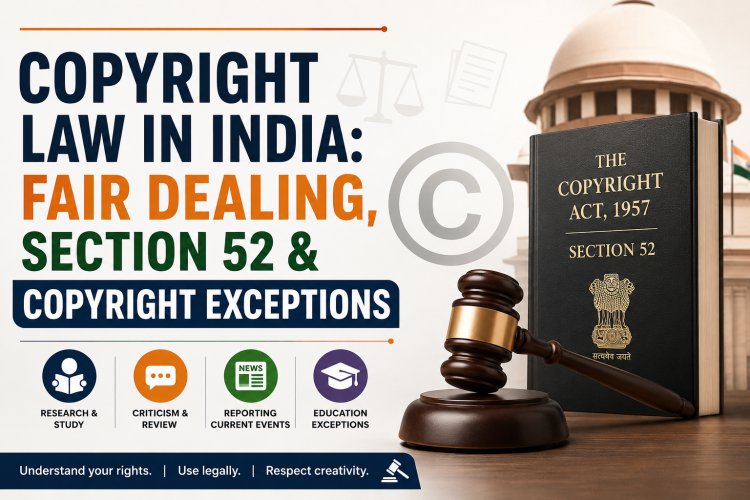
Copyright Law in India: Fair Dealing, Section 52 & Copyright Exceptions
COPYRIGHT
Introduction
Copyright law gives creators important exclusive rights over their original literary, artistic, musical and other protected works. However, these rights are not absolute.
There are situations where society must be able to use copyrighted works for legitimate purposes such as research, private study, criticism, review, education and reporting current events. To accommodate these interests, the Copyright Act, 1957 provides specific statutory exceptions to copyright infringement.
In India, many of these exceptions are found in Section 52 of the Copyright Act, 1957, which is commonly associated with the concept of fair dealing.
But what exactly is fair dealing? How much copyrighted material can be used? Is there a fixed 10% or 20% rule? Can students reproduce copyrighted books? And how is fair dealing different from fair use?
This article explains the concept of fair dealing and copyright infringement in India, with reference to Section 52 and important Indian copyright cases.
What Is Fair Dealing Under Indian Copyright Law?
Fair dealing is a statutory limitation on the exclusive rights of a copyright owner.
The basic idea is that certain socially valuable uses of copyrighted works should be permitted without requiring the copyright owner's permission in every situation.
Under Section 52(1)(a) of the Copyright Act, 1957, fair dealing with a work, other than a computer programme, is recognised for purposes including:
- Private or personal use, including research;
- Criticism or review, whether of that work or another work; and
- Reporting current events and current affairs, including reporting of a lecture delivered in public.
Therefore, copyright law attempts to maintain a balance between:
Copyright protection + Freedom of expression + Research + Education + Public discussion
Fair dealing should consequently not be understood as a general permission to copy copyrighted material.
Fair Dealing vs Copyright Infringement
The fact that a person has copied copyrighted material does not automatically answer the legal question.
The important issue is whether the particular use falls within a statutory exception under Section 52.
For example, using a limited extract of a book while writing a research paper may potentially fall within the research-related exception, depending on the circumstances.
On the other hand, copying an entire copyrighted textbook and distributing copies to others cannot automatically become lawful simply because the person describes the activity as "research."
The purpose, nature and extent of the use can therefore become important when assessing fair dealing.
Fair Dealing for Research and Private Study
Research is one of the purposes expressly recognised under Section 52.
For example, imagine a law student preparing a research paper on privacy law.
The student may need to:
- Quote relevant portions of judgments;
- Refer to academic publications;
- Discuss existing research;
- Reproduce limited material where legally permitted; and
- Critically analyse existing scholarship.
However, the research exception should not be treated as unlimited permission to reproduce and distribute copyrighted works.
For example, purchasing a copyrighted textbook does not generally mean that the purchaser can reproduce the entire book and distribute copies to classmates merely by describing the purpose as "research."
Research is protected as a purpose; unlimited copying is not automatically protected.
Fair Dealing for Criticism and Review
Criticism and review are another important area of fair dealing under Indian copyright law.
Suppose a film critic is reviewing a movie. To explain the review, the critic may need to refer to:
- Particular scenes;
- Dialogue;
- Characters;
- Music;
- Screenplay elements; or
- Other aspects of the copyrighted work.
Copyright law should not prevent genuine criticism merely because the critic has referred to protected material.
However, there is an important distinction between using material to support criticism and reproducing the protected work itself.
If someone reproduces substantial portions of a film or book and adds only minimal commentary, simply calling the content a "review" may not be sufficient.
The use should genuinely relate to the purpose of criticism or review.
Indian courts have recognised that fair dealing is not determined by a simple mathematical formula. The extent and purpose of the use can be relevant.
Fair Dealing and Reporting Current Events
Section 52 also recognises certain uses connected with reporting current events and current affairs.
For example, a news organisation reporting on an art exhibition may need to refer to or show an artistic work displayed during the event.
Similarly, reporting on a public lecture or current event may require limited reference to copyrighted material.
The exception recognises the importance of allowing journalism and news reporting to operate effectively.
However, simply labelling content as "news" does not create unlimited permission to reproduce copyrighted material.
The particular statutory requirements still need to be satisfied.
Copyright Exceptions for Education in India
Education is another important area where copyright exceptions become relevant.
Section 52 contains specific provisions relating to educational activities, including certain reproduction and communication of works in the course of instruction and performances within educational institutions.
These provisions are significant because teaching and learning necessarily involve interaction with existing knowledge and copyrighted material.
However, the educational exceptions should not automatically be interpreted as a blanket licence to commercially reproduce entire books, textbooks or other copyrighted works.
The exact statutory provision and circumstances of the use matter.
The DU Photocopy Case: A Landmark Copyright Case in India
One of the most widely discussed Indian copyright disputes concerning education is:
The Chancellor, Masters & Scholars of the University of Oxford v. Rameshwari Photocopy Services, 2016 SCC OnLine Del 6229.
The dispute involved academic publishers and the photocopying and distribution of course packs containing portions of copyrighted books for university education.
The Delhi High Court examined the educational exception under Section 52(1)(i) and considered the relationship between copyright protection and access to educational materials.
The case became an important reference point in discussions concerning:
- Copyright and education;
- Course packs;
- Photocopying of educational materials;
- Section 52 of the Copyright Act; and
- Access to knowledge.
The case demonstrates why copyright exceptions need to be considered in their statutory and factual context rather than through a simple assumption that either "all copying is infringement" or "educational copying is always permitted."
Is There a 10% or 20% Rule for Copyright in India?
One of the most common copyright myths is that a person can legally copy 10%, 20% or another fixed percentage of a copyrighted work.
There is no universal statutory rule under Indian copyright law that makes copying a particular percentage automatically lawful.
The legality of the use depends on the applicable provision and the circumstances.
Relevant considerations can include:
- The purpose of the use;
- The nature of the copyrighted work;
- The amount and substantiality of the material reproduced;
- The relationship between the reproduced material and the purpose for which it is used; and
- Whether the use effectively substitutes for the original or interferes with legitimate copyright interests.
Therefore, relying on a simple "10% copyright rule" can be misleading.
https://youtu.be/ru1LTrWNcGA?si=2T5Yco7WxC3jvfUp
Fair Dealing Is Not the Same as Fair Use
The terms fair dealing and fair use are sometimes used interchangeably in online discussions, but Indian and US copyright law follow different statutory frameworks.
In India, Section 52 provides specific statutory exceptions, including fair dealing for certain purposes such as research, criticism or review and reporting current events.
The United States, by contrast, has a broader statutory fair use framework under 17 U.S.C. § 107.
Therefore:
Fair Dealing ≠ Fair Use
Although both concepts attempt to balance copyright protection with socially valuable uses, the statutory frameworks and legal analysis are not identical.
How Do Indian Courts Determine Fair Dealing?
There is no single mathematical formula that determines whether a use is fair dealing.
Courts may examine the overall circumstances, including the purpose and character of the use and the quantity and nature of the material reproduced.
The Kerala High Court's decision in Civic Chandran v. Ammini Amma is frequently discussed in the context of fair dealing and criticism. The case concerned a work that was presented as a critique of an earlier literary work.
The broader principle is that the assessment cannot be reduced to merely counting words, pages or percentages.
A short extract accompanied by substantial analysis may present a different situation from extensive reproduction accompanied by only a few comments.