+91 7297051181
How to Know If Your Invention Is Patentable in India?
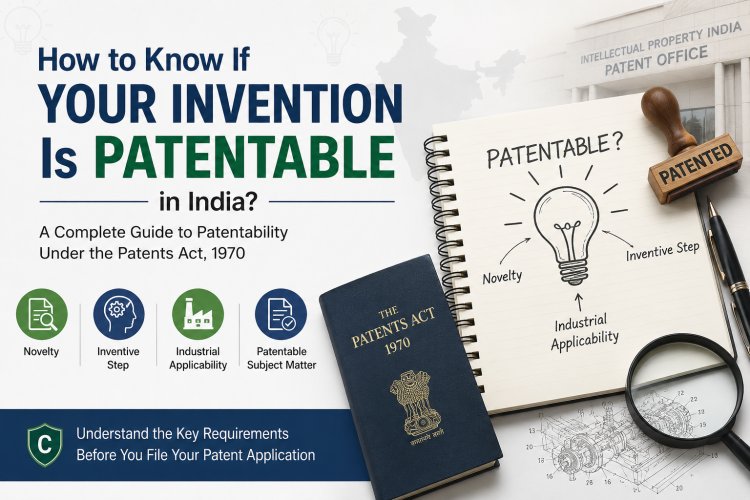
If you have developed a new product, process, technology or technical solution, you may be wondering: Can I get a patent in India?
The answer depends on whether your invention satisfies the legal requirements for patentability under the Patents Act, 1970.
A commercially valuable idea is not automatically patentable. To obtain patent protection in India, an invention generally needs to satisfy key requirements such as novelty, inventive step and industrial applicability, while also falling within the category of subject matter that Indian patent law permits to be patented.
This guide explains the major patentability requirements in India, common exclusions under the Patents Act and why conducting a proper patent search before filing is so important.
What Is an Invention Under Indian Patent Law?
Section 2(1)(j) of the Patents Act, 1970 defines an invention as a new product or process involving an inventive step and capable of industrial application.
In simple terms, a patentable invention generally needs to satisfy three core requirements:
-
Novelty – the invention must be new.
-
Inventive step – the invention must not be obvious to a person skilled in the relevant field.
-
Industrial applicability – the invention must be capable of being made or used in an industry.
However, these requirements are only part of the patentability analysis. Sections 3 and 4 of the Patents Act exclude certain subject matter from patent protection.
Therefore, even a technically new invention may not be patentable if it falls within one of the statutory exclusions.
1. Novelty: Is Your Invention New?
Novelty is one of the most important requirements for patent registration in India.
An invention may fail the novelty requirement if the same subject matter has already been disclosed to the public through prior publication, use or another form of disclosure before the relevant filing or priority date.
Section 2(1)(l) defines a "new invention" with reference to technology that has not been anticipated by publication in a document or used in India or elsewhere in the world before the filing of a patent application with a complete specification.
Example of Lack of Novelty
Suppose an inventor develops a new water-purification device.
Before filing a patent application, a prior patent publication is discovered that already describes the same device and its relevant features.
Even if the inventor developed the device independently, the earlier public disclosure may prevent the invention from being considered novel.
This is why conducting a prior-art search before filing a patent application is extremely important.
What Can Constitute Prior Art?
Depending on the circumstances, prior art may include:
-
Earlier patent applications and publications
-
Scientific and technical journals
-
Research papers
-
Books and technical publications
-
Public demonstrations
-
Products already available in the market
-
Public use of the invention
-
Online publications and disclosures
-
Other publicly accessible technical information
A thorough patent search can help identify whether the proposed invention is genuinely new.
2. Inventive Step: Is the Invention Non-Obvious?
An invention being new does not automatically mean that it is patentable.
The invention must also involve an inventive step.
Section 2(1)(ja) defines inventive step in terms of a feature that involves a technical advance over existing knowledge or has economic significance, or both, and that makes the invention not obvious to a person skilled in the art.
The purpose of this requirement is to prevent patents from being granted for simple or routine modifications that a skilled person could reasonably make using existing knowledge.
Example of Inventive Step
Imagine that an existing electric kettle automatically switches off when water reaches boiling point.
If an inventor merely changes the colour or shape of the switch without creating any meaningful technical or functional advantage, the modification is unlikely to satisfy the inventive-step requirement.
On the other hand, suppose the inventor develops a new temperature-control mechanism that substantially improves energy efficiency and that the solution would not have been obvious to a skilled person based on the existing prior art.
That invention may have a stronger case for satisfying the inventive-step requirement.
Who Is a "Person Skilled in the Art"?
The inventive-step test is not based on whether an invention appears difficult or impressive to an ordinary person.
The relevant question is whether the invention would have been obvious to a person skilled in the relevant technical field.
This hypothetical person is assumed to have ordinary knowledge, skills and experience in the relevant area.
Therefore, when assessing inventive step, factors such as the following can become important:
-
What was already known in the relevant field?
-
What technical problem does the invention address?
-
What differences exist between the invention and the prior art?
-
Would a skilled person have been motivated to make the modification?
-
Would the proposed solution have been obvious based on existing knowledge?
The assessment therefore requires careful analysis of both the prior art and the technical contribution made by the invention.
Indian courts have considered inventive step and patent validity in several important decisions, including F. Hoffmann-La Roche Ltd. v. Cipla Ltd.
3. Industrial Applicability: Can the Invention Be Used in Industry?
Another essential requirement is industrial applicability.
Section 2(1)(ac) provides that an invention is capable of industrial application when it can be made or used in an industry.
The concept is broader than simply asking whether the invention is already commercially successful.
An invention does not necessarily need to be mass-produced or commercially available. However, it should have a practical application and should be capable of being made or used in an industry.
Example
Suppose an inventor develops a machine designed to reduce manufacturing waste.
Even if the machine has not yet been commercially manufactured on a large scale, it may satisfy the industrial-applicability requirement if it can actually be manufactured and used in an industrial setting.
A purely theoretical concept without practical industrial utility may face difficulties in satisfying this requirement.
4. Patentable Subject Matter: What Cannot Be Patented in India?
Meeting the requirements of novelty, inventive step and industrial applicability is not enough.
Indian patent law specifically excludes certain categories from patent protection.
Section 3 of the Patents Act contains several important exclusions, while Section 4 deals with inventions relating to atomic energy.
Some important exclusions under Section 3 include:
-
Mere discoveries of scientific principles
-
Certain new forms of known substances that do not satisfy Section 3(d)
-
Methods of agriculture or horticulture
-
Methods of medical treatment
-
Mathematical methods
-
Business methods
-
Computer programmes per se
-
Literary, dramatic, musical and artistic works
-
Aesthetic creations
-
Traditional knowledge
-
Certain inventions relating to public order or morality
Therefore, before filing a patent application, it is important to determine not only whether the invention is new, but also whether the subject matter is legally eligible for patent protection.
Section 3(d) and Pharmaceutical Patents
Section 3(d) has played a particularly important role in Indian pharmaceutical patent litigation.
It places limitations on obtaining patents for certain new forms of known substances unless the statutory requirements are satisfied.
In Novartis AG v. Union of India, (2013) 6 SCC 1, the Supreme Court considered the patentability of the beta-crystalline form of imatinib mesylate.
The Court examined Section 3(d) and held that the claimed form did not satisfy the statutory requirement relating to enhanced therapeutic efficacy.
The decision demonstrates that simply identifying a new form of an existing substance does not necessarily make that subject matter patentable in India.
5. Why a Patent Search Is Important Before Filing
A patent search in India should ideally be conducted before investing significant time and money in preparing and prosecuting a patent application.
The purpose of a patent search is to identify relevant prior art and understand the existing technical landscape.
A comprehensive search may cover:
-
Indian patent databases
-
International patent databases
-
Published patent applications
-
Scientific journals
-
Research papers
-
Technical literature
-
Commercial products
-
Public disclosures
-
Industry publications
The search can help an inventor answer important questions:
Is my invention genuinely new?
What similar inventions already exist?
What features distinguish my invention from the prior art?
Does my invention have a strong inventive-step argument?
Are there any potential patentability objections?
A strong patent application should clearly identify the technical contribution of the invention rather than merely describing a broad commercial concept.
6. Patentability vs. Commercial Value
One of the most important things inventors should understand is that commercial success and patentability are different concepts.
An invention may have:
-
Strong market demand
-
Significant commercial potential
-
High investment value
-
A large customer base
and still fail to qualify for a patent.
Why?
Because patent law focuses on statutory requirements such as novelty, inventive step, industrial applicability and patentable subject matter.
For example, a commercially successful product that merely combines known technologies in an obvious manner may face objections during patent examination.
Therefore, business potential should not be confused with patentability.
7. Key Patentability Requirements in India
For a quick overview, the major requirements can be summarized as follows:
| Requirement | What It Means |
|---|---|
| Novelty | The invention must be new and not already disclosed through relevant prior art. |
| Inventive Step | The invention should not be obvious to a person skilled in the relevant field. |
| Industrial Applicability | The invention must be capable of being made or used in an industry. |
| Patentable Subject Matter | The invention must not fall within the exclusions under Sections 3 or 4. |
| Sufficient Disclosure | The patent specification must properly disclose the invention and satisfy applicable statutory requirements. |
This last point is also practically important: even when an invention appears patentable, the quality and scope of the patent specification and claims can significantly affect the protection ultimately obtained.
8. What Should Inventors Do Before Filing a Patent Application?
Before filing a patent application in India, inventors should consider the following steps:
Step 1: Identify the Invention
Clearly define the product, process, system or technical solution being developed.
Step 2: Identify the Novel Features
Determine what is actually different from existing products and technologies.
Step 3: Conduct a Prior-Art Search
Search patent databases, technical literature and other publicly available information.
Step 4: Analyse Inventive Step
Ask whether the technical differences would have been obvious to a skilled person.
Step 5: Check Patentable Subject Matter
Review whether the invention falls within any exclusions under Sections 3 or 4 of the Patents Act.
Step 6: Prepare the Patent Specification
The invention should be described clearly and sufficiently, with appropriately drafted claims defining the desired scope of protection.
Step 7: File the Patent Application
Once the invention and patent strategy have been properly assessed, the appropriate patent application can be filed with the Indian Patent Office.
https://youtu.be/MSexoIqYu_o?si=O4ycqFLpfHaqmfkD
Conclusion: What Makes an Invention Patentable in India?
So, what makes an invention patentable in India?
In general, a patentable invention must be new, involve an inventive step, be capable of industrial application and fall within patentable subject matter.
The key lesson for inventors is that having a "new idea" is only the beginning.
The real question is:
What is technically new about the invention, and why would that technical improvement not have been obvious to a person skilled in the relevant field?
A proper prior-art search, patentability assessment and carefully drafted patent specification can help identify potential problems before significant resources are invested in patent prosecution.
If you are developing a new product, technology or process, obtaining professional advice at the early stage can help you understand the potential scope of patent protection and develop an appropriate filing strategy.