+91 7297051181
Trademark Renewal Process in India | Validity, Fees, Grace Period & Restoration
trademark renewal
Trademark Renewal in India: Validity, Grace Period, Restoration & Renewal Process
A trademark registration in India can remain protected indefinitely, provided the proprietor renews it periodically and maintains accurate ownership and contact details with the Trade Marks Registry.
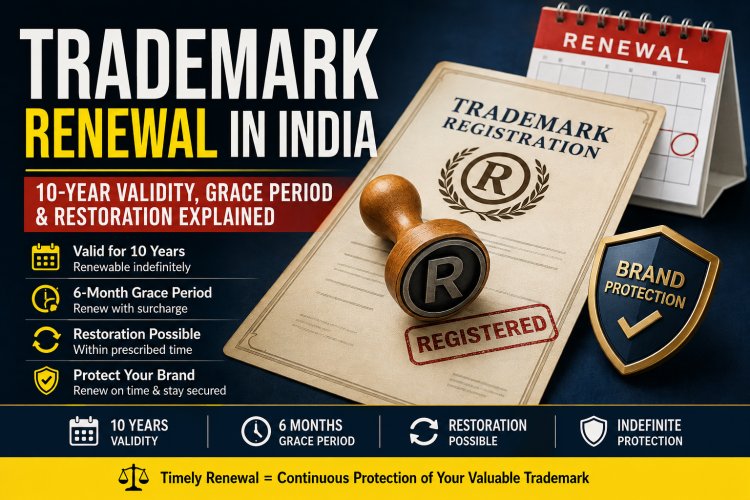
Unlike patents, trademark registrations do not have a fixed maximum lifespan. A registered trademark is initially valid for 10 years and can be renewed repeatedly for further periods of 10 years.
However, failing to renew a trademark on time can create serious legal and commercial risks. Indian trademark law provides a six-month grace period for late renewal and, in certain circumstances, allows a removed trademark to be restored.
This guide explains trademark renewal in India, the renewal period, late renewal, the six-month grace period, restoration of a removed trademark, and important practical steps businesses should follow.
https://youtu.be/zUtFl0PeL9E?si=aLnm0avEH0JDjLCQ
How Long Is a Trademark Registration Valid in India?
Under Section 25 of the Trade Marks Act, 1999, a trademark registration is valid for 10 years from the date of registration.
The registration can be renewed repeatedly for additional periods of 10 years.
Therefore, unlike a patent, there is no fixed maximum period for trademark protection. A business can potentially keep a trademark registered for decades—or indefinitely—by completing the renewal process on time.
Example
Suppose a trademark is registered on 1 January 2020.
Its registration will ordinarily remain valid for 10 years, after which renewal will be required. Once renewed, the registration can continue for another 10 years.
The renewal is an extension of the existing registration rather than a requirement to file an entirely new trademark application.
When Can You Apply for Trademark Renewal?
Under Rule 57 of the Trade Marks Rules, 2017, the proprietor can apply for renewal in Form TM-R during the period of one year before the expiry of the trademark registration.
Early filing is generally advisable because it reduces the risk of:
- Missing the renewal deadline
- Paying late-renewal surcharges
- Administrative complications
- Problems during licensing or assignment
- Difficulties during business due diligence
- Uncertainty regarding the status of the trademark
Before filing the renewal application, the proprietor should also verify the information recorded with the Trade Marks Registry, including:
- Trademark registration number
- Proprietor's name
- Address
- Address for service
- Class of goods or services
- Authorised trademark agent or representative
It is important to understand that trademark renewal does not automatically correct ownership or recordal defects. If the proprietor's name has changed or the trademark has been assigned, the relevant recordal should be completed separately.
Six-Month Grace Period for Late Trademark Renewal
What happens if the trademark owner misses the renewal deadline?
The registration does not necessarily disappear immediately.
Under Section 25(3) of the Trade Marks Act, 1999, a trademark may be renewed after expiry, subject to the prescribed conditions, fees and surcharge.
The proprietor generally receives a six-month period after expiry to complete the renewal process with the applicable surcharge.
The relevant renewal procedure is prescribed under the Trade Marks Rules, including Rule 59 and Form TM-R.
Important Point
The six-month period should not be treated as an ordinary extension of the renewal deadline.
Businesses should ideally renew the trademark before expiry because a delayed renewal can create uncertainty and may complicate:
- Trademark enforcement
- Licensing
- Assignment
- Investment transactions
- Mergers and acquisitions
- Intellectual property due diligence
- Brand valuation
What Happens If a Trademark Is Removed for Non-Renewal?
If the proprietor does not renew the trademark within the applicable period, the Registrar may remove the trademark from the Register.
The removal may also be advertised in the Trade Marks Journal.
However, removal does not necessarily mean that every possibility of recovering the trademark has ended.
Indian trademark law provides a limited mechanism for restoration of a removed trademark.
Restoration of a Removed Trademark in India
Under Section 25(4) of the Trade Marks Act, 1999, restoration may be possible after a trademark has been removed for non-payment of the renewal fee.
The proprietor may apply for restoration within the prescribed period, along with the required renewal and restoration fees.
The application is generally made through Form TM-R.
However, restoration is not simply an automatic reinstatement.
The Registrar may consider whether restoration is just and may impose conditions or limitations where appropriate.
The interests of other persons who may have acquired rights or developed an interest in a similar trademark during the period of lapse may also be relevant.
Therefore, trademark owners should not assume that restoration is guaranteed merely because the application is filed within the prescribed period.
Trademark Renewal Example
Consider the following example:
BlueTrail Pvt. Ltd. owns a registered trademark that expires on 30 June 2027.
The company can apply for renewal during the year preceding the expiry of the registration.
If BlueTrail fails to renew before 30 June 2027, it may still be able to renew the trademark during the applicable six-month period after expiry by paying the prescribed surcharge.
If the trademark is subsequently removed, BlueTrail may have an opportunity to seek restoration within the period prescribed under Section 25.
However, restoration may involve additional considerations because another person could potentially have acquired an interest in a similar mark during the period of lapse.
This is why timely trademark renewal is much safer than relying on late renewal or restoration provisions.
What Is the Effect of Removal on a Later Trademark Application?
Section 26 of the Trade Marks Act, 1999 provides an important protection in relation to trademarks removed from the Register because of non-payment of renewal fees.
For a limited period after removal, the earlier trademark may, in certain circumstances, continue to be considered as though it were still on the Register when examining a later trademark application.
However, this protection is subject to statutory conditions.
For example, the protection may not operate where there was no bona fide use of the earlier trademark during the relevant period before removal or where use of the later trademark would not result in deception or confusion.
The purpose of this provision is to prevent another trader from immediately exploiting an accidental lapse of a commercially active trademark.
Does Trademark Renewal Solve Every Legal Problem?
No.
Trademark renewal extends the registration period, but it does not cure every possible legal defect associated with a trademark.
Even after renewal, a trademark may face legal challenges on grounds such as:
- Invalid registration
- Prior-user rights of another party
- Non-use
- Genericness
- Incorrect ownership records
- Misrepresentation
- Other grounds available under the Trade Marks Act
Therefore, trademark renewal should not be viewed merely as payment of a government fee.
A proper trademark management system should include renewal monitoring, ownership management, evidence of use, licensing review and periodic trademark portfolio audits.
How to Avoid Trademark Renewal Problems
Businesses with multiple trademarks should maintain a central trademark renewal calendar.
The calendar should record:
- Trademark name
- Registration number
- Class
- Proprietor
- Filing date
- Registration date
- Expiry date
- Renewal eligibility date
- Renewal status
- Jurisdiction
- Trademark agent details
Businesses should also consider the following practices:
1. Set Multiple Renewal Reminders
Do not depend on a single reminder. Set internal reminders well before the renewal deadline.
2. Keep Registry Details Updated
Ensure that the address for service and other important details recorded with the Trade Marks Registry remain current.
3. Record Ownership Changes
Assignments, mergers, name changes and other ownership-related changes should be properly recorded.
4. Maintain Evidence of Trademark Use
Keep invoices, advertisements, packaging, websites, social media material and other evidence demonstrating genuine commercial use of the trademark.
5. Review Licensing Arrangements
Trademark licences and permitted-use arrangements should be reviewed periodically to ensure that the brand is being used consistently with the owner's legal and commercial strategy.
6. Conduct Trademark Portfolio Audits
Businesses should periodically identify:
- Important trademarks requiring continued protection
- Marks that are no longer commercially relevant
- New brands requiring registration
- Additional classes that may require protection
- Marks requiring ownership or address updates
Trademark Renewal vs. New Trademark Application
A trademark renewal is generally different from filing a new trademark application.
Renewal continues the existing registered trademark for another 10-year period, subject to the applicable law and procedure.
A new trademark application, on the other hand, starts a separate registration process and does not simply replace an existing registration.
This distinction is particularly important for businesses that have valuable trademarks with a long commercial history.
Frequently Asked Questions About Trademark Renewal in India
How often does a trademark need to be renewed in India?
A registered trademark is generally renewed every 10 years.
Can a trademark be renewed indefinitely?
Yes. There is no fixed maximum number of renewals. A trademark can potentially remain registered indefinitely as long as the applicable renewal requirements are satisfied.
Can I renew my trademark before expiry?
Yes. Under the Trade Marks Rules, the proprietor can generally apply for renewal during the one-year period preceding expiry.
What happens if I miss the trademark renewal deadline?
A trademark may still be renewed during the applicable six-month period after expiry, subject to the prescribed surcharge and requirements.
Can a removed trademark be restored?
In certain circumstances, yes. Section 25(4) provides a mechanism for restoration subject to the statutory requirements and the Registrar's consideration.
Does trademark renewal protect the trademark forever?
Renewal can continue the registration for successive 10-year periods, but renewal does not make the trademark immune from other legal challenges.
Does renewal automatically update the proprietor's name?
No. Changes in ownership, name, address or other registry information may require separate recordal procedures.
Conclusion
Trademark registration in India can potentially last indefinitely, but it does not renew automatically.
Under Section 25 of the Trade Marks Act, 1999, trademark registrations are generally valid for 10 years and can be renewed repeatedly for additional 10-year periods.
Indian law also provides a six-month late-renewal period and a limited mechanism for restoration where a trademark has been removed.
However, businesses should not rely on grace periods or restoration as part of their normal trademark strategy.
A strong trademark management system should include timely renewal, accurate ownership records, evidence of use, proper licensing documentation and periodic trademark portfolio reviews.
For businesses, a trademark is not merely a registration certificate—it is a valuable intellectual property asset. Protecting that asset requires continuous legal and commercial management.
Legal References
- Trade Marks Act, 1999 — Sections 25 and 26
- Trade Marks Rules, 2017 — Rules 57–61
- Trade Marks Rules, 2017 — Form TM-R and First Schedule
- Office of the Controller General of Patents, Designs and Trade Marks — Trade Marks Act, 1999
- Office of the Controller General of Patents, Designs and Trade Marks — Trade Marks Rules, 2017