+91 7297051181
Trademark Scam Alert: How to Identify Fake Trademark Registration & Renewal Notices
TRADEMARK SCAM
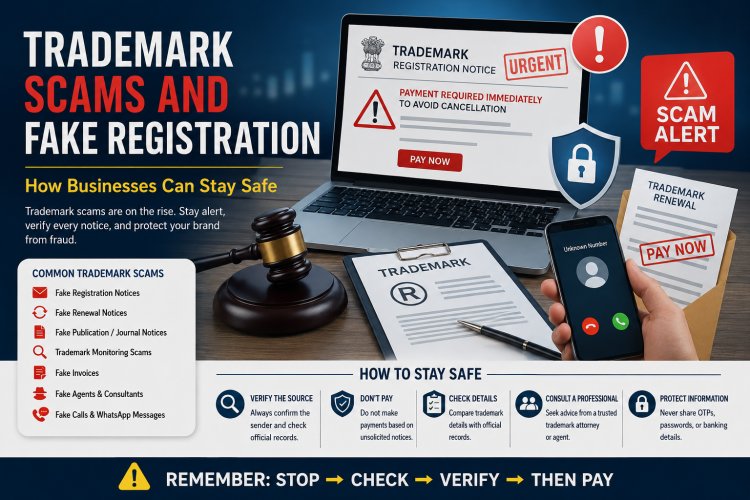
Trademark Scams and Fake Registration Notices in India: How Businesses Can Stay Safe
Trademark registration is an important step for protecting a business name, logo, slogan, product identity, or brand. However, as the number of trademark applications continues to grow, trademark scams and fake registration notices have also become a serious concern for businesses.
Business owners may receive emails, letters, WhatsApp messages, SMS alerts, or phone calls claiming that their trademark requires immediate payment, renewal, publication, registration, or legal action.
Some of these communications may look highly professional and may even contain the correct trademark application number, business name, filing date, or trademark details. However, an official-looking notice does not necessarily mean that it is an official government communication.
Understanding how trademark scams work can help businesses avoid unnecessary payments, financial losses, and misuse of confidential business information.
What Is a Trademark Scam?
A trademark scam is a fraudulent or misleading attempt to obtain money, sensitive information, or business details by pretending to provide legitimate trademark-related services.
Scammers may use names or descriptions such as:
-
Trademark Registry
-
Trademark Department
-
Trademark Registration Office
-
Trademark Renewal Department
-
Trademark Publication Service
-
Trademark Monitoring Agency
The communication may include:
-
Your trademark application number
-
Business or applicant name
-
Trademark name
-
Filing or registration details
-
A payment amount
-
A deadline
-
An official-looking logo
-
A reference number
-
Bank or payment details
These details can make a fraudulent communication appear genuine.
The key point is simple: never assume that a notice is genuine merely because it contains accurate trademark information.
Common Types of Trademark Scams
1. Fake Trademark Registration Notices
One common scam involves a business receiving a letter or email stating that its trademark has been selected or approved for registration and that an immediate payment is required.
For example, the communication may claim:
“Your trademark has been selected for registration. Pay the required fee immediately.”
The notice may contain a payment link, bank account details, or instructions for transferring money.
Before making any payment, independently verify the source and confirm whether the payment is actually required.
https://youtu.be/Q30DpHap12Y?si=6m8NxEczSfgVFBsG
2. Fake Trademark Renewal Notices
Fake trademark renewal notices are another common form of trademark fraud.
A business owner may receive a message stating:
“Your trademark is about to expire. Pay ₹X immediately to renew your trademark.”
The scammer may create urgency by providing a very short deadline and threatening cancellation or loss of trademark rights.
What should you do?
Do not rely solely on an unsolicited renewal notice.
Instead:
-
Check your actual trademark registration details.
-
Verify the current status of the trademark.
-
Check the applicable renewal requirements.
-
Confirm the information through official trademark resources or your authorised trademark professional.
A registered trademark in India generally has a 10-year validity period and may be renewed for further periods subject to the applicable law and procedure.
3. Fake Trademark Publication or Journal Notices
Some businesses receive communications claiming that their trademark must be published in a private journal, directory, or publication and that payment is compulsory.
Businesses should carefully determine whether the requested publication or payment is actually part of the applicable trademark procedure.
Do not assume that every “publication” or “journal” payment request is an official government requirement.
4. Trademark Monitoring Scams
Another type of scam involves messages claiming that another person or business has filed a trademark similar to yours.
For example:
“Another party has applied for a trademark similar to yours. Immediate action is required to protect your trademark.”
The sender may then demand payment for:
-
Trademark opposition
-
Trademark protection
-
Trademark monitoring
-
Legal action
-
Urgent objection filing
Trademark monitoring can be a legitimate professional service. However, businesses should verify:
-
Who sent the communication?
-
Is the sender an authorised professional or service provider?
-
Is there actually a conflicting trademark application?
-
What legal action is being proposed?
-
What exactly are you paying for?
5. Fake Trademark Invoices
Scammers may send invoices designed to look like official government fee demands.
A fake trademark invoice may contain:
-
Business name
-
Trademark number
-
Application number
-
Payment deadline
-
Bank account details
-
Reference number
-
Official-looking branding
Before transferring money, independently verify the payment request through reliable trademark records or your authorised professional.
6. Fake Trademark Agents and Consultants
Some scammers may falsely represent themselves as:
-
Trademark attorneys
-
Trademark agents
-
Legal consultants
-
Trademark representatives
-
Registration consultants
They may promise:
-
100% trademark registration
-
Guaranteed approval
-
Immediate registration
-
No objection
-
Fast-track registration
-
Guaranteed trademark protection
Businesses should be cautious of anyone who guarantees a particular legal outcome.
Trademark registration involves examination and other legal procedures. A genuine professional should not promise that every trademark application will automatically be approved.
7. Fake Trademark Calls and WhatsApp Messages
Trademark scams are not limited to emails and letters.
Businesses may also receive fraudulent:
-
Phone calls
-
WhatsApp messages
-
SMS messages
-
Social media messages
A scammer may say:
“Your trademark will be cancelled today unless you make the payment.”
Such pressure tactics should immediately raise suspicion.
Why Do Trademark Scams Look Genuine?
One reason trademark scams can be convincing is that trademark application information may be publicly available.
Scammers can potentially use details such as:
-
Applicant name
-
Trademark name
-
Application number
-
Filing date
-
Trademark class
-
Application status
They can then use this information to create convincing-looking communications.
Therefore, the fact that a notice contains your correct trademark application number or business details does not prove that the notice is genuine.
Major Warning Signs of a Trademark Scam
Business owners should be particularly careful if they notice one or more of the following warning signs.
1. Unexpected Payment Demand
You receive a payment request that you were not expecting.
2. Extremely Short Deadline
The sender says:
“Pay within 24 hours.”
or:
“Pay today or your trademark will be cancelled.”
Creating panic and urgency is a common scam tactic.
3. Guaranteed Trademark Registration
Claims such as:
“100% trademark registration guaranteed.”
should immediately raise suspicion.
4. Unusual Bank Account Details
The payment is requested to an unfamiliar personal or private bank account.
5. Suspicious Email Address
The sender's email address does not appear to belong to the organisation they claim to represent.
6. Poor Language or Strange Formatting
Spelling mistakes, unusual grammar, inconsistent logos, strange formatting, and poorly designed documents may be warning signs.
However, sophisticated scams can also be professionally written. Therefore, good formatting alone does not establish authenticity.
7. Pressure to Act Immediately
Scammers often discourage recipients from taking time to verify the information.
A demand for immediate payment should make you more careful, not less careful.
8. Request for Sensitive Information
Be extremely cautious if an unknown person asks for:
-
Passwords
-
OTPs
-
Banking information
-
Card details
-
Login credentials
-
Other unnecessary confidential information
Never share an OTP or password with an unknown person.
How to Verify a Trademark Notice in India
If you receive a suspicious trademark communication, do not panic and do not immediately make a payment.
Follow these steps.
Step 1: Do Not Pay Immediately
Never transfer money simply because a notice says that payment is urgent.
Take time to verify the communication first.
Step 2: Check Official Trademark Records
Check your trademark application or registration status through the official resources of the Indian Trade Marks Registry / Controller General of Patents, Designs & Trade Marks.
Do not rely solely on the phone number, email address, website, or payment information provided in the suspicious communication.
Step 3: Verify the Sender
Carefully check:
-
Sender's name
-
Email address
-
Website
-
Telephone number
-
Physical address
-
Professional credentials
A professional-looking name does not automatically mean that the sender is an official authority.
Step 4: Compare the Trademark Information
Compare the communication with your actual trademark records.
Check:
-
Application number
-
Trademark name
-
Applicant name
-
Filing date
-
Trademark class
-
Current status
If the information does not match, exercise extreme caution.
Step 5: Contact Your Trademark Professional
If a lawyer or trademark agent is handling your application, forward the communication to them.
They can help determine:
-
Whether the notice is genuine
-
Whether a legal deadline actually exists
-
Whether any payment is required
-
Whether a response is necessary
-
Whether any legal action should be taken
What Should You Do If You Already Paid a Trademark Scammer?
If you have already made a payment to a suspected scammer, do not ignore the situation.
Take action as quickly as possible.
Immediately:
-
Contact your bank or payment provider.
-
Ask whether the transaction can be stopped, recalled, or reported.
-
Preserve the payment receipt.
-
Save all emails, letters, WhatsApp messages, SMS messages, and screenshots.
-
Preserve the scammer's bank details and contact information.
-
Report the suspected fraud to the appropriate authorities.
-
Consult a legal professional if necessary.
The faster you act, the better your chances of limiting further financial loss.
What If You Shared Your Personal or Business Information?
If you have shared sensitive information with a suspected scammer, take appropriate precautions immediately.
For example, if you shared:
-
Login credentials
-
Banking information
-
OTP
-
Identity documents
-
Business documents
-
Other confidential information
consider changing relevant passwords, contacting your bank or service provider, and taking appropriate steps to secure your accounts.
How Can Businesses Protect Themselves From Trademark Scams?
Prevention is always better than trying to recover money after a fraud.
Maintain Proper Trademark Records
Keep copies of important trademark documents, including:
-
Trademark application
-
Registration certificate
-
Examination reports
-
Opposition documents
-
Renewal information
-
Official correspondence
-
Payment receipts
Maintaining proper records makes it easier to identify suspicious communications.
Know Your Trademark Status
Regularly monitor the status of your trademark application or registration through official channels.
This can help you distinguish between a genuine procedural development and an unsolicited scam message.
Use a Trusted Trademark Professional
If you work with a lawyer or trademark agent, keep their verified contact details.
Communicate through established and trusted channels instead of relying on unknown third parties.
Educate Your Employees
Employees handling legal, finance, accounts, or administrative matters should understand that trademark-related payment requests must be independently verified.
Never Make Payments Under Pressure
If someone tells you to pay immediately or threatens cancellation unless you make an instant payment, stop and verify the claim.
Urgency should be a reason to investigate—not a reason to pay immediately.
Official Trademark Notice vs. Possible Fake Notice
| Genuine Communication | Possible Trademark Scam |
|---|---|
| Can be independently verified | Cannot be independently verified |
| Information matches official records | Information is inconsistent |
| Has a clear legal or procedural basis | Gives a vague reason for payment |
| No unnecessary pressure | “Pay immediately” demands |
| Sender can be verified | Unknown or suspicious sender |
| Proper procedure is explained | Unusual payment method |
| Payment requirement can be independently confirmed | Payment demand is based only on the message |
This comparison is only a general guide. A professional-looking notice can still be fraudulent, so independent verification is always important.
Are All Private Trademark Notices Fake?
No.
This distinction is important.
There are legitimate private:
-
Lawyers
-
Trademark agents
-
Trademark consultants
-
Trademark monitoring services
-
Legal service providers
that may legitimately communicate with trademark owners.
The problem arises when someone:
-
Misrepresents themselves as an official authority
-
Creates a false legal obligation
-
Provides misleading information
-
Demands money without a legitimate basis
Before making any payment, ask:
“Who is contacting me, and exactly what am I being asked to pay for?”
Be Careful With Trademark Renewal Scams
Trademark renewal is particularly important because registered trademarks in India generally have a 10-year validity period and can be renewed for subsequent periods subject to applicable law and procedure.
Scammers may exploit this by sending fake expiry or renewal notices.
If you receive an unexpected trademark renewal letter, do not rely solely on the communication.
Instead:
-
Check your registration details.
-
Verify the current status of your trademark.
-
Confirm the applicable renewal requirement.
-
Consult your authorised trademark professional if necessary.
What Businesses Should Never Do
To protect yourself from trademark fraud, avoid these common mistakes:
❌ Do not immediately pay an unknown person.
❌ Do not click suspicious payment links.
❌ Do not share OTPs or passwords.
❌ Do not provide banking information without verification.
❌ Do not ignore your actual trademark records.
❌ Do not assume an official-looking logo makes a notice genuine.
❌ Do not believe claims of “100% guaranteed trademark registration.”
❌ Do not allow fear or urgency to force you into making a payment.
A Simple Rule to Remember: STOP → CHECK → VERIFY → THEN PAY
Whenever you receive a trademark-related notice, remember:
STOP
Do not make an immediate payment.
CHECK
Read the notice carefully and identify what it is asking you to do.
VERIFY
Confirm the information through official trademark records or a trusted trademark professional.
THEN PAY
Make a payment only after confirming that the request is legitimate and the payment is actually required.
Conclusion: Protect Your Trademark and Your Business
Trademark registration is an important part of protecting a business's brand identity. However, trademark owners must also protect themselves from fake trademark registration notices, renewal scams, fraudulent invoices, fake trademark agents, and misleading monitoring communications.
These scams can appear convincing because scammers may use publicly available trademark information, including application numbers, business names, classes, and filing details.
The best defence against trademark fraud is awareness, verification, and caution.
If you receive an unexpected trademark communication, do not panic and do not immediately make a payment. Check your trademark records, verify the sender, understand what legal or procedural action is actually required, and seek professional advice where necessary.
Remember:
A genuine trademark owner should never feel pressured to make a payment simply because a letter, email, WhatsApp message, or phone call looks official.
STOP → CHECK → VERIFY → THEN PAY.
Taking a few minutes to verify a trademark notice can help protect your business from unnecessary financial loss, information theft, and legal complications.