+91 7297051181
Using Images, Videos & Music Online: How to Avoid Copyright Issues
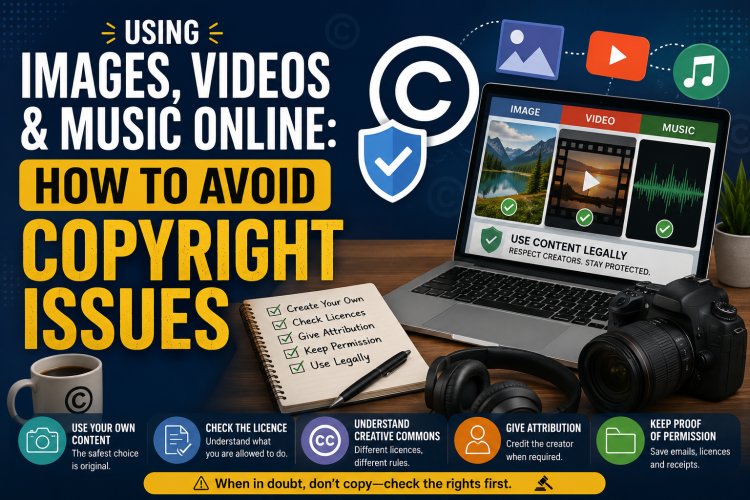
Images, videos, and music can make a blog more engaging, professional, and visually appealing. However, using creative content found online without checking its copyright status can expose bloggers, website owners, businesses, and content creators to legal risks.
A common misconception is that anything available on the internet is free to download and reuse. It is not.
Whether you are writing a blog, creating a social-media post, producing a YouTube video, or running a business website, understanding how to use copyrighted images, videos, and music legally is essential.
The good news is that there are several practical ways to use digital media responsibly while respecting the rights of creators.
Can You Use Images, Videos, and Music From the Internet?
Not automatically.
Finding an image through Google, watching a video on YouTube, or discovering music on a social-media platform does not mean that the content is free to copy, modify, or publish.
Photographs, illustrations, videos, music recordings, artwork, and other creative works may be protected by copyright.
The copyright owner may have exclusive rights over how the work is reproduced, communicated, distributed, adapted, or otherwise used, subject to applicable law and exceptions.
Before using third-party content, you should therefore determine whether you have a legal basis for using it.
1. Don't Assume Online Content Is Free to Use
One of the most common copyright mistakes is assuming that online content is free simply because it is publicly accessible.
For example, suppose you find a beautiful photograph through a Google Image search and download it for your blog.
The fact that Google displays the photograph does not necessarily mean that you have permission to publish it on your website.
The same principle can apply to:
-
Blog photographs
-
Illustrations
-
Infographics
-
YouTube videos
-
Instagram posts
-
Music
-
Stock photographs
-
Digital artwork
-
GIFs
-
Screenshots
Online availability is not the same as permission to reuse.
2. Create Your Own Content Whenever Possible
One of the safest ways to reduce copyright risks is to create your own content.
You can use:
-
Your own photographs
-
Original illustrations
-
Your own videos
-
Original graphics
-
Your own music or sound recordings
When you create an original work, you may generally have copyright in that work, subject to the applicable law, ownership arrangements, employment relationships, assignments, licences, and other relevant circumstances.
For businesses, creating original media can also help establish a consistent visual identity while reducing dependence on third-party content.
3. Check the Licence Before Using Someone Else's Work
If you want to use an image, video, photograph, illustration, or music created by someone else, check the licence first.
A licence is essentially permission to use the work under specified conditions.
Depending on the licence, you may need to check:
-
Whether commercial use is permitted
-
Whether editing or modification is permitted
-
Whether attribution is required
-
Where the content can be used
-
Whether redistribution is permitted
-
Whether the licence has any additional restrictions
-
Whether separate permission is required
Never assume that a licence gives you broader rights than it actually provides.
For example, a licence that permits personal use may not necessarily permit commercial advertising.
4. Understand Creative Commons Licences
Creative Commons licences are commonly used by creators who want to allow others to use their work under specified conditions.
However, Creative Commons does not mean “copyright-free.”
Different Creative Commons licences can impose different requirements.
Depending on the particular licence, conditions may relate to:
-
Attribution
-
Commercial use
-
Modification
-
Distribution
-
Sharing derivative works under similar terms
Before using Creative Commons content, identify the exact licence attached to the work and understand its requirements.
Following the licence conditions is essential.
5. Be Careful When Using Music in Videos
Music is another area where copyright issues frequently arise.
For example, adding a popular song to a promotional video, Instagram Reel, website video, or YouTube content does not automatically make the use lawful.
A song can involve multiple rights, including rights relating to the musical composition and the sound recording.
If you are creating content for a blog, business, YouTube channel, advertisement, or social-media campaign, consider using:
-
Music you created yourself
-
Properly licensed music
-
Music supplied through an appropriate platform licence
-
Music that you are otherwise legally permitted to use
Always check the terms applicable to the particular track and intended use.
6. Videos Can Also Be Copyright-Protected
Videos may contain several different creative elements, including images, music, dialogue, performances, graphics, and cinematography.
Downloading a video from YouTube, Instagram, Facebook, or another platform does not automatically give you the right to upload it somewhere else.
Before reproducing or incorporating someone else's video into your content, determine whether:
-
You have permission
-
A licence covers your intended use
-
The platform's terms provide the necessary rights
-
A statutory copyright exception applies
When the legal position is unclear, obtaining permission or using properly licensed content can reduce risk.
7. What About Giving Credit to the Creator?
Giving credit is good practice, but credit alone does not necessarily give you permission to use copyrighted material.
For example, writing “Photo Credit: XYZ” under a photograph does not automatically mean you have obtained the necessary rights to reproduce that photograph.
Attribution may be a condition of a particular licence, but it should not be confused with permission where permission is otherwise required.
Always check the applicable licence or legal basis for use.
8. Keep Proof of Permission
If you receive permission to use someone else's photograph, video, music, illustration, or other creative work, keep evidence of that permission.
Useful records may include:
-
Emails
-
Written permission
-
Licence agreements
-
Purchase receipts
-
Screenshots of licence terms
-
Download records
-
Platform licence information
Keeping proper documentation can make it easier to demonstrate the basis on which you used the material if a dispute later arises.
For businesses and professional content creators, maintaining a simple copyright or media-rights record can be particularly useful.
9. Be Careful With Commercial Content
Copyright risks can become especially important when content is used commercially.
For example, a business may want to use a photograph in:
-
An advertisement
-
Product packaging
-
A company website
-
Social-media marketing
-
A brochure
-
A promotional video
-
An email campaign
A photograph that may be available for limited personal use may have different licensing requirements for commercial use.
Before using third-party content for business purposes, carefully review the applicable rights and restrictions.
10. What If You Find the Same Image Everywhere?
Seeing the same image on hundreds of websites does not necessarily mean that it is free to use.
Online content can be copied and reposted without the original creator's permission.
Therefore, the number of websites using an image is not a reliable indicator of whether you have the right to use it.
Instead, try to identify:
-
The original creator or copyright owner
-
The source of the work
-
The applicable licence
-
Any restrictions on use
-
Whether permission is required
Common Copyright Mistakes to Avoid
“I Found It on Google, So I Can Use It.”
Wrong. Search engines help you find content but do not automatically grant you copyright permission.
“I Gave the Creator Credit, So It Is Legal.”
Not necessarily. Attribution does not automatically replace a required licence or permission.
“It Says Free Download.”
Be careful. Free to download does not always mean free for every type of reuse.
“Everyone Is Using This Music.”
That does not make it copyright-free. Popularity does not eliminate copyright protection.
“I Changed the Image, So I Own It.”
Not necessarily. Modifying someone else's copyrighted work does not automatically transfer ownership of the underlying work.
A Simple Copyright Checklist for Bloggers
Before publishing an image, video, or music on your blog, ask:
✓ Did I create this content myself?
✓ If not, who owns the copyright?
✓ Do I have a licence or permission to use it?
✓ Does the licence allow my intended use?
✓ Is commercial use permitted if applicable?
✓ Do I need to provide attribution?
✓ Am I allowed to modify the content?
✓ Have I saved proof of the licence or permission?
If you cannot answer these questions, it is better to check the rights before publishing the content.
Why Copyright Compliance Matters for Bloggers
Copyright compliance is not only about avoiding legal disputes.
Respecting copyright also helps bloggers and businesses:
-
Build professional credibility
-
Protect their own creative work
-
Develop responsible content practices
-
Maintain trust with creators and audiences
-
Reduce the risk of takedown requests and disputes
-
Avoid unnecessary business disruption
A good content strategy should therefore include copyright awareness from the beginning.
https://youtu.be/nB21F859Afg?si=uCZ5Xgy9jXlte1pe
Final Thoughts
Using images, videos, and music can make online content more attractive and engaging, but easy access does not mean free use.
The safest approach is to create your own content whenever possible. When using third-party material, check the copyright status, understand the licence, follow its conditions, and obtain permission when necessary.
For bloggers, businesses, influencers, and digital creators, a few minutes spent checking usage rights can prevent significant problems later.
When in doubt, don't simply copy—check the rights first.