+91 7297051181
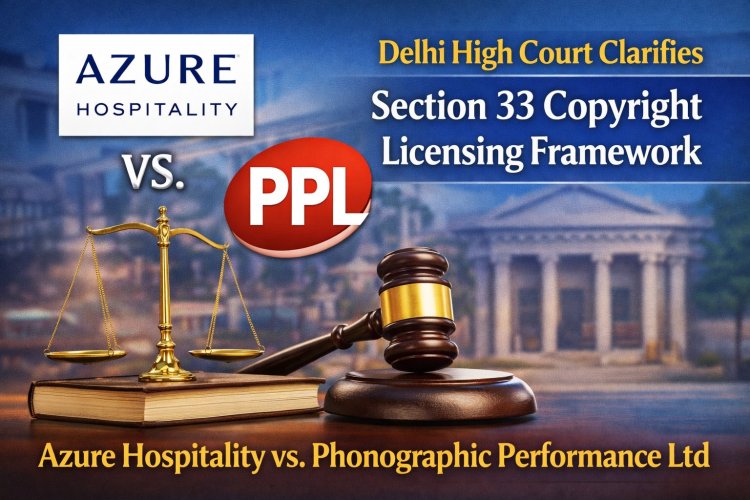
Azure Hospitality vs. Phonographic Performance Ltd: Delhi High Court Clarifies Section 33 Copyright Licensing Framework
A detailed analysis of the Delhi High Court’s Division Bench ruling in Azure Hospitality Pvt. Ltd. vs. Phonographic Performance Ltd., holding that entities engaged in commercial licensing of sound recordings must comply with Section 33 of the Copyright Act, 1957. The judgment reinforces mandatory copyright society registration, tariff transparency, and regulatory oversight in India’s music licensing regime.
Introduction
In the rapidly evolving world of digital content and media licensing, the legal landscape surrounding copyright has never been more critical. The recent case of Azure Hospitality Private Limited vs. Phonographic Performance Limited (2025:DHC:2561-DB) has shed light on the intricate relationship between copyright ownership, licensing, and compliance with statutory frameworks. This ruling from the High Court of Delhi not only impacts the parties involved but also sets a significant precedent in the realm of copyright law in India.
Background of the Case
The dispute arose when Phonographic Performance Limited (PPL), having acquired the copyright of several sound recordings from various record labels through assignment, initiated legal proceedings against Azure Hospitality Private Limited. PPL alleged that Azure was infringing its copyright by playing these sound recordings in its restaurants without securing the necessary licenses. At the first instance, a Single Judge of the High Court granted an interim injunction against Azure, effectively restraining it from using PPL's works. This led Azure to file an appeal, seeking to overturn the injunction and assert its position in the ongoing music licensing debate.
Core Legal Issues
At the heart of the case lies a significant question regarding the interpretation of the Copyright Act, 1957, particularly concerning Section 33, which governs the licensing of copyrighted works. Section 33 mandates that entities engaged in issuing such licenses must be registered as copyright societies. Conversely, it also establishes that individual owners of copyright can grant licenses for their works if they comply with the obligations as members of a registered copyright society.
PPL's Defense
PPL countered Azure's arguments by emphasizing that as the rightful owner of the copyright under Section 18(2), it held an absolute right to license its sound recordings without any hindrance from Section 33. PPL asserted that the proviso to Section 33(1) clearly preserves the owner's right to license individual works. By asserting its status as a voluntary licensor, PPL argued that it should not be forced into a compulsory licensing regime
Court’s Analysis and Implications
Upon reviewing the arguments, the Division Bench of the Delhi High Court took a firm stance, disagreeing with the reasoning provided by the Single Judge. The Court found that Section 33(1) imposes an absolute requirement on any entity conducting a business of licensing copyrighted works. The Court's observations were compelling:
1. Regulatory Framework: The mandatory nature of Section 33(1) implies that PPL, being involved in licensing activities, must adhere to the copyright society registration requirements. This decision reinforces the need for regulatory compliance among entities engaged in the commercial licensing of copyrighted materials.
2. Proviso Interpretation: The Court clarified that the first proviso to Section 33 does not provide a blanket exception for owners. Instead, it signifies that the owner must be a member of a registered copyright society to exercise rights under this provision legitimately. Consequently, PPL's ability to license its repertoire hinges on its registration status.
3. Tariff Transparency: In light of a recent Parliamentary Standing Committee Report advocating for tariff transparency, the Court emphasized that the copyright society framework aims to prevent exploitation and ensure fair practices in licensing. Allowing PPL to function outside this framework would negate the protections afforded to licensees and potentially lead to arbitrary tariff structures.
4. Balance of Equities: Although Azure sought a complete vacation of the injunction, the Court opted for a more measured approach. The ruling partially allowed the appeal, permitting Azure to play recordings from PPL's repertoire under certain conditions: specifically, adherence to tariff rates as displayed on the website of the already registered Recorded Music Performance Limited (RMPL), the only registered copyright society for sound recordings in India.
To know more about this, please check the link below.
Decision and Impact
The decision issued by the High Court not only impacts the parties involved but also has broader implications for the copyright landscape in India. By underscoring the necessity of regulatory compliance for licensing activities, this ruling contributes to improving transparency and fairness in copyright licensing practices. The stipulations regarding the payment of tariffs, along with the requirement for both parties to file statements before the Single Judge, signify a commitment to ensuring accountability in the licensing process. This balanced approach seeks to maintain the rights of copyright owners while protecting commercial entities like Azure from potential exploitation. Beyond its immediate consequences for Azure and PPL, this case lays down a critical legal framework for how copyright law will be interpreted in similar disputes moving forward. It warns against non-compliance with the statutory requirements and serves as a reminder that the structure designed to manage copyright issues must be respected.
Conclusion
The High Court of Delhi’s ruling in the Azure Hospitality vs. Phonographic Performance Limited case is a significant development in copyright law. It highlights the importance of adhering to established legal frameworks governing the operation of copyright societies and licensing of copyrighted works. As the music and entertainment industries continue to evolve, the implications of this case will resonate throughout the sector, guiding businesses in navigating copyright issues. Stakeholders must understand the regulatory landscape to ensure compliance and avoid potential legal entanglements.