+91 7297051181
Design Registration in India: Complete Guide to Process, Cost, Eligibility & Designs Act, 2000
Design Registration in India
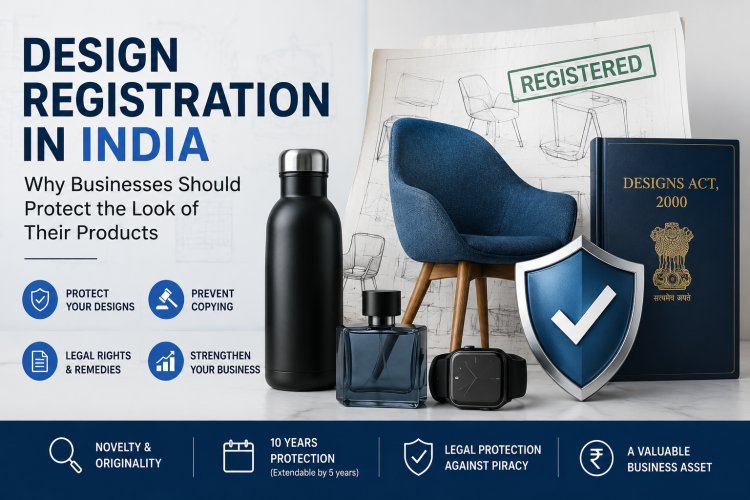
Design Registration in India: Why Businesses Should Protect the Look of Their Products
In today’s competitive market, the visual appearance of a product can be just as important as its functionality. A distinctive chair, bottle, smartphone accessory, automobile component, jewellery piece, or packaging design can become a powerful part of a brand’s commercial identity.
This is where Design Registration in India becomes important.
Under the Designs Act, 2000, businesses can protect the visual features of products through registration. Proper design protection can help businesses prevent competitors from commercially exploiting a distinctive product appearance and can strengthen the overall intellectual property portfolio of a company.
In this guide, we explain what design registration is, what can be registered, the importance of novelty, prior publication, the duration of design protection, design piracy, cancellation of registration, and why businesses should register product designs before public disclosure.
What Is Design Registration in India?
Design registration is the legal process of obtaining statutory protection for the visual appearance of an article under the Designs Act, 2000.
Section 2(d) of the Designs Act defines a “design” in relation to features such as:
- Shape
- Configuration
- Pattern
- Ornament
- Composition of lines or colours
These features must be applied to an article and must appeal to and be judged solely by the eye.
Therefore, design law primarily protects the visual appearance of a product, rather than the underlying technical mechanism or functional principle.
For example, if a company develops a table with an unusual geometric configuration, the engineering mechanism may potentially fall within patent law, while the distinctive visual configuration may potentially qualify for design protection.
Why Is Design Registration Important for Businesses?
A product’s appearance can create significant commercial value.
Consumers may associate a particular visual design with a specific company or brand. If competitors copy or imitate that appearance, the original business may lose its competitive advantage.
Design registration can provide businesses with a stronger legal position against such copying.
It can help:
- Protect distinctive product designs
- Deter competitors from copying registered designs
- Support legal action against design piracy
- Strengthen the company’s intellectual property portfolio
- Increase the commercial value of product designs
- Support licensing and commercialisation opportunities
- Demonstrate formal IP protection to investors and business partners
For businesses investing substantial resources in product development, design registration should be considered at an early stage of product development rather than after imitation occurs.
What Can Be Registered as a Design in India?
The subject matter must fall within the statutory definition of “design” under Section 2(d).
The protection generally concerns the visual features of an article, including its:
Shape + Configuration + Pattern + Ornament + Composition of Lines or Colours
The appearance must be capable of being judged solely by the eye.
Examples of products where design protection may be commercially relevant include:
- Furniture
- Consumer electronics
- Packaging
- Bottles and containers
- Automobile components
- Jewellery
- Fashion accessories
- Lifestyle products
- Household products
- Product accessories
However, not every attractive or commercially successful product appearance automatically qualifies for registration. The statutory requirements must be satisfied.
Design Registration vs Copyright: What Is the Difference?
One common misconception is that copyright and design registration provide the same protection.
They do not.
Copyright generally arises automatically when an eligible original work is created, subject to the applicable legal requirements. Design protection under the Designs Act, however, is based on registration.
For businesses seeking statutory protection for the visual appearance of a commercially manufactured product, it is therefore important to evaluate whether design registration should be pursued.
The nature of the subject matter and the applicable statutory provisions should be carefully examined before deciding which form of intellectual property protection is appropriate.
Novelty and Originality: A Key Requirement
One of the most important considerations before filing a design application is novelty or originality.
Section 4 of the Designs Act restricts registration of designs that do not satisfy the statutory requirements, including designs that have been previously disclosed or are otherwise disqualified under the Act.
This makes a design search and clearance exercise extremely important.
Before filing an application, businesses should consider checking whether substantially the same or similar design has already been:
- Published
- Registered
- Commercially disclosed
- Used publicly
- Made available through online platforms
- Displayed at exhibitions or trade events
A proper search can help identify potential risks before the application is filed.
Why Businesses Should Not Publish a New Design Too Early
One of the biggest practical mistakes businesses make is publicly displaying a new product before considering intellectual-property protection.
For example, a company develops a new bottle design and immediately uploads photographs of the product on:
- E-commerce websites
- Company websites
- Product catalogues
- Trade portals
Such disclosure may create prior publication issues, depending on the circumstances and applicable law.
Therefore, businesses should ideally evaluate design protection before launching a major promotional campaign for a new product.
Confidentiality and timely filing can be critical components of a design-protection strategy.
Supreme Court on Prior Publication: Bharat Glass Tube Case
The importance of prior publication and novelty was considered by the Supreme Court in Bharat Glass Tube Ltd. v. Gopal Glass Works Ltd., (2008) 10 SCC 657.
The decision demonstrates why questions surrounding prior disclosure and the novelty of a design can become central in design-related disputes.
Businesses should therefore avoid assuming that a commercially successful design will automatically qualify for registration merely because it is new to the business.
A proper legal and prior-art assessment should be conducted before filing.
How Long Does Design Registration Last in India?
Under Section 11 of the Designs Act, 2000, registration of a design provides protection for an initial period of 10 years.
The registration may be extended by a further 5 years, subject to the applicable statutory requirements.
Therefore, the maximum statutory period of protection can generally extend to 15 years.
This limited duration reflects the nature of design protection: businesses receive a defined period of exclusivity over the registered visual design without creating a perpetual monopoly over product appearance.
What Is Design Piracy Under Section 22?
Section 22 of the Designs Act, 2000 deals with piracy of registered designs.
The provision addresses certain acts involving the application of a registered design, or a fraudulent or obvious imitation of it, to articles for the purpose of sale or importation, subject to the statutory framework.
Consider a furniture company that spends two years developing a distinctive chair design.
After the product becomes successful, a competitor begins manufacturing and selling chairs having an identical or obviously imitative visual appearance.
If the original design has been properly registered, the registered proprietor may be able to rely on the statutory rights and remedies available under the Designs Act.
This illustrates why design registration can operate as both a defensive and commercial IP asset.
Can a Registered Design Be Cancelled?
Yes.
Design registration does not mean that the registration can never be challenged.
Under Section 19 of the Designs Act, a registered design may be cancelled on specified statutory grounds.
These may include circumstances involving:
- Lack of novelty or originality
- Prior publication
- Other statutory grounds affecting the validity of registration
This is another reason why businesses should not treat registration as a simple formality.
A strong design-protection strategy should include:
- Proper design searches
- Documentation of the development process
- Confidentiality before filing
- Correct representations of the design
- Accurate identification of the article
- Appropriate classification
- Timely filing
Why Design Representation Is So Important
The visual representation submitted with a design application is extremely important because the scope of protection is closely connected with the design represented in the registration.
The applicant should therefore ensure that the representations clearly and accurately show the design for which protection is being sought.
Poor-quality, unclear, inconsistent, or incomplete representations can create difficulties during registration and may also become problematic in future enforcement proceedings.
Businesses should therefore give careful attention to the preparation of the application rather than treating the filing as a routine administrative process.
Design Classification and Application Filing
A design applicant must identify the relevant article and applicable class under the prescribed classification system.
The application should be prepared carefully so that the design, article, representations, and other required particulars are consistent.
Depending on the circumstances, professional assistance may be useful for:
- Selecting the appropriate class
- Preparing design representations
- Conducting prior-design searches
- Evaluating novelty
- Preparing and filing the application
- Responding to examination objections
- Managing registration formalities
Industries That Should Consider Design Registration
Design protection can be particularly valuable in industries where visual appearance influences consumer purchasing decisions.
Examples include:
1. Furniture
Chairs, tables, cabinets, lamps and other furniture products often compete on distinctive appearance as well as functionality.
2. Consumer Electronics
Smartphone accessories, electronic devices and other consumer products may derive substantial commercial value from their external appearance.
3. Fashion and Lifestyle Products
Jewellery, accessories, bags and other lifestyle products can benefit from protection of distinctive visual features.
4. Automobile Industry
Vehicle components and other articles with distinctive visual configurations may raise important design-protection considerations.
5. Packaging
Distinctive containers, bottles and other product packaging can become commercially recognisable.
6. Consumer Products
Household products, kitchen products and lifestyle goods may also contain commercially valuable visual designs.
Design Registration as a Business Asset
A registered design should not be viewed only as a legal document.
It can become a commercial intellectual-property asset.
A properly protected design may support:
- Licensing
- Assignment
- Commercial collaborations
- Investment discussions
- Brand expansion
- Product differentiation
- Enforcement against competitors
For startups and growing businesses, a well-managed IP portfolio can also demonstrate that the company is actively protecting its commercially valuable assets.
Design Registration Before Product Launch: A Better Strategy
A business should ideally consider design protection during the product-development stage.
A practical strategy can look like this:
Step 1 — Develop the Design
Create and document the proposed product appearance.
Step 2 — Maintain Confidentiality
Avoid unnecessary public disclosure before evaluating registration.
Step 3 — Conduct a Design Search
Check existing registered and publicly available designs.
Step 4 — Assess Novelty and Originality
Determine whether the proposed design satisfies the statutory requirements.
Step 5 — Identify the Correct Article and Class
Determine the relevant classification and prepare the application accordingly.
Step 6 — Prepare Clear Representations
Ensure that the visual representations accurately communicate the design.
Step 7 — File the Application
Submit the design application before significant public disclosure wherever possible.
Step 8 — Monitor the Market
After registration, monitor competitors and marketplaces for potentially infringing products.
This approach can significantly improve the effectiveness of a company's design-protection strategy.
Common Mistakes Businesses Should Avoid
Businesses should be careful about the following mistakes:
❌ Launching the product before considering registration
Public disclosure can create novelty and prior-publication issues.
❌ Assuming copyright automatically provides the same protection
Copyright and design protection operate under different legal frameworks.
❌ Filing without conducting searches
An existing design may create serious registration and enforcement risks.
❌ Using poor-quality design representations
The visual representation is central to determining the scope of design protection.
❌ Ignoring classification
The article and relevant classification should be carefully identified during filing.
❌ Waiting until a competitor copies the design
IP protection should ideally be planned before infringement occurs.
Design Registration vs Patent Protection
Design registration and patent protection serve different purposes.
A patent primarily protects qualifying inventions involving technical features, processes or products.
A design registration primarily protects qualifying visual features of an article.
For example, a company developing a new electronic device may potentially need to consider:
Patent → Technical invention
Design Registration → Product appearance
Trademark → Brand name/logo/source identifier
Copyright → Eligible artistic/literary/software and other protected works, depending on the subject matter
A comprehensive IP strategy may therefore involve multiple forms of protection rather than relying on a single IP right.
https://youtu.be/_eo6w7O262I?si=Wzl0srikE-zCtTgL
Conclusion: Protect the Product Before the Market Copies It
In a competitive market, the look of a product can become a valuable business asset.
A company may spend years and significant resources developing a distinctive product appearance. If that appearance is commercially important, failing to consider design protection can expose the business to unnecessary risks.
The key lesson is simple:
Do not wait for competitors to copy your product before thinking about design registration.
Businesses should consider design protection during the product-development stage, conduct appropriate searches, maintain confidentiality, prepare accurate representations and file the application at the appropriate time.
A well-planned Design Registration Strategy in India can help businesses protect the visual identity of their products while strengthening their broader intellectual-property portfolio.