+91 7297051181
Patent Opposition Under Section 25 | Pre-Grant & Post-Grant Explained
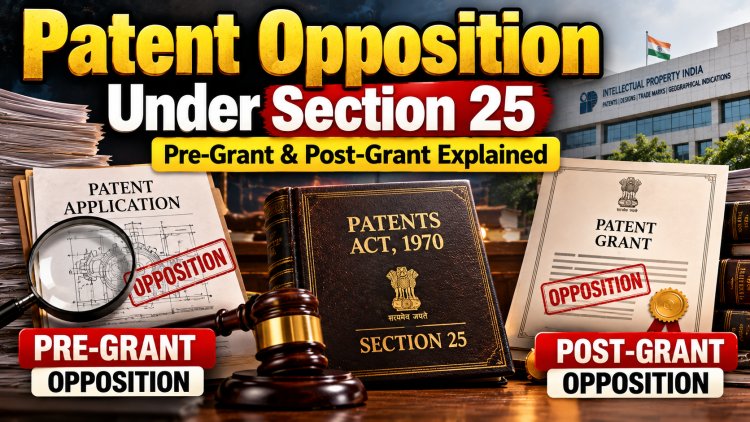
Patent Opposition in India is an important legal mechanism that allows third parties to challenge the grant or continuation of patent rights. Filing a patent application does not automatically mean that the applicant will receive an enforceable patent. The Patents Act, 1970 provides specific procedures through which a patent application or granted patent can be challenged.
Under Section 25 of the Patents Act, 1970, patent opposition is broadly divided into two categories:
- Pre-Grant Opposition – filed before the patent is granted.
- Post-Grant Opposition – filed after the patent has been granted, within the prescribed period.
These mechanisms help ensure that patents are granted and maintained only when the statutory requirements of Indian patent law are satisfied.
What is Patent Opposition in India?
Patent opposition is a legal process through which an eligible person can challenge the grant of a patent on specified statutory grounds.
The opposition process is particularly important because a patent provides the patentee with exclusive rights over the invention. Before or after those rights arise, the law provides opportunities to challenge the patent where there are concerns relating to:
- Lack of novelty;
- Lack of inventive step;
- Prior publication;
- Prior claiming;
- Prior public knowledge or use;
- Non-patentable subject matter;
- Insufficient disclosure;
- Wrongful obtaining; and
- Other grounds specifically recognised under Section 25.
The nature, timing and procedure of the challenge depend on whether it is a pre-grant opposition or post-grant opposition.
Pre-Grant Opposition Under Section 25(1)
A pre-grant opposition is a challenge made before a patent is granted.
Under Section 25(1) of the Patents Act, 1970, any person may make a representation opposing the grant of a patent after the application has been published but before the patent is granted.
The representation is filed in Form 7A in accordance with the applicable patent rules.
When Can a Pre-Grant Opposition Be Filed?
A pre-grant opposition can be filed during the period after publication of the patent application and before the grant of the patent.
The objective is to bring relevant prior art, statutory objections or other grounds to the attention of the Patent Office before exclusive patent rights are granted.
Grounds for Pre-Grant Patent Opposition
Section 25(1) provides several grounds on which a patent application may be opposed.
These include, among others:
1. Wrongful Obtaining
The invention may be challenged where the invention has been wrongfully obtained from the opponent or another person.
2. Prior Publication
A patent application may be opposed where the invention was previously published in a patent document or other relevant publication.
3. Prior Claiming
The invention may already have been claimed in an earlier patent application.
4. Prior Public Knowledge or Public Use
Evidence of prior public knowledge or public use may be relevant to whether the invention satisfies the requirements for patent protection.
5. Lack of Novelty
An invention must satisfy the requirement of novelty. If the claimed invention was already disclosed to the public, the novelty requirement may be challenged.
6. Lack of Inventive Step
An invention must involve an inventive step. An opponent may rely upon prior-art material to demonstrate that the claimed invention lacks the required inventive step.
7. Non-Patentable Subject Matter
An invention may be opposed where it falls within the categories excluded from patentability under the Patents Act, 1970, including relevant provisions of Section 3.
8. Insufficient or Inadequate Disclosure
The patent specification must satisfy the disclosure requirements prescribed under the law. Failure to adequately disclose the invention can become a ground of challenge.
How Does Pre-Grant Opposition Work?
The general process involves:
Patent Application → Publication → Pre-Grant Opposition → Examination/Consideration → Hearing, Where Applicable → Decision → Grant or Refusal
Under the applicable rules, the Controller considers the representation in accordance with the prescribed procedure.
A person opposing a patent should therefore not merely identify a prior-art document. The challenge should explain how the cited material affects the patentability of the claimed invention.
Post-Grant Opposition Under Section 25(2)
A post-grant opposition is filed after the patent has been granted.
Under Section 25(2), a person interested may give notice of opposition to the Controller within one year from the date of publication of the grant of the patent.
The post-grant opposition is filed in the prescribed form under the Patent Rules.
Unlike pre-grant opposition, post-grant opposition is therefore available only after the patent has been granted and is subject to the statutory one-year period.
Grounds for Post-Grant Patent Opposition
The grounds for post-grant opposition substantially correspond to the statutory grounds available for challenging a patent under Section 25.
These may include:
- Wrongful obtaining;
- Prior publication;
- Prior claiming;
- Prior public knowledge or use;
- Lack of novelty;
- Lack of inventive step;
- Non-patentable subject matter;
- Insufficient disclosure;
- Failure to disclose relevant information where required;
- Incorrect or inadequate description of the invention; and
- Other statutory grounds prescribed under Section 25.
The opponent must establish the relevant ground through appropriate pleadings and evidence.
Opposition Board in Post-Grant Opposition
One important feature of post-grant opposition is the role of the Opposition Board.
Under Section 25(3), the Controller constitutes an Opposition Board for consideration of the opposition.
The Board examines the relevant materials and provides its recommendation to the Controller.
The Controller thereafter considers the opposition, the recommendation of the Opposition Board, and the material placed on record before making a decision in accordance with the Patents Act and Rules.
Pre-Grant vs Post-Grant Opposition in India
Particulars
Pre-Grant Opposition
Post-Grant Opposition
Relevant provision
Section 25(1)
Section 25(2)
Stage
Before patent grant
After patent grant
Who can file?
Any person
Person interested
Timing
After publication and before grant
Within one year from publication of grant
Purpose
Prevent grant of an objectionable patent
Challenge a patent after grant
Opposition Board
Not the same statutory post-grant mechanism
Constituted under Section 25(3)
Evidence
Prior art and other statutory evidence
Evidence supporting statutory grounds
Result
Patent may proceed to grant or the application may face objections
Patent may be maintained, amended or otherwise dealt with according to law
Patent Opposition and Prior Art Evidence
Prior art is often central to patent opposition proceedings.
However, merely submitting a collection of patent documents, research papers, websites or other publications may not be sufficient.
A strong opposition should identify:
- The relevant prior-art document;
- Its publication date;
- The specific disclosure relied upon;
- The relevant patent claim;
- The technical features of that claim; and
- Why the disclosure affects novelty or inventive step.
For an inventive-step challenge, the analysis should also explain why the claimed invention would have been obvious to a person skilled in the relevant field based on the prior art and the applicable legal standard.
Novelty vs Inventive Step in Patent Opposition
These two concepts are frequently confused in patent opposition proceedings.
Novelty
The question is essentially whether the claimed invention has already been disclosed in the prior art.
If the claimed invention is already disclosed in a single prior-art reference in the relevant manner, a novelty objection may arise.
Inventive Step
Inventive step involves a different inquiry. The question is whether the claimed invention involves a technical advancement or economic significance over the existing knowledge and is not obvious to a person skilled in the art.
Therefore, an opposition should clearly distinguish between a lack of novelty argument and a lack of inventive-step argument.
Important Supreme Court Case on Patentability
Biswanath Prasad Radhey Shyam v. Hindustan Metal Industries
The Supreme Court's decision in Biswanath Prasad Radhey Shyam v. Hindustan Metal Industries, (1979) 2 SCC 511 remains an important authority in Indian patent law concerning the principles of novelty and inventive step.
The decision emphasised that a patentable invention should involve more than a mere routine workshop improvement.
The case continues to be relevant when analysing whether an alleged invention crosses the threshold required for patent protection.
Patent Opposition vs Patent Infringement
Patent opposition and patent infringement proceedings are not the same legal process.
Patent Opposition
Patent opposition primarily concerns whether a patent application should be granted or whether a granted patent should be challenged through the statutory opposition mechanism.
Patent Infringement
Patent infringement proceedings concern the unauthorised use, manufacture, sale, offering for sale, importation or other exploitation of a patented invention, depending on the applicable statutory rights and facts.
A patent dispute may therefore involve different proceedings at different stages.
Bajaj Auto Ltd. v. TVS Motor Company Ltd.
In Bajaj Auto Ltd. v. TVS Motor Company Ltd., (2009) 9 SCC 797, the Supreme Court dealt with patent infringement litigation and interim relief.
The case is significant in understanding the judicial approach to patent disputes and the importance of timely adjudication in intellectual-property litigation.
However, infringement litigation should not be confused with the statutory pre-grant or post-grant opposition mechanisms under Section 25.
Why is Patent Opposition Important?
Patent opposition plays an important role in maintaining the quality of the patent system.
A patent that does not satisfy the statutory requirements may potentially restrict competition or create unnecessary barriers for other businesses and innovators.
Opposition proceedings provide a mechanism through which relevant information can be brought before the Patent Office.
For competitors, researchers and businesses, patent opposition can therefore be an important part of patent strategy and intellectual-property risk management.
Practical Tips for Filing a Patent Opposition
If you are considering filing a patent opposition in India, the following points should be carefully considered:
1. Identify the Correct Statutory Ground
Do not make general allegations. Identify the specific provision and ground under Section 25.
2. Conduct a Detailed Prior-Art Search
Search patent databases, scientific literature, publications, product documentation and other relevant sources.
3. Analyse the Claims
The opposition should focus on the claims, rather than merely discussing the general subject matter of the invention.
4. Verify Publication Dates
The timing of prior-art documents can be critical. A document must be legally relevant to the particular ground being relied upon.
5. Prepare Technical Evidence
Patent disputes are often technical in nature. Expert or technical evidence may become important depending on the issues involved.
6. Follow Procedural Deadlines
Patent opposition proceedings are subject to prescribed forms, timelines and procedural requirements.
7. Distinguish Novelty and Inventive Step
A proper opposition should clearly explain whether the evidence attacks novelty, inventive step, or another statutory requirement.
How Should a Patent Applicant Respond to an Opposition?
For a patent applicant or patentee facing opposition, the response should generally focus on the specific allegations and evidence submitted by the opponent.
Important considerations may include:
- Claim construction;
- Identification of distinguishing technical features;
- Analysis of cited prior art;
- Novelty analysis;
- Inventive-step analysis;
- Sufficiency of disclosure;
- Patentability under Section 3;
- Procedural compliance; and
- Supporting technical and documentary evidence.
A response should not merely state that the invention is "new." It should explain why the claims satisfy the statutory requirements in light of the evidence relied upon by the opponent.
https://youtu.be/mVb0bFiKQx0?si=Kf1tOF0U1gx1WN0W
Conclusion
Patent Opposition in India provides an important safeguard within the Indian patent system. Section 25 of the Patents Act, 1970 allows challenges both before and after the grant of a patent.
Pre-grant opposition provides an opportunity to challenge a patent application before exclusive rights are granted, while post-grant opposition provides a statutory mechanism for challenging a granted patent within the prescribed period.
A successful patent opposition requires more than simply identifying an earlier patent or publication. The opponent must connect the evidence with the specific claims, statutory grounds and legal requirements for patentability.
For applicants and patentees, an effective response requires careful analysis of the claims, prior art, technical distinctions, statutory requirements and procedural timelines.
Accordingly, patent opposition is both a legal and technical exercise, making proper prior-art research, claim analysis, evidence and drafting essential components of an effective patent strategy.