+91 7297051181
Fashion Design Protection in India: Copyright, Design Registration & Trademark Law Explained
DESIGN PROTECTION
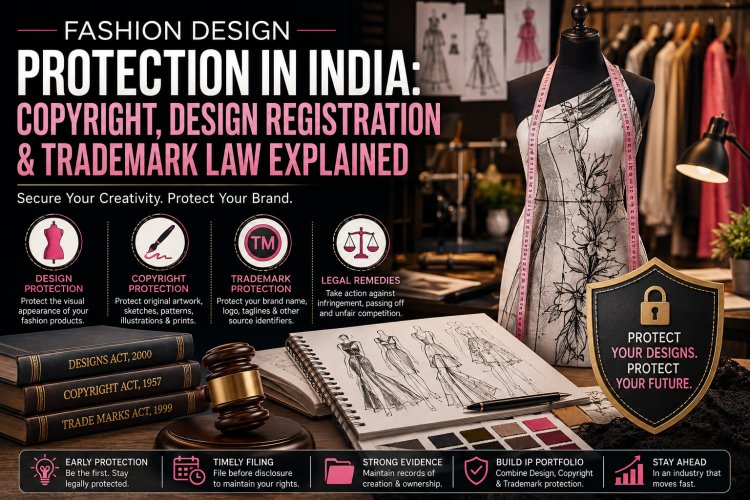
esign Protection in India: Copyright, Design & Trademark Law Explained
Fashion Design Protection in India | Copyright vs Design Registration vs Trademark | Fashion Law & Intellectual Property
Fashion is one of the most design-intensive industries in the world. From clothing and handbags to footwear, textile prints, patterns and accessories, designers invest significant time, creativity and money in developing distinctive products.
But there is a major legal challenge: fashion designs can be copied quickly and commercially reproduced almost immediately after they enter the market.
So, how can fashion designers protect their creations in India?
The answer is not limited to one form of intellectual property (IP) protection. Depending on what has been created, a fashion business may need to consider design registration, copyright protection, trademark registration and other legal remedies such as passing off.
This article explains fashion design protection in India, the difference between copyright and design protection, the importance of Section 15 of the Copyright Act, 1957, relevant Indian case laws, and practical steps fashion designers and brands should take before launching a new collection.
What Intellectual Property Rights Protect Fashion Designs in India?
A single fashion product may contain several different intellectual-property elements.
For example, a designer handbag could involve:
- A distinctive three-dimensional shape;
- Original artwork or illustrations;
- A unique textile pattern;
- A brand name;
- A logo;
- Packaging and other branding elements.
Each element may potentially receive protection under a different area of intellectual-property law.
The three most important forms of protection for fashion businesses are:
- Design registration under the Designs Act, 2000
- Copyright protection under the Copyright Act, 1957
- Trademark protection under the Trade Marks Act, 1999
Therefore, fashion businesses should not treat intellectual property as a one-size-fits-all concept.
Design Registration for Fashion Products in India
The Designs Act, 2000 provides protection for qualifying visual features applied to articles, subject to the statutory requirements.
A fashion designer may consider design registration where a garment, accessory, handbag, footwear product or other article contains a distinctive visual design that satisfies the requirements of the law.
For example, imagine that a designer creates a handbag with a distinctive three-dimensional shape, configuration and ornamental appearance.
If the design satisfies the statutory requirements, it may potentially qualify for registration under the Designs Act.
Similarly, particular patterns, shapes, configurations or ornamental features applied to an article may fall within the scope of design protection depending upon the facts and applicable legal requirements.
Why Is Design Registration Important for Fashion Designers?
Fashion is highly competitive, and product designs can become commercially valuable very quickly.
A registered design can provide an important enforcement mechanism when another party copies the protected design.
However, designers must also pay close attention to novelty and prior disclosure.
Can You Register a Fashion Design After Launching It?
This is one of the most important questions for fashion designers.
A designer may spend months developing a new collection and then reveal it through:
- Fashion shows;
- Exhibitions;
- Instagram;
- Facebook;
- Websites;
- Online stores;
- Product catalogues;
- Marketing campaigns; or
- Other public platforms.
However, public disclosure before filing may affect the novelty requirements applicable to design protection.
This is why fashion businesses should consider their IP strategy before publicly launching a new design.
Instead of waiting until a product becomes successful, designers should evaluate the protectability of the design at the development stage.
Copyright Protection for Fashion Designers in India
Copyright is another important form of protection in the fashion industry.
Original artistic works such as:
- Fashion sketches;
- Illustrations;
- Textile artwork;
- Prints;
- Graphic artwork;
- Certain original patterns; and
- Other qualifying artistic works
may potentially receive copyright protection subject to the requirements of the Copyright Act, 1957.
However, copyright protection and design protection are not interchangeable.
A fashion designer cannot simply assume that copyright will provide unlimited protection for every design that is commercially reproduced.
This is particularly important where an artistic work is applied to articles on an industrial scale.
Section 15 of the Copyright Act and Fashion Designs
One of the most important provisions for fashion businesses is Section 15 of the Copyright Act, 1957.
Section 15 contains specific provisions concerning designs capable of registration under the Designs Act.
This creates an important intersection between copyright law and design law.
A designer therefore needs to ask:
Is the creation an original artistic work, a registrable design, or potentially both at different stages of its development and use?
The answer can have significant consequences for the duration and scope of legal protection.
Fashion businesses should therefore examine the legal status of their designs before mass production and commercial exploitation.
Microfibres Inc. v. Girdhar & Co.: Copyright and Industrial Designs
The relationship between copyright and industrial designs was considered by the Delhi High Court in Microfibres Inc. v. Girdhar & Co., 2009 SCC OnLine Del 511.
The case is important because the Court examined the interaction between copyright protection and designs applied to articles.
For fashion businesses, the case highlights an important principle:
A designer must carefully examine whether a creative work is being protected as an artistic work or as a design applied to an article.
This becomes particularly significant when the work is commercially reproduced on a large scale.
Copyright vs Design Protection for Fashion
Copyright and design protection may appear similar because both can protect visual creativity, but they serve different legal purposes.
Copyright
Copyright may protect qualifying original artistic works such as:
- Illustrations;
- Fashion sketches;
- Textile artwork;
- Graphic works; and
- Other original artistic expressions.
Design Protection
Design registration generally focuses on the visual features applied to an article, subject to the requirements of the Designs Act, 2000.
The distinction becomes particularly important when an artistic creation is converted into a commercially manufactured product.
Therefore, fashion businesses should identify exactly what has been created and how it will be commercially used before deciding which IP protection to pursue.
Can Fashion Designs Be Protected by Trademark Law?
Yes, trademark law can become relevant to fashion businesses, but it protects something different.
Fashion brands commonly register:
- Brand names;
- Logos;
- Word marks;
- Device marks;
- Slogans;
- Other distinctive source-identifying signs.
A distinctive product feature or pattern may also potentially acquire trademark significance in appropriate circumstances if it functions as a source identifier and satisfies the statutory requirements.
However, trademark protection should not be confused with design protection.
Design Protection vs Trademark Protection
Design law generally focuses on the visual appearance of an article.
Trademark law focuses on distinguishing the source of goods or services.
For example, a distinctive handbag shape may raise design-law questions, while the brand name displayed on that handbag may be protected through trademark law.
This is why fashion brands should consider protecting both their products and their brand identity where appropriate.
What Happens When a Fashion Design Is Copied?
Imagine an independent designer creates a distinctive garment and publishes photographs of it online.
A large fashion retailer later produces a visually similar garment and sells thousands of copies.
What legal action can the designer take?
The answer depends on what exactly has been copied.
If a Registered Design Is Copied
Where a registered design has been infringed, the Designs Act, 2000 may provide an enforcement mechanism.
If Original Artwork Is Reproduced
If an original artistic work has been reproduced without authorisation, copyright law may become relevant.
If a Brand Name or Logo Is Copied
If another business copies a protected brand name, logo or other source-identifying mark, trademark law may be implicated.
Passing Off
Depending on the facts, a fashion business may also consider a passing-off action, particularly where another party's conduct creates confusion or misrepresentation concerning the source or commercial origin of goods.
Therefore, the correct legal remedy depends on the specific intellectual-property right involved
https://youtu.be/_eo6w7O262I?si=ZXBM4ka4zFMWCSwm
Fashion Design Copying and Fast-Fashion Businesses
The rapid growth of fast fashion has made design copying an increasingly important issue.
A designer may spend months developing a collection, while another business may reproduce a similar-looking product within a very short period.
This makes early IP planning particularly important.
Fashion businesses should consider:
- Which elements of the product are protectable?
- Has the design been publicly disclosed?
- Should a design application be filed?
- Is there original artwork that requires copyright protection?
- Has the brand name been protected through trademark registration?
- Are contracts with designers and manufacturers properly drafted?
- Is there sufficient evidence of creation and ownership?
These questions should ideally be addressed before commercial launch.
Why Fashion Designers Should Preserve Evidence of Creation
Fashion businesses should maintain proper records showing how their designs were developed.
Useful records may include:
- Initial sketches;
- Design drafts;
- Digital design files;
- Textile artwork;
- Development documents;
- Production records;
- Designer agreements;
- Assignment agreements;
- Communications with manufacturers;
- Dates of creation; and
- Evidence of public disclosure and commercial launch.
Such records can become important when establishing creation, ownership, development history or priority in a legal dispute.
Social Media and Fashion Design Protection
Social media has transformed fashion marketing.
Designers can now showcase new collections instantly through Instagram, websites and other digital platforms.
However, there is an important IP consideration.
Public Disclosure Before Filing
If a designer publicly displays a new design before seeking design protection, that disclosure may have implications for the novelty requirements under the Designs Act.
Therefore, fashion brands should coordinate their:
Design → IP assessment → Filing → Marketing → Commercial launch
rather than treating intellectual-property protection as an issue to be considered after the product becomes successful.
Important Indian Case Laws on Fashion and Design Protection
Several Indian cases provide useful guidance on copyright, industrial designs and fashion-related intellectual property.
1. Microfibres Inc. v. Girdhar & Co.
2009 SCC OnLine Del 511
This Delhi High Court decision is significant for understanding the relationship between copyright protection and designs applied to articles.
2. Bharat Glass Tube Ltd. v. Gopal Glass Works Ltd.
(2008) 10 SCC 657
This Supreme Court decision is an important authority concerning design protection and the requirements surrounding registered designs.
3. Rajesh Masrani v. Tahiliani Design Pvt. Ltd.
2009 SCC OnLine Del 817
This case is particularly relevant in the context of copyright and fashion/design-related creative works.
4. Micolube India Ltd. v. Rakesh Kumar
1996 SCC OnLine Del 394
The decision is relevant to the interaction between copyright and design protection and the legal consequences associated with industrial application.
These cases demonstrate why fashion businesses need to analyse the precise nature of the intellectual-property right involved rather than relying on a general assumption that every creative fashion product is automatically protected in the same way.
How Can Fashion Designers Protect Their Designs in India?
A practical fashion IP strategy can involve several steps.
Step 1: Identify the Intellectual Property
Separate the different elements of the product.
For example:
Garment shape → Design
Original artwork → Copyright
Brand name → Trademark
Logo → Trademark
Original textile artwork → Copyright / potentially other protection depending on use
Step 2: Check Novelty and Existing Rights
Before launching a new design, conduct appropriate searches and assess whether similar rights already exist.
Step 3: Consider Design Registration
Where a product contains a qualifying design, consider filing a design application before public disclosure where legally appropriate.
Step 4: Protect Brand Identity
Register important fashion brand names, logos and other distinctive marks under the Trade Marks Act, 1999.
Step 5: Maintain Ownership Documents
Use appropriate agreements with:
- Designers;
- Employees;
- Freelancers;
- Manufacturers;
- Vendors; and
- Other creative contributors.
Step 6: Preserve Evidence
Maintain dated records of creation, development, ownership and commercial use.
Step 7: Monitor the Market
Fashion businesses should actively monitor online marketplaces, social media and competing products for potential copying.
How Long Does Fashion Design Protection Last in India?
The duration of protection depends on the type of intellectual-property right involved.
Design protection, copyright protection and trademark protection operate under different statutory frameworks and have different requirements and durations.
Therefore, fashion businesses should not assume that registering one form of IP automatically provides the same duration or scope of protection as another.
The applicable provisions of the Designs Act, 2000, Copyright Act, 1957 and Trade Marks Act, 1999 should be examined separately.
Why Fashion Businesses Need an IP Portfolio
A single fashion product can contain multiple intellectual-property rights.
For example:
| Fashion Element | Potential IP Protection |
|---|---|
| Garment design | Design registration |
| Handbag shape | Design registration |
| Textile artwork | Copyright |
| Fashion illustration | Copyright |
| Brand name | Trademark |
| Logo | Trademark |
| Distinctive source-identifying features | Trademark, where legally applicable |
| Commercial goodwill | Passing off, where applicable |
This demonstrates why a fashion business should develop an IP portfolio strategy instead of relying on a single registration.
Fashion Law in the Age of Fast Fashion
The fashion industry's biggest challenge is speed.
A designer can create a new product today, publish it on social media tomorrow, and potentially see similar products appear online shortly thereafter.
Technology has made copying easier, but it has also made evidence collection, online monitoring and enforcement increasingly important.
For fashion businesses, intellectual-property protection should therefore be integrated into the design and product-development process itself.
The question should not be:
“Can we protect this after someone copies it?”
The better question is:
“What should we protect before we launch it?”
Conclusion: How to Protect Fashion Designs in India
Fashion intellectual property law in India demonstrates that there is no single form of protection that covers every aspect of a fashion product.
A single garment or accessory may involve:
- Copyright in original artwork;
- Design protection for qualifying visual features applied to an article;
- Trademark protection for brand identity; and
- Passing off or other legal remedies, depending on the circumstances.
The interaction between copyright and design law, particularly under Section 15 of the Copyright Act, 1957, makes early legal analysis especially important.
For fashion designers and brands, the best strategy is to identify each potentially protectable element separately and select the appropriate intellectual-property mechanism.
In an industry where a successful design can be copied almost instantly, early IP identification, timely filing, proper contracts and evidence preservation can be just as important as the creative process itself.
Frequently Asked Questions (FAQs)
Can fashion designs be copyrighted in India?
Original artistic works associated with fashion, such as qualifying sketches, illustrations, textile artwork and graphic works, may receive copyright protection. However, the application of copyright law to designs commercially applied to articles must be examined carefully, particularly in light of Section 15 of the Copyright Act, 1957.
Can I register a clothing design under the Designs Act, 2000?
A qualifying visual design applied to an article may potentially be registered under the Designs Act, 2000, provided the statutory requirements are satisfied.
Is trademark protection the same as design protection?
No. Design protection generally concerns the visual features of an article, whereas trademark protection primarily concerns signs that distinguish the source of goods or services.
Should I register my fashion design before posting it on Instagram?
Fashion businesses should consider the implications of public disclosure before filing a design application because disclosure may affect novelty requirements under the Designs Act.
What should I do if another brand copies my fashion design?
The appropriate remedy depends on what has been copied. A registered design, original artistic work, brand name or other protected element may involve different legal remedies under design, copyright or trademark law.
Why is Section 15 of the Copyright Act important for fashion designers?
Section 15 is important because it addresses the relationship between copyright protection and designs capable of registration under the Designs Act. It is therefore particularly relevant when artistic works are applied to commercially manufactured products.