+91 7297051181
Copyright in India Explained: Ideas vs Expression, Originality & Public Domain
Copyright is one of the most important forms of intellectual property protection in India. It gives creators legal rights over original literary, artistic, musical, dramatic and other creative works.
However, one of the biggest misconceptions about copyright law in India is that copyright protects every idea, concept, name or business model. It does not.
Understanding what can and cannot be copyrighted in India is essential for creators, authors, artists, photographers, entrepreneurs, businesses and content creators who want to protect their intellectual property.
In this guide, we explain the copyrightable works in India, the idea-expression distinction, originality requirement, derivative works, public domain and what copyright does not protect.
What Can Be Copyrighted in India?
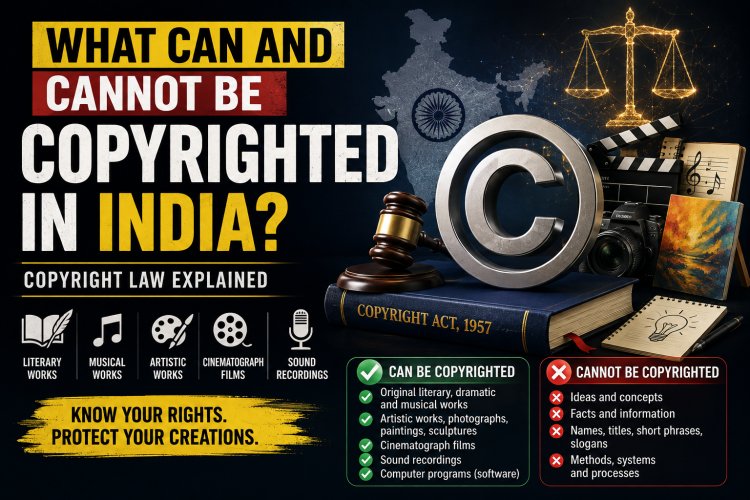
Under the Copyright Act, 1957, copyright protection is available for several categories of original works.
1. Literary Works
Literary works are not limited to books or novels. They can include:
-
Books and articles
-
Blog posts and written content
-
Research papers
-
Reports
-
Manuals
-
Speeches
-
Website content
-
Computer programs and software code
-
Tables and compilations, where the required originality exists
Importantly, computer programs are treated as literary works under Indian copyright law.
2. Dramatic Works
Dramatic works can include:
-
Scripts
-
Plays
-
Dramatized works
-
Choreography
-
Written arrangements for dramatic performances
The protection generally applies to the original expression contained in the work rather than the underlying concept or theme.
3. Musical Works
Copyright can protect an original musical composition, including elements such as musical notation and composition.
It is important to distinguish the musical work from a sound recording. A composition and the recording of that composition can involve separate copyright interests.
4. Artistic Works
Copyright protection can apply to various artistic works, including:
-
Paintings
-
Drawings
-
Photographs
-
Sculptures
-
Illustrations
-
Graphic designs
-
Maps
-
Architectural drawings
-
Certain works of craftsmanship
For businesses, this can be particularly relevant when protecting original artwork, illustrations, website graphics, photographs and other creative assets.
5. Cinematograph Films
Cinematograph films are separately protected under copyright law.
This can include films, videos and other qualifying audiovisual productions.
6. Sound Recordings
Sound recordings are also protected as a separate category of copyright.
For example, a recorded song may involve different copyright interests in the:
-
Musical composition
-
Lyrics
-
Performance
-
Sound recording
Therefore, owning one right does not necessarily mean that you own all copyright associated with the recording.
The Most Important Rule: Copyright Protects Expression, Not Ideas
The idea-expression distinction is one of the most important concepts in copyright law.
Copyright generally protects the specific expression of an idea, not the underlying idea itself.
For example, imagine two writers independently develop the idea of:
A detective solving a murder in a small town.
The general concept itself cannot ordinarily be monopolized through copyright.
However, if one writer creates a novel containing original characters, dialogue, scenes, descriptions and a particular sequence of events, those specific expressions may receive copyright protection.
Another person cannot simply copy that expression and claim that they only copied the "idea."
In simple terms:
Idea = generally not protected
Original expression of the idea = potentially protected
This distinction is particularly important for authors, filmmakers, YouTubers, entrepreneurs and content creators.
What Cannot Be Copyrighted in India?
Understanding what copyright does not protect is just as important as understanding what it does protect.
1. Ideas and Concepts
A business idea, story concept, invention concept or general creative idea is generally not protected by copyright merely because someone thought of it first.
For example:
-
An idea for a food-delivery app
-
An idea for a reality TV show
-
An idea for a novel
-
An idea for an educational platform
may not itself qualify for copyright protection.
However, the original expression of that idea—such as written content, artwork, software code or a detailed creative work—may qualify for protection.
Depending on the circumstances, other forms of intellectual property protection may also be relevant.
2. Facts and Information
Copyright does not generally give someone exclusive ownership over facts.
For example, a person cannot claim copyright over the fact that:
A particular company was incorporated in 2025.
However, an original article explaining those facts, including its original wording, structure and presentation, may itself be protected.
This is why facts and the creative expression of facts need to be distinguished.
3. Names, Titles and Short Phrases
Names, titles, short phrases and slogans generally do not receive copyright protection merely because they are used creatively.
For example:
-
A business name
-
A product name
-
A short title
-
A short slogan
may require protection through another intellectual property mechanism.
For brands, trademark registration may be more appropriate because trademarks can protect distinctive names, logos, slogans and other brand identifiers when they meet the applicable requirements.
4. Methods, Systems and Processes
Copyright generally does not protect an underlying:
-
Method
-
System
-
Procedure
-
Process
-
Business method
Copyright may protect the written or creative expression used to describe a method or process, but that does not necessarily give the author exclusive rights over the underlying method itself.
Where applicable, patent law may be a more relevant form of intellectual property protection.
What About Government Works and Public Domain Content?
Another important area is the public domain.
When copyright protection expires, the work may enter the public domain. Such material can generally be used by the public without obtaining permission from the former copyright owner.
However, there is an important distinction.
Suppose an old literary work is in the public domain. A newly created:
-
Translation
-
Adaptation
-
Annotated edition
-
Modern arrangement
-
Edited version
may contain new original expression that can potentially receive separate copyright protection.
Therefore:
Public domain status of the original work does not automatically mean that every version of that work is free to copy.
This is particularly important when using old books, classical music, photographs or literary works found online.
Does a Work Have to Be Original to Receive Copyright Protection?
Yes.
But originality under copyright law does not necessarily mean that the work must be revolutionary, unique or artistically extraordinary.
The key question is whether the work originated from the author's own independent effort rather than being copied from someone else.
For example, a simple photograph may still qualify for copyright protection if it reflects the photographer's own independent creation.
Similarly, a straightforward article may be protected if it represents the author's own original expression.
Therefore, copyright law does not require "genius."
It requires the necessary level of originality and independent creation.
What Are Derivative Works?
A derivative work is a work based upon or derived from an existing work.
Examples may include:
-
Translations
-
Adaptations
-
Arrangements
-
Modified versions
-
Other transformations of an existing work
A sufficiently original derivative work may itself contain copyrightable expression.
However, there is an important legal distinction:
Having copyright in your original contribution to a derivative work does not automatically give you permission to use the underlying copyrighted work.
For example, creating your own translation of a copyrighted book does not automatically mean you had the legal right to translate and publish it.
The rights of the original copyright owner must also be considered.
Copyright vs Trademark vs Patent
One of the easiest ways to understand intellectual property protection is to compare the different rights.
| Intellectual Property | Generally Protects |
|---|---|
| Copyright | Original creative expression |
| Trademark | Brand names, logos, marks and identifiers |
| Patent | Qualifying inventions and technical innovations |
| Design | Certain visual features and appearance of articles |
For example:
Brand name: Trademark may be relevant.
Original advertisement video: Copyright may be relevant.
New technical invention: Patent may be relevant.
Original product artwork: Copyright may be relevant.
Choosing the correct form of intellectual property protection can be critical for a business.
Why Understanding Copyright Protection Matters
A misunderstanding of copyright law can create problems in both directions.
Mistake 1: Assuming an idea is automatically copyrighted
A person may believe that simply coming up with a business idea, story concept or content idea gives them exclusive copyright rights.
Generally, it does not.
Mistake 2: Assuming copying is allowed if the words are changed
Copyright infringement is not necessarily limited to exact word-for-word copying.
Taking substantial original expression and merely changing some words or presentation may still create legal issues depending on the circumstances.
Therefore, simply "rewriting" someone else's work does not automatically make it legally safe.
Key Takeaways: What Can and Cannot Be Copyrighted in India?
The easiest way to remember the basic principle is:
Copyright protects original expression—not ideas.
Copyright can potentially protect:
-
Literary works
-
Computer programs
-
Dramatic works
-
Musical works
-
Artistic works
-
Photographs
-
Cinematograph films
-
Sound recordings
-
Other qualifying original creative works
Copyright generally does not protect, by itself:
-
Ideas
-
Concepts
-
Facts
-
Methods
-
Systems
-
Processes
-
Names
-
Titles
-
Short phrases
-
Slogans as such
However, the legal position can depend on the nature of the work, the originality involved, how it was created and whether another form of intellectual property protection applies.
https://youtu.be/2ghmJUeOBRU?si=lP8AgnyqFU9e5WX1
Knowing what can and cannot be copyrighted in India is essential for protecting creative work and avoiding intellectual property disputes.
If you have created a book, photograph, software program, website, video, music, artwork, course material or other original content, copyright may provide valuable protection. At the same time, if your primary asset is a brand name, invention, product design or business identity, copyright may not be the appropriate protection on its own.
The key is to identify what exactly you are trying to protect and then choose the appropriate intellectual property right.
Important: This article provides general information about Indian copyright law and should not be treated as legal advice for a specific dispute or transaction.