+91 7297051181
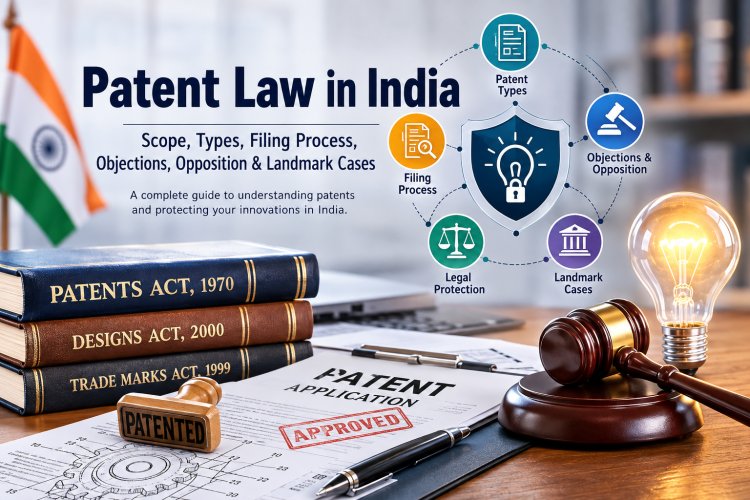
Patent Law in India: Patent Scope, Types, Filing Process, Objections, Opposition & Landmark Case
PATENT
Introduction
In today’s knowledge-driven economy, technological innovation has become one of the most valuable assets for businesses, startups, research institutions, and individual inventors. However, developing a new product, process, technology, or technical solution is only one part of the journey. Protecting that innovation through patent registration in India is equally important.
A patent provides the inventor or applicant with legally enforceable rights over a qualifying invention for a limited period. In India, the patent system is primarily governed by the Patents Act, 1970 and the Patents Rules, 2003, along with subsequent amendments.
Understanding patent law in India, patentability requirements, different types of patent applications, the patent filing process, examination, objections, opposition, and revocation proceedings is essential for anyone seeking to commercialize or protect an invention.
This comprehensive guide explains the Indian patent registration process, patent protection framework, application types, patent objections, opposition proceedings, and important Indian patent law cases.
1. What Is a Patent in India?
A patent is a statutory intellectual property right granted by the Government for an invention that satisfies the legal requirements of patentability.
Under Indian patent law, an invention generally refers to a new product or process involving an inventive step and capable of industrial application.
A patent essentially creates a legal balance between private rights and public knowledge.
The inventor receives exclusive rights over the patented invention for a limited period. In return, the inventor is required to disclose the invention in sufficient technical detail so that the invention becomes part of the body of publicly available technical knowledge.
The patent holder can generally prevent unauthorized third parties from commercially exploiting the patented invention, subject to the rights and limitations provided under Indian law.
How Long Is a Patent Valid in India?
The normal term of a patent in India is 20 years from the date of filing of the patent application, subject to payment of the prescribed renewal fees and other statutory requirements.
After expiry of the patent term, the invention enters the public domain and can generally be used by others without requiring permission from the former patent holder.
2. Why Are Patents Important for Businesses and Startups?
Patent protection is not merely a legal mechanism. For technology-driven businesses, patents can become important commercial and strategic assets.
Market Exclusivity
A patent can help a business prevent unauthorized commercial exploitation of the patented invention, subject to the scope of the granted claims.
This can provide an important competitive advantage and allow a business to establish a stronger position in the market.
Protection of Research and Development Investment
Developing innovative technology can require substantial expenditure on:
-
Research and development
-
Product development
-
Testing
-
Prototyping
-
Engineering
-
Commercialization
Patent protection can help businesses protect the technological results of these investments.
Patent Licensing and Monetization
A patent does not necessarily have to be commercially exploited directly by the patent owner.
The patent holder may, subject to applicable law, commercialize the technology through:
-
Licensing
-
Technology transfer
-
Assignment
-
Royalty arrangements
-
Strategic partnerships
Therefore, a patent can become a valuable intangible asset capable of generating revenue.
Investor Confidence
For startups and technology companies, a strong intellectual property portfolio can demonstrate technological differentiation and create additional value during investment discussions, due diligence, mergers, acquisitions, and strategic partnerships.
3. Patentability Requirements in India
Not every new idea or invention can be patented.
For patent registration in India, an invention generally needs to satisfy three fundamental requirements:
1. Novelty
The invention must be new.
It should not have been anticipated by prior publication, prior use, or other forms of prior disclosure that destroy novelty under applicable law.
This makes conducting a prior art search before filing a patent application extremely important.
2. Inventive Step
The invention must involve an inventive step.
In simple terms, the invention should not be obvious to a person skilled in the relevant technical field.
The assessment may consider whether the invention demonstrates technical advancement, economic significance, or both, as applicable under the Patents Act.
3. Industrial Applicability
The invention must be capable of being made or used in an industry.
An invention that cannot practically be manufactured or utilized in an industrial context may not satisfy this requirement.
4. What Cannot Be Patented in India?
Sections 3 and 4 of the Patents Act, 1970 contain important exclusions from patentability.
Depending on the facts and statutory requirements, non-patentable subject matter includes categories such as:
-
Frivolous inventions
-
Inventions contrary to natural laws
-
Certain discoveries
-
Mathematical methods
-
Business methods
-
Computer programme per se
-
Methods of medical treatment
-
Plants and animals, subject to statutory exceptions
-
Certain agricultural and horticultural methods
-
Traditional knowledge
-
Atomic energy-related inventions covered by Section 4
Therefore, before filing a patent application, an inventor should evaluate not only whether an invention is new but also whether the subject matter falls within any statutory exclusion.
5. Patent vs Design Registration in India
One of the most common mistakes in intellectual property strategy is confusing patent protection with design registration.
A patent primarily protects the technical or functional aspects of an invention.
A design registration, governed by the Designs Act, 2000, primarily protects the visual features of an article, such as its shape, configuration, pattern, ornamentation, or composition, subject to the statutory requirements.
Simple Example
Suppose a company develops a new type of bottle.
-
The new technical mechanism used to improve the bottle's functionality may potentially be protected through a patent.
-
The unique visual appearance or ornamental design of the bottle may potentially be protected through design registration.
The appropriate form of IP protection therefore depends on what exactly the business wants to protect.
6. Types of Patent Applications in India
When people search for “types of patents in India,” it is important to understand that Indian patent law primarily categorizes applications and filing routes rather than offering separate “patent types” in the same sense used in some jurisdictions.
Provisional Patent Application
A provisional specification can be filed when the invention has reached a stage where the applicant wants to secure an early priority date but the invention is still being developed.
A provisional specification allows the applicant to establish an early filing date while continuing to refine the invention.
A complete specification must generally be filed within 12 months from the provisional filing date. Failure to file the complete specification within the prescribed period can result in the application being treated as abandoned.
Complete Specification
A complete specification contains the detailed disclosure of the invention and includes the claims defining the legal scope of protection.
It generally contains:
-
Title
-
Field of invention
-
Background
-
Summary
-
Detailed description
-
Drawings, where applicable
-
Examples, where applicable
-
Claims
-
Abstract
The claims are particularly important because they define the boundaries of the protection sought.
Ordinary Patent Application
An ordinary application is filed directly in India without claiming priority from a previously filed foreign application.
Convention Application
A convention application allows an applicant who has first filed an application in a convention country to claim priority in India, subject to the applicable requirements and timelines.
PCT International Application
A PCT application is filed under the Patent Cooperation Treaty and provides a centralized international filing mechanism.
It does not itself result in a single worldwide patent. Instead, it facilitates the process of seeking patent protection in multiple jurisdictions.
PCT National Phase Application
A PCT applicant seeking patent protection in India must enter the Indian national phase within the applicable statutory period, generally 31 months from the relevant priority date, subject to the governing rules and circumstances.
Patent of Addition
Under Section 54 of the Patents Act, a patent of addition may be sought for a modification or improvement relating to an existing patented invention, subject to statutory requirements.
A patent of addition generally follows the term of the main patent and has specific provisions concerning renewal fees.
Divisional Application
Under Section 16 of the Patents Act, where an application relates to more than one invention, a divisional application may be filed in accordance with the statutory requirements.
A divisional application can retain the priority date of the parent application where legally permissible.
7. Patent Registration Process in India: Step-by-Step Guide
The patent filing process in India involves multiple stages, from evaluating the invention to obtaining the patent grant.
Step 1: Conduct a Prior Art Search
Before filing, the applicant should conduct a comprehensive patent and prior art search.
The search may cover:
-
Indian patent databases
-
International patent databases
-
Scientific journals
-
Technical publications
-
Existing products
-
Research papers
-
Public disclosures
A prior art search can help determine whether the invention is likely to satisfy novelty and inventive-step requirements.
It can also assist in drafting stronger and more commercially relevant claims.
Step 2: Prepare the Patent Specification
Patent drafting requires both technical understanding and legal precision.
The specification should disclose the invention sufficiently and clearly.
A patent application may contain:
-
Title
-
Technical field
-
Background
-
Problem addressed
-
Summary of invention
-
Detailed description
-
Drawings
-
Examples
-
Claims
-
Abstract
The patent claims are particularly important because they define the legal scope of the protection sought.
Step 3: File the Patent Application
Patent applications can be filed before the appropriate Indian Patent Office.
India has patent offices located in:
-
Delhi
-
Mumbai
-
Kolkata
-
Chennai
Depending on the circumstances, applications may be filed electronically through the Patent Office's online system.
Commonly relevant forms can include:
-
Form 1 – Application for Grant of Patent
-
Form 2 – Provisional or Complete Specification
-
Form 3 – Statement and Undertaking under Section 8
-
Form 5 – Declaration as to Inventorship
-
Form 26 – Authorization of Patent Agent, where applicable
The exact documents and forms required depend upon the nature and circumstances of the application.
Eligible startups, small entities, educational institutions, and other prescribed categories may receive benefits concerning official fees and expedited procedures.
8. Patent Application Publication
After filing, a patent application generally remains confidential for a statutory period.
Ordinarily, patent applications are published after 18 months from the filing or priority date, subject to the applicable provisions.
An applicant may also seek early publication by filing the prescribed request, commonly through Form 9.
Publication makes the application available for public inspection and also triggers the statutory framework concerning pre-grant opposition.
9. Request for Examination and First Examination Report
A patent application is not ordinarily examined automatically merely because it has been filed.
The applicant must submit a Request for Examination (RFE) within the prescribed period.
The relevant request may be filed using:
-
Form 18 for ordinary examination; or
-
Form 18A where expedited examination is available and the applicant satisfies the prescribed eligibility conditions.
The Patent Office then examines the application for issues relating to:
-
Novelty
-
Inventive step
-
Industrial applicability
-
Sufficiency of disclosure
-
Claim clarity
-
Unity
-
Formal requirements
-
Patentable subject matter
If objections are raised, the Patent Office issues a First Examination Report (FER).
The applicant must respond to the FER within the applicable statutory period and may need to amend the specification or claims, submit arguments, or provide supporting material.
10. How to Respond to Patent Objections
Patent objections can broadly be categorized into procedural and substantive objections.
Formal Objections
These may relate to:
-
Incorrect forms
-
Missing documents
-
Deficiencies in drawings
-
Incorrect applicant details
-
Authorization issues
-
Procedural requirements
Substantive Objections
These may concern:
-
Lack of novelty
-
Lack of inventive step
-
Lack of industrial applicability
-
Insufficient disclosure
-
Claim construction
-
Section 3 exclusions
-
Prior art
-
Unity of invention
A strong response to an FER should address each objection separately and provide legally and technically supported arguments.
Where appropriate, amendments to the claims may be proposed to distinguish the invention from cited prior art.
11. Patent Opposition in India
Indian patent law provides mechanisms through which third parties can challenge patent applications and granted patents.
The two principal mechanisms are:
-
Pre-grant opposition
-
Post-grant opposition
Pre-Grant Opposition
Under Section 25(1) of the Patents Act, any person may submit a pre-grant opposition against a published patent application before the patent is granted, subject to the statutory requirements.
Potential grounds include:
-
Prior publication
-
Prior claiming
-
Lack of inventive step
-
Non-patentable subject matter
-
Insufficient disclosure
-
Failure to comply with statutory requirements
-
Incorrect or incomplete disclosure
Pre-grant opposition can therefore become an important tool for businesses monitoring competitor patent applications.
12. Post-Grant Opposition
A post-grant opposition is governed by Section 25(2).
Unlike pre-grant opposition, post-grant opposition is available to a person interested, subject to the statutory requirements.
A post-grant opposition generally has to be filed within one year from the date of publication of the grant of the patent.
The matter is considered through the statutory opposition procedure, including consideration of evidence and recommendations of the Opposition Board.
Depending on the outcome, the patent may be maintained, amended, or revoked in accordance with law.
13. Patent Revocation in India
Opposition is not the only mechanism for challenging a granted patent.
A patent may also be challenged through revocation proceedings under Section 64 of the Patents Act, subject to the applicable jurisdiction and procedural requirements.
Patent revocation proceedings can raise grounds including:
-
Lack of novelty
-
Lack of inventive step
-
Non-patentability
-
Insufficient disclosure
-
Failure to comply with statutory requirements
-
Wrongful obtaining
-
Prior claiming
-
Other grounds specified under Section 64
Businesses involved in patent disputes should therefore evaluate both offensive and defensive patent strategies.
14. Freedom-to-Operate Search: Why Businesses Need It
Obtaining a patent does not automatically mean that a business is free to manufacture or sell a product.
A business may own a patent while another party owns a separate patent covering a technology necessary to commercialize that product.
This is where a Freedom-to-Operate (FTO) search becomes important.
An FTO analysis helps businesses identify potentially enforceable third-party patent rights before launching a product or entering a market.
Businesses should consider conducting FTO searches particularly before:
-
Product launches
-
Large-scale manufacturing
-
Technology commercialization
-
International expansion
-
Licensing
-
Acquisitions
-
Major investments in R&D
Regular monitoring of patent publications can also help businesses identify potentially conflicting competitor applications.
15. 4 Landmark Indian Patent Law Cases
Indian patent law has developed significantly through judicial decisions involving biotechnology, pharmaceuticals, telecommunications, and patent procedure.
Case 1: Monsanto Technology LLC v. Nuziveedu Seeds Ltd.
Year: 2019
Court: Supreme Court of India
Facts
Monsanto's technology involved a genetic construct used in cotton plants to provide protection against bollworm.
A licensing dispute subsequently arose between Monsanto and Nuziveedu Seeds.
Nuziveedu challenged the validity of the patent, including arguments relating to the exclusions under Section 3(j) of the Patents Act.
Supreme Court Decision
The Supreme Court set aside the Division Bench decision that had summarily revoked the patent.
The Court emphasized that complex questions concerning patentability of biotechnology inventions and the interaction between patent law and plant variety protection required proper adjudication.
The case demonstrates the importance of detailed technical and legal analysis in complex patent disputes.
16. Aloys Wobben v. Yogesh Mehra & Anr.
Year: 2014
Court: Supreme Court of India
Facts
Dr. Aloys Wobben was involved in patent litigation concerning wind turbine technology.
The defendants pursued challenges through different statutory mechanisms, including post-grant opposition and revocation proceedings.
This raised questions regarding parallel proceedings challenging the validity of the same patent.
Supreme Court Decision
The Supreme Court examined the relationship between Section 25(2) post-grant opposition and Section 64 revocation proceedings.
The judgment established important principles concerning the circumstances in which parallel validity challenges could be pursued.
The case remains significant for understanding procedural strategy in Indian patent litigation.
17. Telefonaktiebolaget LM Ericsson v. Intex Technologies
Year: 2015
Court: Delhi High Court
Facts
Ericsson owned Standard Essential Patents relating to telecommunications standards.
Ericsson alleged that Intex used technologies covered by its patents without obtaining an appropriate licence.
The dispute also involved questions concerning FRAND—Fair, Reasonable and Non-Discriminatory—licensing terms.
Delhi High Court Decision
The Delhi High Court dealt with issues concerning enforcement of Standard Essential Patents, licensing obligations, royalty determination, and FRAND principles.
The case became an important part of the development of Indian jurisprudence concerning Standard Essential Patents and FRAND licensing.
18. Sugen Inc. & Anr. v. Cipla Limited
Year: 2017
Court: Delhi High Court
Facts
The dispute concerned a patent relating to Sunitinib, a pharmaceutical compound.
Sugen alleged infringement after Cipla introduced a generic version.
Cipla challenged the validity of the patent, including issues relating to inventive step and the statutory patentability framework.
Delhi High Court Decision
The Court undertook a detailed examination of the technical characteristics of the invention and the relevant prior art.
The case demonstrates the importance of technical evidence and careful analysis when assessing inventive step in pharmaceutical patent litigation.
It also highlights the importance of avoiding hindsight when evaluating whether an invention would have been obvious to a person skilled in the art.
19. How Businesses Can Build a Strong Patent Strategy
Patent protection should not be treated as a one-time filing exercise.
A successful IP strategy may include:
1. Identify Patentable Innovations
Businesses should maintain internal processes for identifying inventions generated through R&D.
2. Conduct Prior Art Searches
Searching existing patents and technical literature before filing can help refine the invention and claims.
3. File Before Public Disclosure
Public disclosure before filing can create serious novelty issues.
Therefore, businesses should coordinate patent filing with product launches, investor presentations, exhibitions, publications, and marketing activities.
4. Draft Commercially Relevant Claims
Patent claims should be drafted strategically to provide meaningful protection while complying with statutory requirements.
5. Monitor Competitor Patents
Businesses should regularly monitor competitor patent applications and grants.
6. Conduct FTO Searches
Before commercialization, businesses should evaluate third-party patent risks.
7. Consider International Protection
For businesses targeting foreign markets, international patent filing strategies should be considered within the applicable priority timelines.
https://youtu.be/43CKXApdA6U?si=R_LVp1Z4yy5lDLOv
20. Conclusion
Patent registration in India is a powerful tool for protecting technological innovation, but obtaining a patent involves considerably more than simply filing an application.
Inventors and businesses must understand patentability requirements, patent application types, patent drafting, prior art searches, filing procedures, publication, examination, FER responses, opposition, revocation, and commercialization strategies.
A well-drafted patent can become a valuable business asset by providing enforceable rights, supporting licensing opportunities, attracting investment, and strengthening competitive positioning.
At the same time, businesses should remember that obtaining a patent is only one component of an effective intellectual property strategy. Prior art searching, Freedom-to-Operate analysis, competitor monitoring, strategic claim drafting, and timely prosecution are equally important for building meaningful patent protection.
For startups, technology companies, research institutions, and individual inventors, understanding the Indian patent system at an early stage can help protect innovation while reducing the risk of costly disputes and missed filing opportunities.