+91 7297051181
Taking Your Brand Abroad: International Trademark Protection Through the Madrid System
trademark protection
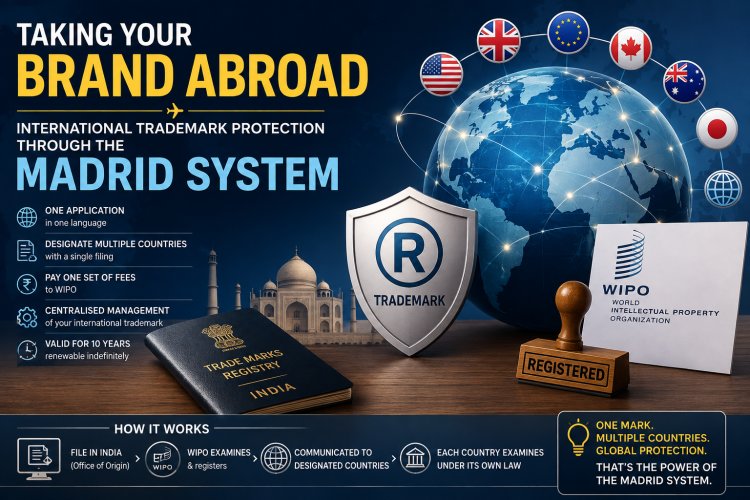
A trademark registered in India is not automatically protected throughout the world. Trademark rights are territorial, meaning that a business generally needs protection in every country where it sells products, provides services or plans to expand.
Filing separate applications in numerous countries can involve different forms, currencies, representatives and procedural requirements. The Madrid System, administered by the World Intellectual Property Organization, provides a centralised method for seeking trademark protection in several jurisdictions.
What Is the Madrid System?
The Madrid System allows an eligible applicant to submit one international application, in one language, and pay a central set of fees while designating the countries in which protection is sought.
However, the Madrid System does not create one universally valid trademark. Each designated country examines the mark under its own domestic law and may accept, limit or refuse protection. WIPO centrally administers the application, but the national trademark offices decide whether rights will be granted within their territories.
India is a member of the Madrid Protocol. The Indian Trade Marks Registry acts as the Office of Origin for Indian applicants seeking foreign protection and as the designated office when an overseas applicant requests protection in India.
Who Can File Through India?
An Indian applicant must possess either:
- a pending Indian trademark application; or
- an Indian trademark registration.
This Indian application or registration is known as the basic application or basic registration.
Section 36D of the Trade Marks Act permits the applicant or registered proprietor to file an international application based upon the Indian mark. The applicant must designate the Madrid System members in which protection is required.
The international application is filed electronically through the Trade Marks International Application System. The Indian Registrar verifies whether the details correspond with the basic Indian application or registration and, if the requirements are satisfied, certifies and forwards it to WIPO’s International Bureau.
What Happens at WIPO?
WIPO examines the application for formal requirements, including classification, applicant details and payment of fees. If the application complies, the mark is entered in the International Register, published and communicated to the trademark offices of the designated countries.
This registration does not mean that protection has been finally granted in every selected country. Each designated office then conducts substantive examination under its national law.
For example, a mark may be accepted in one country but refused in another because it is descriptive in the local language or conflicts with an earlier national trademark.
What Happens When India Is Designated?
When an international registration designates India, the Indian Registrar records and examines it under Indian trademark law.
Sections 9 to 21 of the Trade Marks Act broadly apply to such an application. It may face objections under Sections 9 or 11 and may also be advertised for opposition. If India finds grounds for refusal, the Registrar communicates a provisional refusal through WIPO.
The foreign applicant must then respond according to Indian procedure, usually through an Indian trademark professional with an address for service in India.
The Five-Year Dependency Period
One important limitation is that the international registration remains dependent upon the basic national application or registration for its first five years.
If the Indian basic application is finally refused, withdrawn or cancelled during that period, the international protection may also be cancelled for the corresponding goods or services. This is sometimes called a central attack because one successful challenge to the basic mark can affect protection in several designated countries.
After the five-year period, the international registration generally becomes independent of the basic mark.
Advantages of the Madrid System
The system can reduce paperwork and simplify portfolio management. Changes in ownership, name or address may be recorded centrally. The proprietor may also renew the international registration centrally or later extend protection to additional member countries.
International registrations last for ten years and may be renewed for further ten-year periods.
Limitations and Strategic Risks
The Madrid route is not automatically cheaper in every situation. Fees depend upon the countries and classes selected. Refusals may still require local lawyers, evidence and hearings.
The description of goods and services must also be drafted carefully. It cannot ordinarily extend beyond the basic Indian application. A narrow Indian specification may therefore restrict the scope of the international application.
Businesses should conduct searches in their target markets because registration in India does not establish that the mark is available elsewhere.
<iframe width="560" height="315" src="https://www.youtube.com/embed/8DedtfC0cUY?si=HXwmH-Nhjs0ZJ1dk&start=6" title="YouTube video player" frameborder="0" allow="accelerometer; autoplay; clipboard-write; encrypted-media; gyroscope; picture-in-picture; web-share" referrerpolicy="strict-origin-when-cross-origin" allowfullscreen></iframe>
Conclusion
The Madrid System simplifies the process of seeking trademark protection internationally, but it does not replace national trademark law. It provides one filing and management framework while leaving each country to determine whether protection should be granted.
It is most effective when supported by a clear expansion strategy, carefully drafted specifications and prior searches in every commercially important market.
References
- Trade Marks Act, 1999, Chapter IVA, Sections 36A–36G.
- Trade Marks Rules, 2017, Rules 62–74.
- WIPO, Madrid System—International Trademark Protection.
- WIPO, Guide to the Madrid System International Registration of Marks under the Madrid Protocol.
- Trade Marks Registry, Government of India, International Registration under the Madrid System.