+91 7297051181
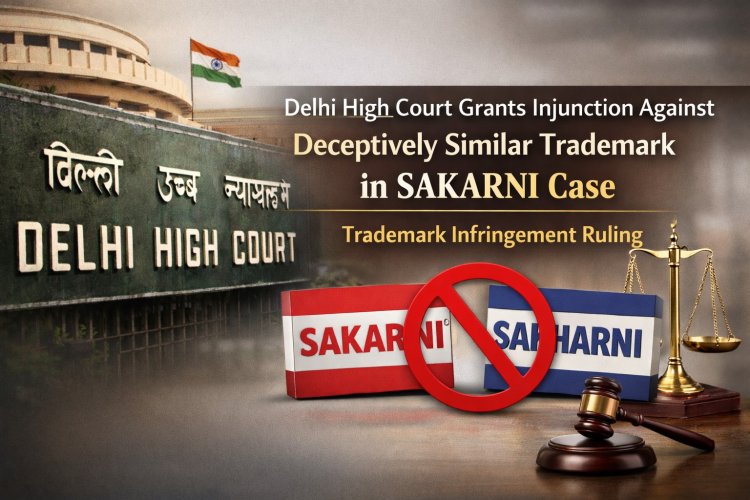
Delhi High Court Grants Injunction Against Deceptively Similar Trademark in SAKARNI Case
The Delhi High Court restrained the use of the mark “SIKARNI” for infringing the registered trademark and copyright of “SAKARNI”. Deciding ex-parte, the Court granted a permanent injunction and awarded damages, reaffirming strict protection against deceptive similarity and dishonest trademark adoption.
Introduction
In a significant ruling reaffirming the protection accorded to registered trademarks and original artistic works, the Delhi High Court in Ashok Kumar Gupta v. Arif Khan (CS(COMM) 608/2023 & I.A. 16670/2023) granted a permanent injunction and awarded damages against a defendant who adopted a deceptively similar mark for identical goods. The judgment highlights the judiciary’s zero-tolerance approach toward dishonest trademark adoption, particularly where the defendant chooses to evade court proceedings. Decided on 28 February 2025 by Hon’ble Mr. Justice Amit Bansal, the case underscores key principles governing trademark infringement, passing off, copyright infringement, and the consequences of ex-parte conduct in commercial intellectual property disputes.
Factual Background of the Case
The plaintiffs in the suit were:
- Ashok Kumar Gupta, proprietor of Jai Durga Plaster Industries
- Sakarni Plaster (India) Pvt. Ltd.
The plaintiffs are engaged in the manufacture and trade of Plaster of Paris, wall putty, and allied construction materials, marketed under the trademark “SAKARNI” and its Hindi version “सकारणी”. The mark has been in continuous and extensive use since 2004 and is registered under Class 19 of the Trade Marks Act, 1999. Over the years, the plaintiffs claimed to have built substantial goodwill and reputation in the market through consistent quality, wide distribution networks, and promotional efforts. The “SAKARNI” mark had come to be uniquely associated with the plaintiffs’ goods among traders and consumers. The dispute arose when the plaintiffs discovered that the defendant, Arif Khan, had started manufacturing and selling identical goods under the mark “SIKARNI” / “सिकारणी”, accompanied by a label that was visually and structurally similar to the plaintiffs’ packaging. The adoption of the mark was alleged to be deliberate, dishonest, and intended to ride upon the plaintiffs’ established reputation.
Nature of the Suit and Reliefs Sought
The plaintiffs instituted a commercial suit before the Delhi High Court seeking multiple reliefs, including:
- Permanent injunction restraining trademark infringement
- Permanent injunction restraining copyright infringement
- Relief against passing off
- Delivery up of infringing goods
- Damages and costs
Despite being duly served with summons, the defendant failed to appear or file a written statement within the statutory timeline. Consequently, the defendant’s right to defend the suit was closed, and the matter proceeded ex-parte.
Issues Before the Court
Given the ex-parte nature of the proceedings, the Court primarily examined whether the plaintiffs had successfully established:
- Trademark infringement under the Trade Marks Act, 1999
- Passing off due to deceptive similarity and prior use
- Copyright infringement in respect of the artistic label
- Entitlement to damages and costs in light of the defendant’s conduct
Trademark Infringement: Deceptive and Phonetic Similarity
The Court found that the defendant’s mark “SIKARNI” was phonetically identical and deceptively similar to the plaintiffs’ registered mark “SAKARNI”. The mere substitution of the letter “A” with “I” and the addition of expressions such as “No.1” were held to be inconsequential.
Justice Amit Bansal observed that:
- The marks were used for identical goods falling under the same class
- The target consumers were ordinary purchasers of construction materials
- The likelihood of confusion or deception was extremely high
The Court reiterated the settled principle that marks must be compared as a whole, and not dissected minutely. When viewed from the perspective of an average consumer with imperfect recollection, the defendant’s mark was clearly capable of misleading the public.
Passing Off: Prior Use and Established Goodwill
On the issue of passing off, the plaintiffs successfully demonstrated:
- Continuous use of the “SAKARNI” mark since 2004
- Trademark registration dating back to 2007
- Extensive commercial presence and goodwill
The Court held that the defendant’s adoption of a deceptively similar mark for identical goods amounted to misrepresentation, calculated to deceive consumers into believing that the defendant’s products originated from or were associated with the plaintiffs. The dishonest intent was inferred from the close similarity of the marks, the identical nature of goods, and the absence of any explanation from the defendant for choosing such a mark.
Copyright Infringement: Protection of Artistic Work
Apart from trademark rights, the plaintiffs were also the registered proprietors of the copyright in the artistic label “SAKARNI PLASTER / SAKARNI”. The defendant’s label was found to be a near replica, incorporating similar font styles, layout, and visual elements.
The Court held that:
- The plaintiffs’ artistic work qualified as an original work under the Copyright Act, 1957
- The defendant’s reproduction amounted to substantial copying
- Such use constituted clear copyright infringement
The overlap between trademark infringement and copyright infringement further strengthened the plaintiffs’ case.
To know more about this, please check the link below.
Ex-Parte Proceedings and Legal Presumptions
Since the defendant failed to appear despite service, the Court proceeded ex-parte and treated the plaintiffs’ pleadings and documentary evidence as admitted. Relying on Satya Infrastructure Ltd. v. Satya Infra & Estates Pvt. Ltd., [2013 (54) PTC 419 (Del)], the Court held that where the plaint is supported by affidavits and documents, and the defendant chooses not to contest, directing ex-parte evidence would serve no meaningful purpose. Accordingly, the suit could be decreed under Order VIII Rule 10 of the Code of Civil Procedure, 1908.
Award of Damages and Costs
A notable aspect of the judgment was the award of INR 1,00,000/- as aggravated damages and costs. The Court relied on the decision in M/s Inter Ikea Systems BV v. Imtiaz Ahamed & Anr., emphasizing that defendants who evade legal proceedings should not be allowed to benefit from such conduct. The damages were awarded not only to compensate the plaintiffs but also to serve as a deterrent against future infringing activities.
Final Reliefs Granted
The Delhi High Court decreed the suit in favour of the plaintiffs and granted the following reliefs:
- Permanent injunction restraining the defendant from using the mark “SIKARNI” or any other deceptively similar mark
- Permanent injunction restraining copyright infringement of the plaintiffs’ artistic label
- Aggravated damages and costs amounting to INR 1,00,000/-
Significance of the Judgment
This decision reinforces several critical principles of Indian trademark law:
- Minor spelling variations do not negate infringement when phonetic similarity exists
- Prior use and goodwill remain decisive in passing off actions
- Ex-parte defendants cannot escape liability by avoiding court proceedings
- Courts will award damages to discourage dishonest commercial practices
For trademark owners, the judgment serves as a reminder of the importance of registration, documentation, and swift enforcement. For infringers, it sends a clear message that imitation and evasion will invite strict judicial consequences.
Conclusion
The ruling in Ashok Kumar Gupta v. Arif Khan is a robust affirmation of intellectual property rights in India. By granting injunctive relief and monetary damages in an ex-parte proceeding, the Delhi High Court demonstrated its commitment to protecting brand integrity and consumer trust. The judgment strengthens the enforcement framework for trademarks and copyrights and contributes meaningfully to India’s growing body of commercial IP jurisprudence.