+91 7297051181
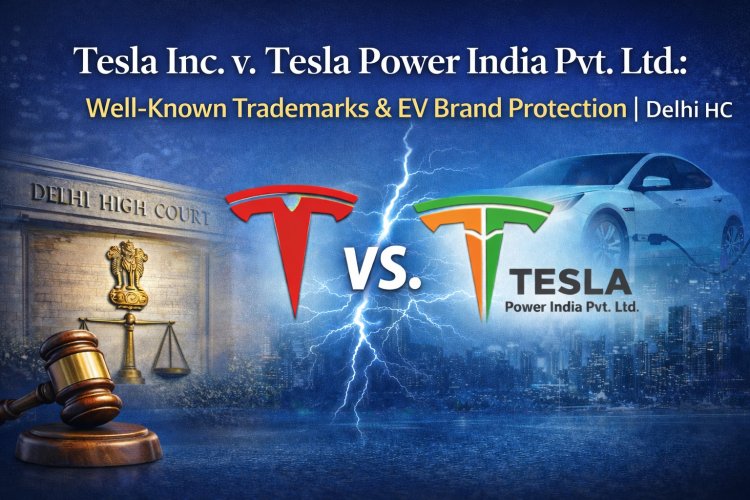
Tesla Inc. v. Tesla Power India Pvt. Ltd.: Well-Known Trademarks & EV Brand Protection | Delhi HC
A detailed analysis of Tesla Inc. v. Tesla Power India Pvt. Ltd. (CS(COMM) 353/2024) examining well-known trademark protection, interim injunctions, brand dilution, and the Delhi High Court’s approach to safeguarding global EV brands under Indian trademark law.
Introduction
The electric vehicle (EV) industry has been at the forefront of innovation and disruption, characterized by rapid advancements, evolving technologies, and intense competition. As companies vie for market attention and consumer loyalty, intellectual property, particularly trademark protection, becomes paramount. The case of “Tesla Inc. v. Tesla Power India Pvt. Ltd.CS (COMM)353/2024”. serves as a crucial example of how established brands protect their trademarks against potential infringers in a globalized economy. This case not only focuses on trademark infringement but also raises critical questions about brand identity, market recognition, and consumer confusion in the context of EVs and associated products.
Case Background
Court and Procedural History
The case was adjudicated by the High Court of Delhi, identified as CS(COMM) 353/2024, under the coram of Hon'ble Mr. Justice Tejas Karia. On November 24, 2025, the court passed an order granting interim injunction on the application for trademark infringement, following a procedural journey that began when Tesla Inc. initiated the commercial suit. Tesla Inc. sought a permanent injunction against Tesla Power India Pvt. Ltd. and others, alleging trademark infringement and passing off with respect to its well-known trademark "TESLA". The court examined various submissions and evidence, including the defendants’ business practices and statements regarding their intentions related to the use of the TESLA mark.
Key Facts
Tesla Inc., recognized as a pioneer in the EV sector, has established a global brand presence since its founding in 2003, with continuous commercial use since 2006. The company's success is underpinned by significant revenue growth, a robust online presence, and multiple trademark registrations across various classes, including those pertinent to automobiles and energy products. On the other hand, the defendants, Tesla Power India Pvt. Ltd., have been operating in the energy sector, specifically focusing on battery products. Despite their disclaimers about not entering the EV market under the TESLA brand, their use of marks that incorporate "TESLA" raised concerns from the plaintiff regarding consumer confusion and potential damage to their brand reputation.
PLANTIFF ‘S TRADE MARKS REEGISTERED IN INDIA ARE AS UNDER:
|
Name |
Registration No. |
Date/Use Claim |
class |
|
TESLA |
IRDI-3318405 |
January 7, 2016 Proposed to be used |
39 |
|
TESLA |
2689306 |
February28,2014 Proposed to be used |
12,36,37 |
|
TESLA |
IRDI-3615907 |
December 21, 2016 Proposed to be used |
42 |
|
|
IRDI-2881361 |
December9,2013 Proposed to be used |
12,25,36,37 |
|
|
3702931 |
December 14, 2017 Proposed to be used |
42 |
|
|
3029514 |
August11,2015 Proposed to be used |
36,37,42 |
|
|
3702936 |
December 14, 2017 Proposed to be used |
37 |
|
|
IRDI-3332559 |
August 11, 2015 Proposed to be used |
9, 37, 42 |
|
|
IRDI-2760695 |
June 5, 2014 Proposed to be used |
12, 25, 36, 37 |


THE TOTAL REVENUE FOR THE YEARS 2008-2023 FROM THE SALE OF THE PRODUCTS AND PROVIDING THE SERVICES FROM THE USE OF THE TRADE MARK ‘TESLA’ IS AS UNDER:
|
Year |
Total Revenue (In US$) (approx.) |
|
2008 |
15 million |
|
2009 |
112 million |
|
2010 |
117 million |
|
2011 |
204 million |
|
2012 |
413 million |
|
2013 |
2 billion |
|
2014 |
3.2 billion |
|
2015 |
4 billion |
|
2016 |
7 billion |
|
2017 |
11.8 billion |
|
2018 |
21.5 billion |
|
2019 |
24.6 billion |
|
2020 |
31.5 billion |
|
2021 |
53.8 billion |
|
2022 |
81.46 billion |
|
2023 |
98.6billion |
THE STATISTICS OF THE ACCESS BY THE USERS OF THE INDIAN SUB-CONTINENT OF THE PLAINTIFF’S WEBSITES IS AS UNDER:
|
Year |
Number of times visited |
|
2016 |
52970 |
|
2017 |
1043574 |
|
2018 |
1105348 |
|
2019 |
1494346 |
|
2020 |
1915906 |
|
2021 |
4470738 |
|
2022 |
2403706 |
|
2023 |
1972816 |
|
2024 (YTD) |
379595 |
Legal Framework for Trademark Protection
- Trademark Registration and Protection in India: Under the Indian Trade Marks Act, 1999, the protection of trademarks is governed by several key provisions. Notably, Sections 28 and 31 confer exclusive rights to the registered trademark owner, providing a basis for legal recourse in cases of infringement. Furthermore, well-known trademarks receive additional protections to prevent dilution and misuse, regardless of the class of goods or services involved.
- Well-Known Marks: A well-known trademark is recognized for its distinctiveness and reputation in the marketplace. In the “Tesla” case, the plaintiff relied on the status of the TESLA mark as a well-known trademark worldwide, claiming its recognition extends to India. This aspect is crucial as it impacts the assessment of confusion among consumers and the likelihood of infringement based on the principles laid out in trademark law.
The Court's Decision
Injunctive Relief and Its Implications
The Delhi High Court's ruling to grant an interim injunction highlights several essential considerations in trademark disputes. The court assessed the likelihood of confusion arising from the defendants' use of similar trademarks and the potential harm to Tesla Inc.'s brand reputation. The defendants had previously acknowledged their non-intention to manufacture or market EVs under the TESLA name, yet the court's decision suggests that their existing use of related marks was deemed sufficiently problematic to warrant legal intervention.
Factors Considered by the Court
Ø Reputation and Use: The court recognized the extensive global and Indian reputation of the TESLA mark. Tesla Inc. presented evidence of its long-standing use and significant investments in building its brand image.
Ø Likelihood of Confusion: The defendants’ marks, including "TESLA POWER" and "TESLA POWER USA", were evaluated against the criteria for likelihood of confusion. The court determined that the use of "TESLA" in combination with other descriptive terms did not sufficiently distinguish the marks.
Ø Intent: The court considered the defendants’ intentions in adopting the TESLA mark, particularly their prior knowledge of Tesla Inc.'s established rights, as a critical factor.
To know more about this, please check the link below.
Implications for Trademark Law and Brand Owners
The outcome of this case carries significant implications for trademark law and brand management, particularly in emerging markets like India, where the EV sector is rapidly expanding. Companies operating within the same industry must be mindful of established trademarks and the legal protections afforded to them.
Reputation Management
For brands aiming for global recognition, establishing a robust intellectual property strategy is essential. This includes proactive efforts to register trademarks and defend them vigorously to prevent unauthorized usage that could tarnish brand reputation.
Navigating a Competitive Landscape
As competition intensifies, especially in sectors like renewable energy and electric mobility, companies must navigate the complexities of trademark law to secure their market positioning. This case exemplifies the importance of legal frameworks in maintaining brand integrity and consumer trust.
Comparative Table of Plaintiff and Defendant Marks
|
Aspect |
Plaintiff: Tesla Inc |
Defendants: Tesla Power India Pvt. Ltd. & Ors. |
|
Core words element |
TESLA
|
TESLA POWER, TESLA POWER USA
AND
|
|
Key Device/Logo |
Stylized TESLA word mark; “T” logo (stylized letter T) |
TESLA POWER USA device with lightning/energy motif and “USA” suffix |
|
Registration Status in India |
Multiple registrations: TESLA word (Reg. No. 2689306, Classes 12, 36, 37); TESLA devices and T logo in Classes 9, 12, 25, 36, 37, 39, 42 |
Applications pending: TESLA POWER (No. 4855017, Class 9) and TESLA POWER USA device (No. 4855802, Class 9). No granted registration for contested marks at time of order. |
|
Goods/Services (Core Overlap) |
Class 12: Automobiles, structural parts of automobiles including EVs. Class 9: Inverters and solar-related energy equipment. Also, EV batteries and battery technologies globally. |
Class 9: Lead-acid batteries for two-wheelers, four-wheelers, trucks; inverters; UPS; water purifiers/filters; battery rejuvenation services. |
|
Territorial Use Claimed |
Global use including India (trans-border reputation; physical presence and imports since around 2010; Indian subsidiary for EV and energy operations). |
Extensive use claimed in India since 2020; markets allegedly in Asia, Middle East and Africa; no actual client base in USA despite “USA” suffix. |
|
Adoption Story |
Name chosen in 2003 inspired by inventor Nikola Tesla; used consistently for EV and clean energy business. |
Conflicting explanations: acronym for “THE ENERGY STORAGE on Leased ASSETS” and homage to Nikola Tesla’s work. |
|
Domains |
tesla.com (official global website) |
teslapowerusa.com, teslapowerusa.in, teslapowerusa.ae, teslahealthylife.com |
|
Court’s View on Dominant Feature |
TESLA is distinctive and identifies plaintiff, especially in EV and battery space. |
TESLA is dominant and identical to plaintiff’s mark; “POWER” and “USA” are descriptive and insufficient to avoid confusion. |
|
Outcome at Interim Stage |
Recognized as prior user and proprietor of TESLA marks with goodwill and trans-border reputation; granted broad interim protection. |
Restrained from using TESLA or TESLA POWER / TESLA POWER USA and related logos/trade names for EVs, all automotive lead-acid batteries, inverters and UPS, as well as from using plaintiff’s TESLA logos, pending final disposal. |


Conclusion
The case of “Tesla Inc. v. Tesla Power India Pvt. Ltd. CS (COMM)353/2024” serves as a pivotal reminder of the critical role that trademark protection plays for businesses, particularly in dynamic sectors like electric vehicles. The High Court of Delhi's interim injunction reflects the judiciary's commitment to safeguarding well-known brands and ensuring that consumer interests are protected from confusion and deception. In an age where brands are increasingly challenged by new entrants and innovative products, the case highlights the need for vigilance, proactive trademark management, and a thorough understanding of the legal landscape surrounding intellectual property. As Tesla Inc. continues to expand its footprint in India, the outcomes of this case will undoubtedly influence how both established and emerging brands strategize to protect their identity and market share.