+91 7297051181
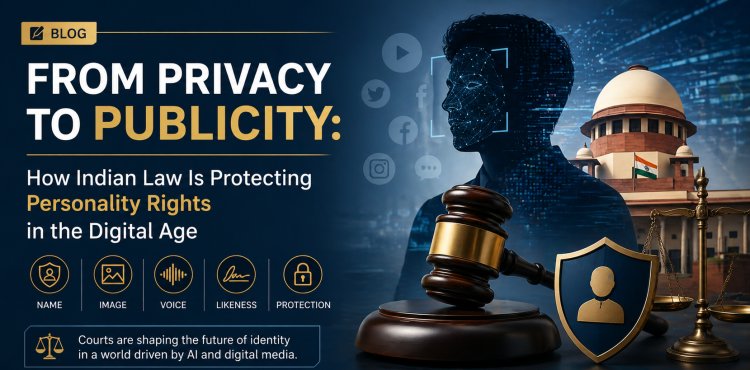
From Privacy to Publicity: How Indian Law Is Protecting Personality Rights in the Digital Age
In the age of artificial intelligence, deepfakes, and viral social media content, the boundaries of identity and reputation are increasingly under threat. This blog explores the evolving concept of personality rights in India, examining how courts are stepping in to protect an individual’s name, image, and likeness from unauthorized use. With a focus on the recent Delhi High Court ruling in favour of Sanjiv Goenka, the article highlights a significant shift in Indian jurisprudence—extending legal protection beyond traditional celebrities to business figures and addressing the challenges posed by AI-generated content. It further analyses the delicate balance between personality rights and freedom of speech, while identifying key legal gaps and future implications. This piece offers a comprehensive yet accessible insight into one of the most dynamic and rapidly developing areas of Indian law.
Introduction
In an era where a person’s face can be superimposed onto another’s body, their voice cloned, and their persona manipulated within seconds, the law is being forced to confront a new frontier. The rapid proliferation of artificial intelligence, deepfakes, and viral social media content has made identity itself vulnerable to misuse. What was once limited to celebrity endorsements and unauthorized advertisements has now expanded into memes, parody videos, and synthetic media capable of causing real reputational harm.
Against this backdrop, the recent decision of the Delhi High Court granting protection to the personality rights of Sanjiv Goenka marks a significant step in Indian jurisprudence. The case underscores a growing judicial recognition that personality is not merely an abstract concept but a legally protectable asset. It also raises critical questions about the balance between freedom of speech and the right to control one’s identity.
This article examines the concept of personality rights in India, traces their legal evolution, and analyses the implications of the Goenka ruling in the digital age.
Understanding Personality Rights
Personality rights, often referred to as publicity rights, protect an individual’s control over the commercial and reputational use of their identity. This includes elements such as name, image, likeness, voice, signature, and other distinctive attributes.
Unlike defamation, which focuses on false statements harming reputation, personality rights address unauthorized use—even if the content is not strictly defamatory. Similarly, while the right to privacy protects personal autonomy, personality rights extend to the economic and proprietary value attached to one’s persona.
In essence, personality rights operate at the intersection of privacy, property, and intellectual property law. They recognize that an individual’s identity—particularly that of a public figure—can hold significant commercial value and must be protected against exploitation.
Legal Framework in India
India does not yet have a codified statute exclusively governing personality rights. Instead, the doctrine has evolved through judicial interpretation, drawing from constitutional principles and common law remedies.
The primary constitutional basis lies in Article 21 of the Constitution of India, which guarantees the right to life and personal liberty. Over time, the Supreme Court has interpreted this provision to include the right to privacy and dignity, thereby providing a foundation for personality rights.
Courts have also relied on principles of tort law, particularly misappropriation and passing off, to address unauthorized use of identity. In certain cases, analogies have been drawn from intellectual property law, treating personality as a form of proprietary interest.
This fragmented yet dynamic framework has enabled courts—especially the Delhi High Court—to develop a robust body of jurisprudence protecting personality rights in the absence of legislation.
Landmark Judgments Shaping Personality Rights
The evolution of personality rights in India has been largely driven by judicial precedents.
In ICC Development (International) Ltd. v. Arvee Enterprises, the Delhi High Court recognized that the right of publicity vests in an individual and cannot be claimed by an event organizer. This case laid the foundation by distinguishing between commercial rights of events and personal identity rights.
The Madras High Court, in Shivaji Rao Gaikwad v. Varsha Productions, upheld the personality rights of actor Rajinikanth, restraining the unauthorized use of his persona in a film. The court emphasized that a celebrity’s identity carries economic value and deserves protection.
More recently, in Amitabh Bachchan v. Rajat Nagi, the Delhi High Court granted a sweeping injunction protecting Amitabh Bachchan’s name, image, voice, and likeness. The court even directed intermediaries to remove infringing content, signalling a proactive approach toward enforcement.
These cases collectively establish that personality rights are enforceable, inheritable in some contexts, and adaptable to new forms of media.
The Sanjiv Goenka Case: A Turning Point
The case involving Sanjiv Goenka represents a significant expansion of personality rights jurisprudence.
Goenka approached the Delhi High Court alleging misuse of his identity through memes, morphed images, and AI-generated content circulating widely on social media. Much of this content, linked to cricket-related discussions, depicted him in a distorted and potentially damaging manner.
Recognizing the urgency of the matter, the court granted an ex parte ad-interim injunction. It held that Goenka had established a prima facie case and that continued circulation of such content could cause irreparable harm to his reputation.
Importantly, the court restrained the unauthorized use of his name, likeness, and persona across platforms and directed intermediaries to take down infringing content.
This ruling is notable for several reasons. First, it extends personality rights protection beyond traditional celebrities such as actors and athletes to include business personalities. Second, it explicitly addresses the challenges posed by AI-generated content and deepfakes. Third, it reinforces the role of courts in providing swift remedies in the digital ecosystem.
Personality Rights vs Freedom of Speech
One of the most complex aspects of personality rights is their intersection with the fundamental right to freedom of speech and expression under Article 19(1)(a).
Not all use of a person’s identity is unlawful. Satire, parody, and commentary—especially in matters of public interest—are essential components of democratic discourse. Courts must therefore distinguish between legitimate expression and exploitative or harmful misuse.
The key lies in proportionality. Content that is clearly transformative, humorous, or in public interest may be protected. However, when the use of identity becomes misleading, commercially exploitative, or maliciously damaging, it may cross the line into illegality.
The Goenka case highlights this tension. While memes are often considered harmless, the court recognized that large-scale dissemination of manipulated content can have serious consequences, particularly when amplified by technology.
Impact of AI, Deepfakes, and Digital Media
The emergence of artificial intelligence has fundamentally altered the landscape of personality rights.
Deepfake technology enables the creation of hyper-realistic but entirely fabricated content. Voices can be cloned, faces swapped, and actions simulated with alarming accuracy. This not only increases the risk of reputational harm but also complicates enforcement.
Traditional legal remedies, which relied on identifiable defendants and static content, are often inadequate in a digital environment characterized by anonymity and rapid dissemination.
Courts are increasingly acknowledging these challenges. The Goenka ruling reflects a willingness to adapt legal principles to contemporary realities, including holding intermediaries accountable for hosting infringing content.
However, the absence of a comprehensive statutory framework remains a significant gap. As technology continues to evolve, the law must keep pace to ensure effective protection.
Challenges and Grey Areas
Despite judicial progress, several challenges persist.
First, the lack of codification creates uncertainty. Different courts may adopt varying standards, leading to inconsistent outcomes.
Second, the definition of a “public figure” remains unclear. While celebrities and prominent individuals are obvious candidates, the extension of personality rights to businesspersons raises questions about the scope of protection.
Third, enforcement in the digital space is inherently difficult. Content can be replicated, modified, and redistributed across jurisdictions, making complete removal nearly impossible.
Finally, there is a risk of overreach. Excessive protection of personality rights could stifle creativity, satire, and legitimate public discourse, leading to a chilling effect on free speech.
The Road Ahead
The future of personality rights in India lies in a balanced and structured approach.
There is a pressing need for legislation that clearly defines the scope, limitations, and enforcement mechanisms of personality rights. Such a framework should address emerging technologies, platform liability, and cross-border issues.
Courts will continue to play a crucial role in shaping the doctrine, but legislative intervention can provide much-needed clarity and consistency.
For individuals and organizations, the message is clear: identity is a valuable asset, and its misuse can have serious legal consequences. Proactive measures, including monitoring and timely legal action, are essential in safeguarding personality rights.
Conclusion
The recognition of personality rights in India reflects an evolving understanding of identity in the modern world. No longer confined to physical presence, a person’s persona now exists across digital platforms, vulnerable to manipulation and misuse.
The Delhi High Court’s decision in favour of Sanjiv Goenka is a timely reminder that the law must adapt to protect individuals in this new reality. It reinforces the principle that while freedom of expression is vital, it cannot come at the cost of dignity and reputation.
As India navigates the complexities of the digital age, personality rights will undoubtedly remain at the forefront of legal discourse—shaping the balance between innovation, expression, and individual protection.