+91 7297051181
Haldiram v. Punjab Trading: U.S. Trademark Infringement & Gray Market Goods Explained
An analysis of Haldiram India (P) Ltd. v. Punjab Trading, Inc., a U.S. trademark dispute involving unauthorized imports and materially different gray-market goods. Explore FDA compliance, preliminary injunction standards, and key principles of brand protection under U.S. trademark law.
Introduction
In the realm of international trade and commerce, cases involving trademark infringements often set important precedents. One such case is Haldiram India (P) Ltd. v. Punjab Trading, Inc., which unfolded in the United States District Court for the Western District of Washington. The outcome not only reflects the complexities faced by businesses in protecting their brands but also illustrates the legal principles that guide these disputes.
Case Overview
The case, filed under case number 2:25-cv-01462-LK, was presided over by Judge Lauren King. Haldiram India, a well-renowned manufacturer and distributor of Indian-style snack foods, stood as the plaintiff. The defendant, Punjab Trading, Inc., was accused of engaging in trademark infringement and unfair competition.
Ø Haldiram: A Leader in Snack Foods
Haldiram India has positioned itself as a key player in the snack food industry, earning its reputation through the development, manufacturing, and distribution of various Indian snack foods. The company's commitment to quality is underscored by its compliance with stringent FDA requirements for the U.S. market. Haldiram holds several U.S. trademarks, including:
1. Reg. No. 2766286 for “ ”- covering processed nuts, preserved fruits and vegetables, and related products.
2. Reg. No. 2357883 for “”- encompassing a line of candy and baked goods.
3. Reg. No. 1963956 for “ ” - concerning snack mixes primarily composed of crackers, pretzels, and candy.
Haldiram's exclusive distributor in the U.S. is Reshmi’s Group, Inc., which operates across Washington, Oregon, Idaho, Alaska, and Montana.
Causes of Action
The plaintiff raised three primary claims against Punjab Trading, including:
Ø Federal Trademark Infringement under 15 U.S.C. § 1114.
Ø Federal Unfair Competition and False Designation of Origin under 15 U.S.C. § 1125(a).
Ø Common Law Unfair Competition.
These claims were lodged following the discovery that Punjab Trading was not authorized to import or distribute Haldiram products, leading to a default judgment after their failure to respond to the legal proceedings.
Factual Background
Products with Regional Differences
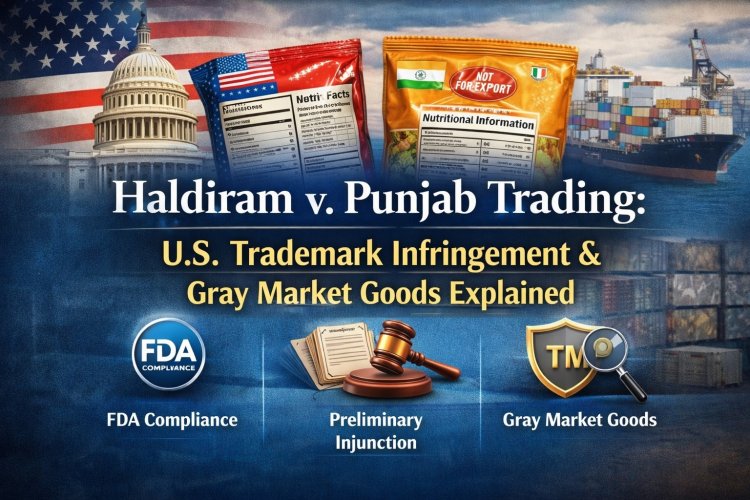
A key aspect of this case centers on the product versions manufactured by Haldiram. The company produces different formulations and packaging for the Indian and U.S. markets. U.S. products meet FDA requirements with appropriate “Nutrition Facts” labels, while products for the Indian market have “Nutritional Information” panels that do not conform to U.S. standards. For example, the Kaju Mixture showcases these differences: the U.S. version has 12% cashews, whereas the Indian counterpart features 10% cashews along with local spices and artificial colouring agents absent in the U.S. version. These variations illustrate the need for compliance with local regulations and consumer preferences.
Discovery of Unauthorized Goods
The case took a serious turn when Reshmi employees recognized Haldiram's products marked “NOT FOR EXPORT” in a customer’s vehicle back in July 2024. They traced these products back to Punjab Trading, leading to an investigation that revealed numerous unauthorized Haldiram products being sold in the Seattle area. The inspection revealed that Punjab Trading was selling products that displayed temporary “Nutrition Facts” stickers placed over noncompliant nutritional panels. The alterations made to the labels were unauthorized by Haldiram, breaching trademark laws and showing blatant disregard for consumer safety.
Pre-suit Communications
Prior to filing the lawsuit, Haldiram attempted to communicate with Punjab Trading. On August 29, 2024, Haldiram sent an initial correspondence with no response. A cease-and-desist letter was sent in October 2024, to which Punjab Trading responded by denying any intent to act as a distributor and claiming ignorance of import restrictions. They even requested a meeting to discuss proper channels pertaining to distribution. However, these communications failed to resolve the issue, prompting Haldiram to file a formal complaint on August 4, 2025.
Motion for Preliminary Injunction
Following the filing of the complaint, Haldiram sought an Ex Parte Application for Temporary Restraining Order and an Order to Show Cause regarding a preliminary injunction. Although the court denied the temporary restraining order due to procedural delays, they required Punjab Trading to show cause regarding the preliminary injunction. Throughout the proceedings, Punjab Trading's lack of engagement became apparent. Their motion for an extension was deemed improper, no counsel ever appeared for them, and a default judgment was entered due to their inaction.
To know more about this, please check the link below.
Legal Standards Applied
Ø Preliminary Injunction Test: The court employs several legal standards when issuing preliminary injunctions, focusing on:
a) Likelihood of success on the merits: Whether the plaintiff is likely to win the case.
b) Likelihood of irreparable harm: The potential harm to the plaintiff if the injunction isn’t granted.
c) Balance of equities: Whether the benefits of the injunction outweigh any harms it might cause the defendant.
d) Public interest: Whether granting the injunction serves the public interest.
In this case, the court determined that a prohibitory injunction was necessary to maintain the status quo by preventing Punjab Trading from importing and selling unauthorized Haldiram products in the U.S. market.
Ø Trademark Principles: A crucial aspect of trademark law is that registrations on the Principal Register provide prima facie evidence of a trademark's validity and rights. In the context of gray-market goods—products manufactured abroad and imported without the consent of the trademark owner—such goods are only considered non-infringing if they are “genuine,” meaning not materially different from U.S.-authorized products. The threshold for material differences is relatively low and focuses on factors relevant to consumer perceptions and preferences. This case brings several precedents into focus, such as Hokto Kinoko Co. v. Concord Farms, Inc., 738 F.3d 1085, 1092 (9th Cir. 2013), and Societe Des Produits Nestle, S.A. v. Casa Helvetia, Inc., 982 F.2d 633, 638 (1st Cir. 1992), which evaluate how material differences influence the likelihood of consumer confusion.
Conclusion
The case of Haldiram India (P) Ltd. v. Punjab Trading, Inc. encapsulates the complexities involved in protecting trademarks and the repercussions of non-compliance with trademark laws. With a granted preliminary injunction, Haldiram aims to safeguard its brand integrity and maintain the quality and consistency of its products in the United States. As businesses increasingly navigate the global market, understanding the legal framework around trademark infringement becomes essential. Companies must not only comply with international laws but also remain vigilant against unauthorized distribution and counterfeiting, ensuring that they protect their name, reputation, and consumer trust. This case is a powerful reminder that intellectual property rights are invaluable and that infringement, intentional or not, can lead to significant legal consequences. As the market for imported goods continues to expand, vigilance and adherence to trademark laws will be paramount for companies wishing to thrive without compromising their brand integrity.