+91 7297051181
Delhi High Court Upholds Patanjali “Gonyle” Trademark: Key Takeaways from a Landmark Trademark Dispute
The Delhi High Court has upheld Patanjali’s “Gonyle Floor Cleaner” trademark, rejecting a rectification plea by Holy Cow Foundation. The judgment clarifies principles of prior use, deceptive similarity, evidentiary credibility, and the significance of house marks under Indian trademark law.
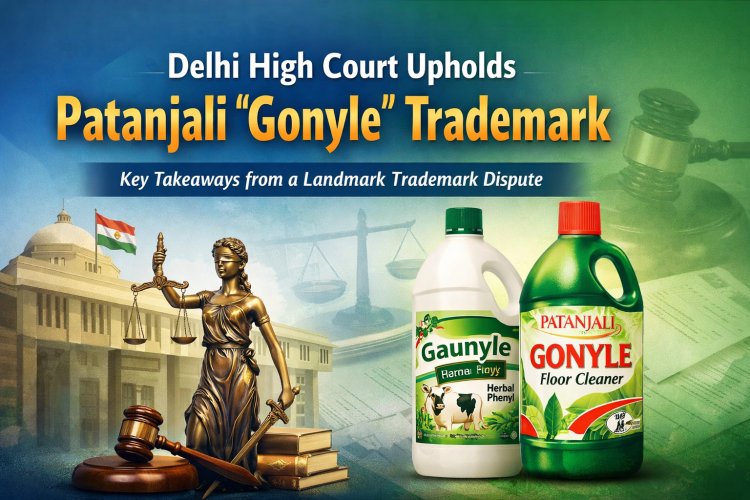
Delhi High Court Upholds Patanjali “Gonyle” Trademark: A Detailed Legal Analysis
In an important ruling reinforcing the fundamentals of Indian trademark law, the Delhi High Court has dismissed a rectification petition filed against Patanjali Gramodyog Nyas, thereby upholding the registration of its trademark “Patanjali Gonyle Floor Cleaner.” The judgment, delivered by Justice Tejas Karia on 9 January 2026, provides valuable clarity on issues such as prior use, deceptive similarity, evidentiary standards, and the role of house marks in trademark disputes.
Background of the Dispute
The case arose from a rectification petition filed by Holy Cow Foundation, an NGO that claimed rights over the mark “Gaunyle.” The petitioner contended that it had been using the mark since 2013 for cow-urine-based floor cleaning products and alleged that Patanjali’s “Gonyle” mark was deceptively similar, both phonetically and conceptually.
On this basis, the petitioner sought removal of Patanjali’s trademark from the register under relevant provisions of the Trade Marks Act, 1999, arguing that the registration was wrongly granted and likely to cause consumer confusion.
Timeline and Priority of Applications
A critical aspect examined by the Court was the priority of trademark applications:
-
Patanjali Gramodyog Nyas filed its trademark application for “Gonyle” in August 2015
-
Holy Cow Foundation filed its application for “Gaunyle” later, in December 2015
Even at the threshold level, this chronology favoured Patanjali. However, the petitioner attempted to override this by asserting prior use, which required strict proof.
Court’s Scrutiny of Prior Use Evidence
The High Court subjected the petitioner’s documents to close scrutiny. Several invoices and records produced to establish prior use were found to be internally inconsistent and unreliable, with dates that did not align logically with the claimed period of use.
The Court observed that in rectification proceedings, mere assertions are insufficient. The burden lies heavily on the petitioner to establish continuous, bona fide, and verifiable commercial use of the mark. In this case, the documentary evidence failed to meet that standard, severely undermining the petitioner’s claim.
TO know more about this you can follow the ;link below:
Assessment of Deceptive Similarity
Addressing the allegation of deceptive similarity, the Court reiterated settled law: trademarks must be compared as a whole, and not dissected in isolation.
While acknowledging some phonetic resemblance between “Gaunyle” and “Gonyle,” the Court emphasized that Patanjali’s product is always marketed with the prominent and well-known house mark “Patanjali.” This significantly alters the overall commercial impression of the mark.
The Court held that an average consumer of floor cleaning products, exercising ordinary caution, is unlikely to be confused when the product clearly bears the Patanjali brand identity, which enjoys widespread recognition across India.
Importance of the House Mark Doctrine
A key legal principle reinforced by this judgment is the house mark doctrine. The Court recognized that the presence of a strong, distinctive, and well-established house mark can decisively reduce the likelihood of confusion, even where the product name shares similarities with another mark.
In Patanjali’s case, the word “Patanjali” was not incidental or minor—it was the dominant feature of the mark and packaging. This weighed heavily in the Court’s conclusion that deception or confusion was improbable.
Rectification Standards under the Trade Marks Act
The High Court also clarified that rectification under Sections 9, 11, and 57 of the Trade Marks Act is not automatic. A petitioner must demonstrate that the mark was registered contrary to law or that it unjustly remains on the register.
Given the lack of credible prior use evidence, absence of deceptive similarity in overall impression, and Patanjali’s earlier application date, the Court found no valid grounds to interfere with the registration.
Final Decision
The Delhi High Court dismissed the rectification petition, upheld the validity of the “Patanjali Gonyle Floor Cleaner” trademark, and ordered that the mark shall remain on the Register of Trade Marks, with no order as to costs.
Why This Judgment Matters
This ruling serves as a strong reminder that:
-
Prior use claims must be supported by credible and consistent evidence
-
Phonetic similarity alone is insufficient to prove deceptive similarity
-
Well-known house marks enjoy enhanced protection
-
Rectification proceedings demand a high evidentiary threshold
For brand owners, startups, and IP practitioners, the judgment underscores the importance of early trademark filings, accurate record-keeping, and strong brand identity.