+91 7297051181
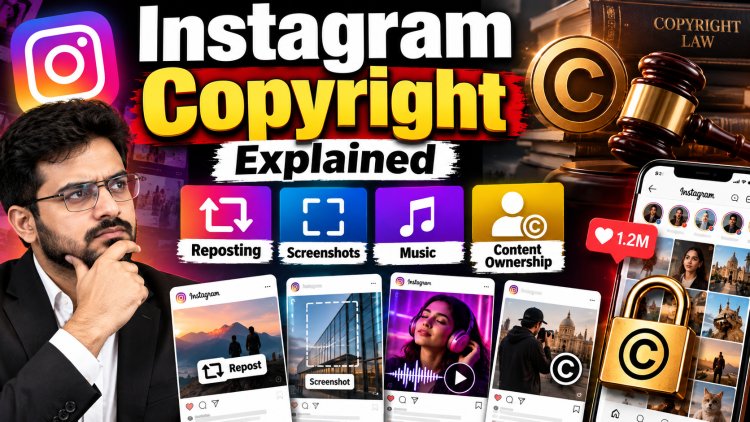
Instagram Copyright Explained: Reposting, Screenshots, Music & Content Ownership
1. Introduction
Social media has transformed the way creative content is created, shared and consumed. A photograph can reach thousands of people within hours, a short video can be reposted across multiple accounts, and an original caption can be copied and reproduced almost instantly.
This ease of sharing, however, often creates a common misconception: if something is publicly available on social media, anyone can freely use it.
That is generally not how copyright law works.
A post being publicly visible does not automatically mean that it is in the public domain. A photograph uploaded to Instagram, a video posted on YouTube or a graphic shared on another social platform may remain protected by copyright even though anyone can view it.
Visibility and ownership are two different concepts.
The fact that a photograph can be downloaded, copied or screenshotted does not, by itself, establish a legal right to reproduce or commercially exploit it.
This distinction has become increasingly important because social-media platforms make copying technically easy, while copyright law continues to regulate the rights attached to original creative works.
2. Copyright Protection for Original Social-Media Content
Social-media users can create copyright-protected works directly through their online activities.
Depending on the applicable legal requirements, copyright protection may extend to:
-
Photographs;
-
Illustrations;
-
Original videos;
-
Written content;
-
Music;
-
Graphics; and
-
Other original creative works.
Uploading content to a social-media platform does not ordinarily mean that the creator has transferred ownership of the copyright to every other user of the platform.
Social-media platforms may obtain certain contractual rights or licences from users so that they can host, display, distribute or technically process uploaded content.
However, that relationship should not automatically be interpreted as permission for an unrelated third party to download the same work and use it commercially.
For example, if a photographer uploads an original photograph to a social-media account, another business cannot necessarily download that photograph and use it in an advertisement simply because the photograph was publicly accessible.
The source and scope of the permission are important.
3. Reposting, Copying and Giving Credit
Reposting another person's work can raise copyright concerns depending upon the manner in which the material is used.
A common misconception is:
“If I give credit to the creator, I can use the content.”
Attribution is important, but credit alone does not necessarily amount to copyright permission.
Before reposting or reproducing content, a user should consider whether the particular use is authorised through:
-
A platform's built-in sharing feature;
-
A copyright licence;
-
Direct permission from the copyright owner;
-
The creator's stated terms; or
-
An applicable statutory exception.
There can also be an important difference between using an official platform feature to share a post and downloading the original file and uploading it independently to another account.
The technical method of sharing may affect the legal and contractual analysis.
Therefore, giving credit and obtaining permission are not always the same thing.
4. Screenshots, Memes and Copyright
Screenshots may appear simple, but they can contain several forms of copyright-protected expression.
A screenshot might include:
-
A photograph;
-
Written content;
-
Artwork;
-
Graphics;
-
Illustrations; or
-
Other creative material.
Similarly, memes frequently combine existing copyrighted material with newly created text or graphics.
The fact that a meme has been modified does not automatically eliminate copyright concerns.
For example, a user may create an original caption but place that caption over a photograph belonging to another creator.
The legal analysis therefore requires identifying:
-
What material was taken?
-
Who owns that material?
-
How much of the original work was used?
-
What is the purpose of the new use?
-
Was permission obtained?
-
Does a statutory exception apply?
A final image looking different from the original does not, by itself, answer these questions.
5. Short-Form Videos and Music
Music has become an integral part of short-form social-media content.
Platforms may have agreements or licences allowing users to incorporate certain music into content within the platform. However, users should not automatically assume that such permission extends to every commercial or off-platform use.
For example, music available through a platform's library may be permitted for certain forms of user-generated content while requiring separate permission for:
-
Commercial advertising;
-
Films;
-
Brand campaigns;
-
External distribution; or
-
Other forms of exploitation.
Music can also involve multiple layers of rights.
A single musical track may involve rights relating to the musical composition as well as the sound recording.
Therefore, creators and businesses should examine the exact scope of the relevant licence before using music for commercial campaigns.
6. Influencers and Commercial Social-Media Content
Influencer marketing can create additional copyright considerations because a single campaign may involve content from several different sources.
For example, an influencer's post may contain:
-
A brand-provided product photograph;
-
An original photograph created by the influencer;
-
Stock imagery;
-
Music;
-
Graphics; and
-
A video clip created by another person.
Each component may have a different owner and different licensing conditions.
A written agreement between the brand, influencer and agency can help establish:
-
Who owns the content;
-
Who is responsible for obtaining permissions;
-
Where the content can be used;
-
How long it can be used;
-
Whether it can be reused for advertisements; and
-
Whether the brand can modify or repurpose the content.
This becomes particularly important when a successful social-media post is later converted into a website advertisement, paid campaign, printed material or another commercial asset.
7. User-Generated Content and Copyright Ownership
Social-media platforms contain enormous amounts of user-generated content.
The fact that content has been created by an ordinary social-media user rather than a professional media organisation does not automatically mean that it is free to use.
An individual photograph, video, illustration or written work may have its own copyright owner.
A platform may have contractual permission to host or display that content, but that does not necessarily give every third-party account permission to download and commercially reproduce it.
This distinction becomes particularly important when user-generated content becomes commercially valuable.
For example, an ordinary post may later be:
-
Used in advertising;
-
Included in a commercial compilation;
-
Featured in promotional material; or
-
Reproduced by a business.
Before reusing such content, the intended user should identify a lawful basis for the reuse, such as appropriate permission, a suitable licence, a platform mechanism or an applicable statutory exception.
8. Copyright Notices, Takedowns and Online Disputes
If a creator discovers that their work has been used without authorisation, it is important to preserve relevant evidence before the content is deleted or modified.
Useful evidence may include:
-
Screenshots;
-
Original files;
-
URLs;
-
Account names;
-
Publication dates;
-
Copies of the disputed content; and
-
Relevant correspondence.
Social-media disputes can develop rapidly. A post may be deleted, an account may change its username, or the same content may appear on multiple platforms.
Preserving evidence can therefore help establish:
-
What the original work looked like;
-
Where the allegedly infringing content appeared;
-
How it was used; and
-
When the relevant use occurred.
Platforms may also provide copyright reporting or takedown procedures. However, a platform's internal decision is not necessarily the same as a final judicial determination of copyright ownership or infringement.
9. Public Domain and Creative Commons Content
Not every work found online is protected in the same way.
Some works may be in the public domain, while others may be made available under licences such as Creative Commons.
These concepts should not be confused with ordinary social-media content.
A public-domain work may generally be used without obtaining copyright permission, subject to other applicable laws.
Creative Commons works, on the other hand, generally remain protected by copyright but are made available under specific licence conditions.
Depending on the particular licence, the user may need to comply with conditions relating to:
-
Attribution;
-
Commercial use;
-
Modification;
-
Distribution; or
-
Other specified restrictions.
Therefore, users should verify the actual status and applicable licence instead of assuming that online material is “free to use.”
10. Copyright and Brand Collaborations
Social-media collaborations between creators and businesses can involve multiple layers of copyright ownership.
A campaign may include:
Photographs + Videos + Graphics + Music + Captions + Promotional Content
The parties should clearly determine who owns each component and what permissions have been granted.
For example, a creator may retain copyright in an original photograph even if a brand has paid for the campaign, unless the agreement provides otherwise.
A well-drafted collaboration agreement can specify:
-
Ownership;
-
Platforms where content may be published;
-
Duration of use;
-
Geographic scope;
-
Commercial purposes;
-
Advertising rights;
-
Editing rights; and
-
Future reuse.
Clear contractual terms can reduce disputes when successful social-media content is later adapted for advertisements, websites, print campaigns or other marketing purposes.
11. Content Moderation and Copyright Complaints
Social-media platforms receive large numbers of copyright complaints and may use both automated systems and human review to identify potentially infringing content.
Automated systems may detect matching:
-
Audio;
-
Videos;
-
Images; or
-
Other digital material.
However, automated identification does not necessarily provide a final answer regarding copyright ownership or infringement.
Mistaken copyright claims can affect legitimate content, while inadequate enforcement can leave creators without effective control over their work.
Users who receive a copyright complaint should therefore understand the basis of the complaint and review the applicable platform procedure before responding.
The creator's legal rights and the platform's contractual enforcement process are related, but they are not necessarily the same legal question.
12. Practical Checklist for Social-Media Users
Before using someone else's content online, ask the following questions:
1. Who created the content?
Identify the original creator or copyright owner wherever possible.
2. Is the work protected by copyright?
Do not assume that publicly available content is copyright-free.
3. Do I have permission?
Check whether the creator has granted a licence or direct permission.
4. Am I using an official sharing feature?
Sharing through a platform's own functionality may differ from downloading and independently re-uploading content.
5. Is there a relevant statutory exception?
Consider whether an applicable exception permits the particular use.
6. Is the content being used commercially?
Commercial use may require closer examination of the applicable licence and rights.
7. Does the content contain multiple copyrighted works?
Photographs, music, videos, graphics and written material may have different rights holders.
8. Can I prove my own ownership?
Creators should preserve original files and records showing their creation and use of the work.
13. What Creators Should Do to Protect Their Content
Creators can take practical steps to strengthen their ability to manage and enforce their rights.
They should consider maintaining:
-
Original files;
-
Dated drafts;
-
Metadata where available;
-
Publication records;
-
Contracts;
-
Licence agreements;
-
Campaign documents;
-
Screenshots of unauthorised use; and
-
Records of commercial exploitation.
Creators should also clearly communicate licensing terms where they want to control how their content is reused.
For businesses and influencers, written agreements can be particularly useful because they establish who owns the content and what each party is permitted to do with it.
14. The Bigger Picture: Copyright in the Social-Media Era
Social media has not eliminated copyright.
Instead, it has moved copyright decisions into everyday online activity.
The basic questions remain:
Who created the work?
Who owns the rights?
How is the work being used?
What permission exists?
Does a statutory exception apply?
The technology may make copying instantaneous, but the underlying copyright relationship remains relevant.
A photograph posted publicly can still belong to its creator. A video uploaded online can still be protected. A song available inside an application may still be subject to licensing restrictions.
Understanding these distinctions helps creators protect their work and helps users avoid treating the internet as a copyright-free environment.
https://youtu.be/GrTs_5IIjg4?si=HEHiWzZhsYCDmFDB
Conclusion
Social media has made the creation and distribution of creative content faster than ever before. At the same time, it has made copyright issues part of everyday online behaviour.
Public visibility does not automatically mean public ownership.
Reposting, screenshots, memes, music, influencer campaigns and user-generated content can all involve different copyright considerations.
The safest approach is to identify the copyright owner, understand the nature of the intended use, check the applicable permission or licence and consider whether a statutory exception applies.
For creators, maintaining evidence of ownership and use can be equally important. For businesses and influencers, clear licensing and collaboration agreements can prevent disputes over commercial content.
Ultimately, social-media copyright disputes are still copyright disputes. The platform may change how content is shared, but it does not automatically remove the rights of the person who created or owns the work.