+91 7297051181
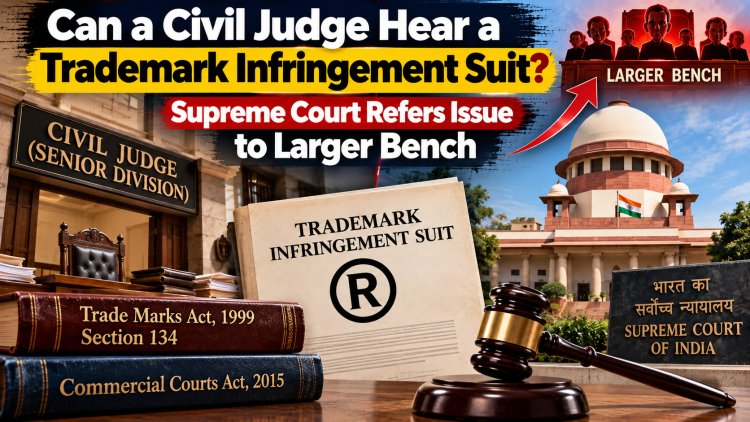
Can a Civil Judge Hear a Trademark Infringement Suit? Supreme Court Refers Issue to Larger Bench
Trademark Jurisdiction in India | Section 134 Trade Marks Act | Commercial Courts Act 2015 | Supreme Court Trademark Case 2026
The Supreme Court of India has referred an important trademark jurisdiction issue to a larger Bench, concerning the relationship between Section 134 of the Trade Marks Act, 1999 and the Commercial Courts Act, 2015.
In I.S.D.S. Private Limited & Anr. v. M/s Khemka Food Products Pvt. Ltd. & Anr., by order dated 21 September 2026, the Supreme Court considered whether a Civil Judge (Senior Division) notified as a Commercial Court can entertain a trademark infringement suit when Section 134 of the Trade Marks Act provides that such a suit cannot be instituted before a court inferior to a District Court.
The issue arose from Jharkhand, where Civil Judges (Senior Division) had been notified as Commercial Courts for disputes falling within specified pecuniary limits.
Rather than finally deciding the jurisdiction question, the Supreme Court found that earlier authorities appeared to require reconsideration and directed that the matter be placed before the Chief Justice of India for constitution of an appropriate larger Bench.
The pending commercial suit before the Civil Judge (Senior Division)-I, Jamshedpur was also stayed.
I.S.D.S. v. Khemka Food Products: What Is the Case About?
Trademark litigation usually focuses on issues such as:
-
Trademark infringement;
-
Passing off;
-
Deceptive similarity;
-
Prior use;
-
Consumer confusion; and
-
Trademark ownership.
However, the I.S.D.S. v. Khemka Food Products matter raises a different but equally important question:
Which court has jurisdiction to hear a trademark infringement suit?
The issue is significant because the court in which a suit is instituted can affect the entire litigation process, including the applicable procedure and appellate remedy.
The Supreme Court was therefore required to examine the interaction between the Trade Marks Act, 1999 and the Commercial Courts Act, 2015.
Section 134 of the Trade Marks Act, 1999 Explained
Section 134 of the Trade Marks Act, 1999 contains a special jurisdictional provision concerning suits relating to infringement of registered trademarks and certain connected reliefs.
The provision states, among other things, that such a suit cannot be instituted in a court inferior to a District Court having jurisdiction to try the suit.
This statutory language becomes important when it is considered alongside the Commercial Courts Act.
The Commercial Courts Act creates a specialised framework for commercial disputes and permits the establishment or designation of Commercial Courts in accordance with the statutory scheme.
The central question is therefore whether a Civil Judge who has been notified as a Commercial Court can exercise jurisdiction over a trademark infringement suit despite the language of Section 134.
How Did the Trademark Jurisdiction Dispute Arise in Jharkhand?
The issue arose in Jharkhand, where certain Civil Judges (Senior Division) had been notified as Commercial Courts.
These courts were given commercial jurisdiction within specified pecuniary limits.
A trademark infringement suit was pending before the:
Civil Judge (Senior Division)-I, Jamshedpur
The appellants questioned whether this court could legally entertain the trademark dispute.
Their argument was based primarily on Section 134 of the Trade Marks Act, which provides that a trademark infringement suit cannot be instituted before a court inferior to a District Court.
This created the central jurisdictional question that ultimately reached the Supreme Court.
What Was the Appellants’ Argument?
The appellants argued that Section 134 of the Trade Marks Act should continue to govern the forum for trademark infringement suits.
According to the argument recorded by the Supreme Court, Section 134 was enacted to ensure that infringement and related trademark disputes are dealt with by a District Court.
The appellants therefore contended that merely designating a Civil Judge (Senior Division) as a Commercial Court should not remove or dilute the specific jurisdictional requirement contained in the Trade Marks Act.
In other words, the argument was that:
Special jurisdiction under the Trade Marks Act → District Court requirement
could not simply be overridden by a notification designating a lower-level judicial officer as a Commercial Court.
Why Does the Appellate Structure Matter?
The dispute is not limited to the question of which judge hears the case at the first instance.
The appellate consequences are also important.
The appellants pointed out that if a trademark infringement suit were initially heard by a Civil Judge (Senior Division) acting as a Commercial Court, an appeal could potentially lie to the District Court under the Commercial Courts framework.
This raised questions regarding the subsequent role of the High Court.
The appellants argued that such an arrangement could affect the ordinary appellate structure available in trademark litigation and potentially leave the High Court's role primarily within its supervisory or revisional jurisdiction.
Thus, the issue has implications beyond the filing of the original suit.
What Was the Respondents’ Position?
The respondents relied upon the framework of the Commercial Courts Act, 2015.
The Commercial Courts Act was enacted to provide a specialised and efficient mechanism for resolving commercial disputes.
Intellectual property disputes, including trademark disputes, fall within the category of commercial disputes contemplated by the statutory framework.
From this perspective, once a Civil Judge (Senior Division) is validly notified as a Commercial Court and given jurisdiction over specified commercial disputes, such a court may exercise the commercial jurisdiction assigned to it.
The competing arguments therefore required the Supreme Court to examine how the two statutory frameworks operate together.
Supreme Court Examines Earlier Decisions
During the hearing, the Supreme Court considered previous decisions dealing with the interaction between special statutes and the Commercial Courts Act.
The order referred to decisions including:
-
Kandla Export Corporation v. OCI Corporation
-
Jaycee Housing Private Limited v. Registrar General, Orissa High Court
The Bench observed that the earlier authorities appeared to raise questions requiring authoritative consideration by a larger Bench.
Instead of resolving the issue within the two-Judge Bench, the Supreme Court therefore directed that the question be placed before the appropriate larger Bench.
Supreme Court Order Dated 21 September 2026
On 21 September 2026, a Bench comprising:
Justice J.B. Pardiwala
and
Justice K. Vinod Chandran
granted leave and directed that the matter be placed before the Chief Justice of India for constitution of an appropriate larger Bench.
Importantly, the Supreme Court did not finally decide the jurisdiction question in this order.
The Court instead recognised the need for an authoritative determination of the apparent conflict between the relevant statutory provisions and earlier judicial decisions.
This distinction is important.
The September 2026 order is therefore a reference order, not a final judgment establishing a universal jurisdictional rule.
What Is the Jharkhand Pecuniary Jurisdiction Issue?
Another important aspect of the matter concerns the pecuniary jurisdiction of Commercial Courts in Jharkhand.
According to the material considered by the Court, Civil Judges (Senior Division) notified as Commercial Courts had jurisdiction over specified commercial disputes valued between:
₹3 lakh and ₹1 crore.
This creates an interesting jurisdictional question.
If a trademark infringement dispute falls within the specified pecuniary range, could it be heard by a Civil Judge (Senior Division) acting as a Commercial Court?
Or does Section 134 of the Trade Marks Act independently require the suit to be instituted before a District Court?
The answer to this question has potentially significant consequences for trademark litigation in Jharkhand and potentially for the interpretation of similar statutory arrangements elsewhere.
Why Is This Supreme Court Trademark Case Important?
The I.S.D.S. v. Khemka Food Products case is significant because jurisdiction is not merely a procedural technicality.
The court where a suit is filed can influence:
-
The trial process;
-
Interim applications;
-
Evidence;
-
Case management;
-
Appeals;
-
Supervisory jurisdiction; and
-
Overall litigation strategy.
For trademark owners operating across multiple States, uncertainty regarding the appropriate forum can create additional litigation risks.
A uniform interpretation of Section 134 and the Commercial Courts Act could therefore provide greater clarity for trademark owners, businesses and legal practitioners.
Section 134 vs Commercial Courts Act: What Is the Core Legal Question?
The dispute can essentially be understood through two statutory frameworks.
Section 134 of the Trade Marks Act
It provides a special forum requirement for certain trademark infringement and related suits and refers to a District Court having jurisdiction.
Commercial Courts Act, 2015
It creates a specialised system for commercial disputes and provides for the establishment or designation of Commercial Courts.
The Question
The Supreme Court is being asked to determine how these provisions should operate when a Civil Judge (Senior Division) has been designated as a Commercial Court with jurisdiction over commercial disputes within a specified pecuniary range.
The larger Bench will be required to provide authoritative guidance on this interaction.
Does a Commercial Court Automatically Have Jurisdiction Over Trademark Suits?
The September 2026 Supreme Court order does not finally answer this question.
That is precisely why the matter has been referred to a larger Bench.
The answer may depend upon the interpretation of:
-
Section 134 of the Trade Marks Act;
-
The Commercial Courts Act;
-
The relevant State notification;
-
The pecuniary jurisdiction involved; and
-
Earlier Supreme Court authorities concerning the interaction between special statutes and the Commercial Courts framework.
Until the larger Bench settles the issue, practitioners need to examine the applicable statutory provisions and State-specific notifications carefully.
Impact on Trademark Infringement Suits
The jurisdiction question could have practical implications for how trademark infringement suits are instituted.
Before filing a trademark infringement case, lawyers and brand owners may need to examine:
-
Whether the dispute qualifies as a commercial dispute;
-
The valuation of the suit;
-
The court's territorial jurisdiction;
-
The applicable State notification concerning Commercial Courts;
-
Section 134 of the Trade Marks Act;
-
The applicable appellate mechanism; and
-
Relevant binding judicial precedents.
This makes jurisdictional analysis an important part of trademark litigation strategy.
Why Correct Trademark Jurisdiction Matters
For a trademark owner, filing a case in the wrong forum can result in unnecessary procedural complications.
Jurisdictional objections can potentially affect:
-
Interim injunction applications;
-
Service of proceedings;
-
Evidence;
-
Trial proceedings;
-
Transfer applications;
-
Appeals; and
-
Litigation timelines.
Therefore, forum selection should be addressed at the beginning of trademark litigation, rather than after substantial proceedings have already taken place.
Is This a Final Supreme Court Judgment?
No.
This is one of the most important points about the I.S.D.S. v. Khemka Food Products case.
The order dated 21 September 2026 is a reference to a larger Bench.
The Supreme Court has not finally determined the universal rule governing the interaction between Section 134 of the Trade Marks Act and the Commercial Courts Act.
The Court directed that the issue be placed before the Chief Justice of India for constitution of an appropriate larger Bench.
The pending Commercial Suit No. 11 of 2023 before the Civil Judge (Senior Division)-I, Jamshedpur was stayed pending further consideration.
Therefore, the final legal position remains to be settled by the larger Bench.
What Should Trademark Lawyers and Businesses Watch?
Until the larger Bench gives its decision, practitioners dealing with trademark infringement litigation should carefully verify:
1. State-Specific Notifications
Commercial Court structures may differ depending upon the relevant State notification.
2. Pecuniary Jurisdiction
The monetary valuation of the commercial dispute can determine which Commercial Court has jurisdiction under the applicable framework.
3. Section 134
The special jurisdictional language of the Trade Marks Act must be considered independently.
4. Appellate Route
Lawyers should examine where an appeal from the relevant Commercial Court would lie.
5. Existing Supreme Court Precedents
Earlier decisions concerning the interaction between special statutes and the Commercial Courts Act remain relevant until the larger Bench settles the issue.
Key Takeaways from I.S.D.S. v. Khemka Food Products
1. Trademark jurisdiction is now before a larger Bench
The Supreme Court has referred the jurisdiction question for authoritative consideration.
2. Section 134 of the Trade Marks Act is central
The provision contains a specific forum requirement concerning trademark infringement suits.
3. Commercial Court designation creates an important legal question
The case concerns whether a Civil Judge (Senior Division) notified as a Commercial Court can entertain a trademark infringement suit despite Section 134.
4. The appellate structure is also relevant
The issue involves not only the trial court but also the potential route of appeal.
5. Jharkhand's pecuniary framework is important
The notified jurisdiction of Civil Judges (Senior Division) as Commercial Courts forms part of the factual background.
6. The September 2026 order is not the final answer
The Supreme Court has referred the matter to a larger Bench rather than finally deciding the jurisdiction issue.
7. Practitioners should examine State-specific rules
Until the larger Bench decides the issue, lawyers should carefully consider the applicable State notifications and statutory provisions before filing trademark litigation.
https://youtu.be/LQ7a1zNPyeE?si=ekdZ3Uragh-MX7HK
Conclusion
The I.S.D.S. v. Khemka Food Products Supreme Court case brings an important procedural issue to the forefront of Indian trademark litigation.
Unlike conventional trademark disputes involving deceptive similarity, infringement, passing off or prior use, this matter focuses on a fundamental litigation question:
Which court has jurisdiction to hear a trademark infringement suit?
The apparent interaction between Section 134 of the Trade Marks Act, 1999 and the Commercial Courts Act, 2015 has significant implications for trademark practitioners and businesses.
The Supreme Court's decision to refer the issue to a larger Bench indicates the need for an authoritative interpretation that can provide consistency regarding the appropriate forum and appellate structure.
For now, the September 2026 order should not be treated as a final determination of the jurisdictional issue.
Until the larger Bench settles the question, trademark practitioners should carefully examine the Trade Marks Act, Commercial Courts Act, applicable State notifications, pecuniary jurisdiction and existing precedents before instituting infringement proceedings.
The eventual larger-Bench decision may provide important guidance on the jurisdiction of Commercial Courts in trademark infringement litigation across India.
Case Details
Case Name: I.S.D.S. Private Limited & Anr. v. M/s Khemka Food Products Pvt. Ltd. & Anr.
Court: Supreme Court of India
Order Date: 21 September 2026
Proceeding: Civil Appeal arising from SLP(C) No. 6793 of 2026
Issue: Jurisdiction in Trademark Infringement Suits
Key Provision: Section 134, Trade Marks Act, 1999
Related Legislation: Commercial Courts Act, 2015
Pending Suit: Commercial Suit No. 11 of 2023
Court Below: Civil Judge (Senior Division)-I, Jamshedpur