+91 7297051181
International Barcodes & GS1 Standards Guide for USA, UAE & UK Businesses
Learn why international GS1 barcodes like UPC-A and EAN-13 are essential for businesses in the USA, UAE, and UK. This detailed guide explains GTINs, barcode registration, compliance, inventory control, and global trade readiness.
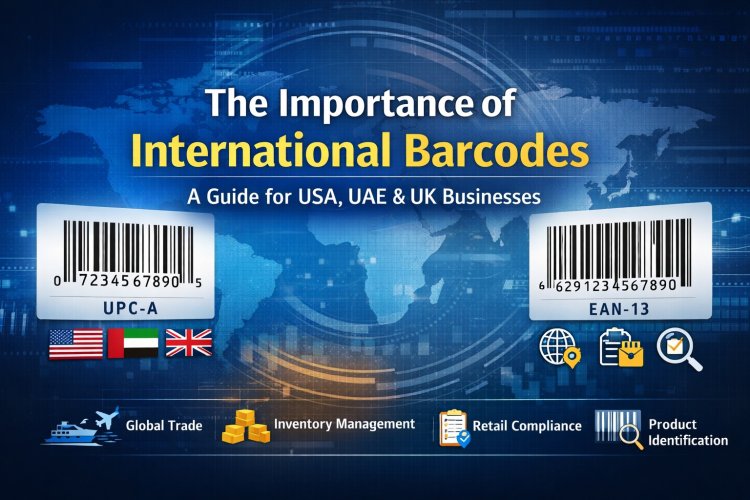
Introduction
In today’s global market, the efficient movement of goods across borders is vital for success. One fundamental component of this process is the use of barcodes, particularly those governed by the Global Standards One (GS1) organization. With barcode systems like the 12-digit UPC-A primarily adopted in the USA and the 13-digit EAN-13 being the standard in the UK and UAE, understanding these systems can significantly enhance your business's operational capabilities. This blog will delve into the specifics of international barcodes, their importance, and how to implement them effectively in your business practices.
Understanding Barcode Standards
Barcodes are unique strings of numbers accompanied by specific patterns that can be scanned and recognized by machines at points of sale, warehouses, and during shipping. In the USA, the Universal Product Code (UPC) is the most commonly used system, primarily adhering to the 12-digit UPC-A format. In contrast, most other countries, including the UK and UAE, primarily utilize the 13-digit European Article Number (EAN), specifically EAN-13.
These barcodes serve three main purposes: to uniquely identify products, streamline operations, and facilitate consumer interactions. For example, in the USA, barcodes often begin with the prefixes 00-19, while in the UK, the prefix 50 might be common, and the UAE utilizes 629. These prefixes help in identifying the country of origin and the goods associated with it.
Contact our barcode experts at +91 729705118 and +91 8949793519.
The Role of GS1
The GS1 is the global organization responsible for managing barcode standards. By registering with your local GS1 member organization, such as GS1 US, GS1 UK, or GS1 UAE, you can obtain unique barcode prefixes that represent your business. This uniqueness is crucial for identifying your products globally and ensuring that they meet international acceptance criteria.
Steps to Obtain Barcodes
1. Register with GS1: Start by contacting your local GS1 member organization. Each region has specific requirements, but generally, you must apply for a company prefix that aligns with your business’s identity.
2. Obtain GTINs: Once registered, you’ll receive Global Trade Item Numbers (GTINs) for your products. These numbers are essential for creating the actual barcode that will be printed on your product packaging.
3. Create Barcodes: With your GTINs ready, you can generate the barcode images (UPC or EAN-13). Many online tools are available for this purpose, ensuring that your barcodes meet the standard requirements.
Benefits of GS1 Barcodes
Implementing GS1 barcodes offers numerous advantages, particularly for businesses operating in the competitive markets of the USA, UAE, and UK. Below are some critical benefits:
1. Streamlined International Operations
Global Interoperability: GS1 barcodes are recognized and accepted worldwide, allowing your products to be easily scanned and identified by retailers and distributors irrespective of the geographic location. This universal acceptance is essential as it eliminates the need for different codes for different regions, simplifying international trade.
Faster Market Entry: Leading online marketplaces such as Amazon and eBay require GTINs for listing products. Complying with these requirements is essential for securing your place in competitive marketplaces across the USA, UAE, and UK.
Simplified Logistics and Export: Having a standardized identification system greatly simplifies customs procedures. This streamlining facilitates efficient logistics management, ensuring your products avoid unnecessary delays.
2. Enhanced Efficiency and Accuracy
Improved Inventory Management: Barcodes enable real-time tracking of inventory throughout the supply chain. This real-time visibility helps to avoid costly stockouts or overstocking situations, ensuring that products are available when and where they are needed.
Reduction in Errors: Automated data capture minimizes the inaccuracies that often accompany manual data entry. Implementing barcode systems ensures greater accuracy in pricing, inventory records, and order fulfillment.
Increased Speed: Scanning barcodes accelerates various processes, including checkout at retail points of sale, warehouse operations, and data entry tasks. This increased efficiency correlates directly with lower labor costs and improved customer satisfaction.
3. Building Brand Credibility and Consumer Trust
Unique Product Identification: Each product variant receives a unique GTIN, fostering trust among trading partners and consumers. This distinct identification helps prevent the sale of counterfeit products, ultimately protecting your brand’s reputation.
Enhanced Visibility and Traceability: Barcodes support end-to-end traceability from manufacturing to consumer, which is critical for effective product recalls and quality control. This transparency builds confidence in your brand, particularly in industries where trust is paramount.
Better Consumer Experience: Consumers can employ smartphone apps to scan barcodes, accessing detailed product information such as origin, ingredients, or expiration dates. This accessibility empowers consumers with information, reinforcing brand loyalty.
Contact our barcode experts at +91 729705118 and +91 8949793519.
Preparing for Barcode Registration
In preparation for obtaining barcodes, certain prerequisites are typically necessary, particularly when registering after 2026. While the specific documentation may vary by country, the following core requirements are often applicable across the USA, UAE, and UK:
1. Core Business Requirements
Proof of Business Entity: You must provide legal documentation for your business. This can include a Trade License in the UAE, a Certificate of Incorporation in the UK, or proof of a registered proprietorship or partnership.
Contact Information: A valid business address, official email, and a designated authorized contact person must be included in the application. This ensures that GS1 can effectively communicate with you regarding your registration and barcoding needs.
Sales Turnover Proof: GS1 often utilizes your business's annual turnover to determine membership fees. Prepare recent financial statements, balance sheets, or turnover statements to fulfill this requirement.
2. Product-Related Documentation
It’s crucial to have detailed information about the products you intend to barcode. This includes:
- Product descriptions
- Categories and subcategories
- Variants of products (size, color, etc.)
This information will assist GS1 in assigning the appropriate GTINs based on your product lines.
Conclusion
In an increasingly interconnected world, the importance of adopting international barcode standards cannot be overstated. Using GS1-managed barcodes, such as UPC-A and EAN-13, not only aids in compliance with global retail demands but also makes logistical operations much more manageable.
The advantages, ranging from improved inventory management to enhanced brand credibility—demonstrate that investing in an efficient barcode system is essential for businesses wanting to thrive in the diverse markets of the USA, UAE, and UK. By embracing these standards, businesses can ensure seamless operations, increased efficiency, and overall success in today's thriving global marketplace.
Contact our barcode experts at +91 729705118 and +91 8949793519.