+91 7297051181
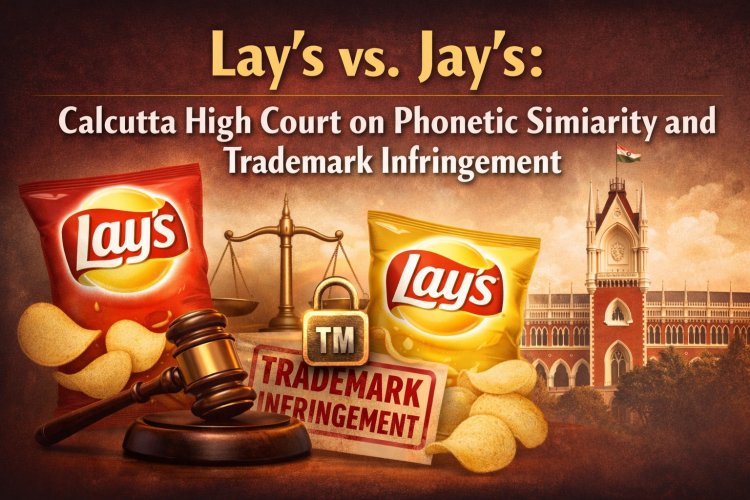
Lay’s vs. Jay’s: Calcutta High Court on Phonetic Similarity and Trademark Infringement
This blog analyses the Calcutta High Court’s decision in Pepsico, Inc. v. Jagdamba Foods Pvt. Ltd. (IPDATM/210/2023), reaffirming that minor phonetic variations like “LAY’S” and “JAY’S” cannot bypass trademark law, and highlighting key principles of deceptive similarity, goodwill, and brand protection under the Trade Marks Act, 1999.
INTRODUCTION
Intellectual property rights play a crucial role in the global economy, providing a framework for businesses to protect their innovations and brands. The case of “Pepsico, Inc. v. Jagdamba Foods Pvt. Ltd.IPDATM/210/2023” serves as a pertinent reminder of the importance of trademark law in safeguarding a company's identity. Pepsico, a global leader in the beverage and snack industry, sought legal recourse against Jagdamba Foods for what it alleged was a clear case of trademark infringement. The heart of the dispute lies in the similarity between Pepsico's well-known brand, LAY'S, and Jagdamba Foods' registered mark, JAY'S. This judgment not only addresses issues of deceptive similarity but also reinforces the principles enshrined in the Trade Marks Act, 1999.
MATERIAL FACTS
Pepsico, Inc., a prominent multinational company with a vast portfolio of popular snack and beverage brands, has utilized the LAY'S trademark since its initial adoption in 1938. Over the decades, the mark has gained substantial recognition and goodwill, particularly in markets like India, where Pepsico has been selling LAY'S products since 1965. The mark has been registered in India since July 31, 1992, further solidifying its protection under the law. In stark contrast, Jagdamba Foods Pvt. Ltd. applied for the registration of the mark JAY'S in Nepal in 2015, focusing on similar snack products. Although the company operates in Nepal rather than India, Pepsico argued that the registration of JAY'S in India was misleading and violated Pepsico's trademark rights. The case revolves around the interpretation of the Trade Marks Act, particularly Sections 9 and 11(b), which address absolute and relative grounds for refusal of trademark registration.
KEY LEGAL PROVISIONS
The court's deliberation was centered on several significant provisions of the Trade Marks Act, 1999:
1. Section 9: Addresses absolute grounds for refusal of registration, which includes marks that are devoid of distinctive character.
2. Section 11(b): Pertains to relative grounds for refusal, primarily focusing on the likelihood of confusion among consumers due to similarity with an existing trademark.
3. Section 47: Provides for the removal of a trademark from the register if it has been misused or is otherwise not entitled to registration.
4. Section 57: Allows for the cancellation or variation of a trademark, providing a mechanism to rectify the register.
“In applying these provisions, the court was tasked with determining whether JAY'S was deceptively similar to LAY'S and if its registration was warranted under the law”.
To knore more about this, you can follow the below link:
COURT'S ANALYSIS
The court undertook a thorough comparison of the marks, focusing on their visual and phonetic characteristics. A key element in trademark disputes is the likelihood of consumer confusion. The court highlighted the inherent phonetic similarity between LAY'S and JAY'S, suggesting that they could easily be mispronounced or confused by the average consumer. This phonetic resemblance becomes especially pivotal in the context of snack foods, where sound and brand recall are critical for customer retention.Additionally, the court referenced established case law, emphasizing that a close similarity in marks can suffice to establish infringement, regardless of differences in packaging or other branding elements. The precedents set by cases such as “Kaviraj Pandit Durga Dutt Sharma v. Navaratna Pharmaceutical Laboratories” and “K.R. Chinna Krishna Chettiar v. Shri Ambal Co.” were instrumental in shaping the court's conclusions.
ARGUMENTS PRESENTED
The petitioner presented compelling arguments surrounding the strong reputation and longstanding usage of the LAY'S mark. Pepsico's counsel emphasized that LAY'S had acquired distinctiveness and was synonymous with high-quality snack foods, leading to substantial commercial success and brand loyalty. On the other hand, Jagdamba Foods' inability to represent themselves in court left Pepsico's assertions largely unchallenged. The respondent's absence raised questions regarding their intentions in seeking the JAY'S mark and whether it was an attempt to ride on the goodwill developed by Pepsico over decades.
CONCLUSION
The judgment delivered by the High Court at Calcutta marks a monumental moment in trademark law. By ruling in favor of Pepsico, the court underscored the importance of protecting well-established trademarks from deceptive similar registrations that may confuse consumers.This case illustrates how vital it is for companies to remain vigilant about their intellectual property rights and the potential risks posed by similar trademarks, especially in competitive markets. The principles established in this ruling will undoubtedly serve as a point of reference in future trademark disputes in India. As the landscape of intellectual property continues to evolve with the expansion of global trade, this judgment will resonate within the legal community and among corporations looking to defend their brand identities against unauthorized usage. The insights garnered from “Pepsico, Inc. v. Jagdamba Foods Pvt. Ltd. IPDATM/210/2023” will aid both legal practitioners and businesses in navigating the complexities of trademark law and reinforce the necessity of registering and protecting intellectual property.
“In an age where branding is paramount, companies must recognize the importance of existing legal frameworks, ensuring thorough due diligence to safeguard their marks against potential infringements and preserve their hard-earned reputations in the marketplace”.