+91 7297051181
Trademark Infringement Explained: Identical Marks, Phonetic Similarity & Consumer Confusion
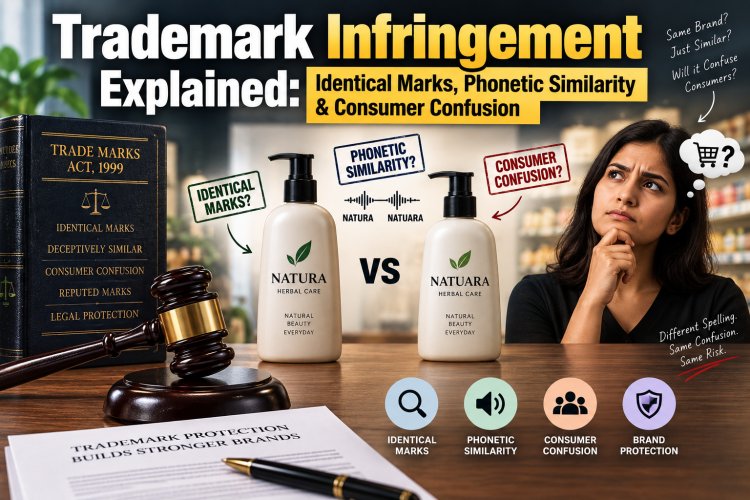
What Is Trademark Infringement in India?
Trademark infringement does not occur only when one business copies another brand exactly word-for-word. In India, a registered trademark can be infringed in several different circumstances, depending on the similarity between the marks, the goods or services involved, and the manner in which the trademark is being used.
The primary statutory provision governing trademark infringement in India is Section 29 of the Trade Marks Act, 1999.
Section 29 contains different categories of infringement. As a result, determining whether a particular use amounts to trademark infringement requires more than simply comparing two brand names.
The legal analysis may involve questions such as:
-
Are the two trademarks identical?
-
Are they deceptively similar?
-
Are the goods or services identical or similar?
-
Is there a likelihood of consumer confusion?
-
Do the trademarks sound similar even if they are spelled differently?
-
Does the registered trademark have a reputation in India?
-
Does the defendant's use fall within any statutory limitation?
Understanding these factors is essential for businesses seeking to protect their trademarks in India.
Identical Trademark and Identical Goods
The most straightforward form of trademark infringement arises when a person uses a trademark that is identical to the registered trademark in relation to identical goods or services, subject to the statutory requirements.
Section 29(1) provides the basic framework for this category of infringement.
For example, if Brand A owns a registered trademark for a particular class of goods and another business uses the exact same trademark for the same goods in the course of trade, the use may fall within Section 29(1).
However, trademark infringement is not limited to such obvious cases.
The more difficult disputes usually arise when the defendant changes the spelling, pronunciation, appearance or some other element of the trademark.
What Is Deceptive Similarity in Trademark Law?
A trademark does not have to be identical to another trademark to create legal problems.
A mark may be considered deceptively similar where its overall resemblance is such that it may create confusion or association in the minds of consumers, depending on the applicable statutory provision and circumstances.
Indian courts generally avoid treating trademark comparison as a purely technical exercise.
Instead, the marks are considered from the perspective of the relevant consumer and the commercial circumstances in which the trademarks are encountered.
This is particularly important because consumers do not always carefully analyse every letter or design element before making a purchase.
Trademark Similarity: Why the Overall Impression Matters
One of the fundamental principles in trademark disputes is that trademarks should generally be compared as a whole.
In Parle Products (P) Ltd. v. J.P. & Co., (1972) 1 SCC 618, the Supreme Court emphasised the importance of considering the overall similarity between competing marks.
This means that a defendant cannot necessarily avoid a trademark dispute merely by pointing out small differences between two marks.
For example, changing:
-
One or two letters;
-
The font;
-
The arrangement of words;
-
A minor graphic element; or
-
Another relatively small feature
may not necessarily eliminate the possibility of confusion if the overall impression remains sufficiently similar.
The assessment depends on the facts of the individual case.
What Factors Determine Trademark Similarity?
The Supreme Court's decision in Cadila Health Care Ltd. v. Cadila Pharmaceuticals Ltd., (2001) 5 SCC 73 is an important authority concerning deceptive similarity.
The Court identified various factors that may be relevant when determining whether competing trademarks are deceptively similar.
These include:
1. Nature of the Trademarks
The court may examine whether the marks are word marks, device marks, composite marks or otherwise.
2. Degree of Resemblance
The resemblance may be visual, phonetic or conceptual.
3. Nature of the Goods
The products or services associated with the trademarks are important to the analysis.
4. Similarity in the Character and Performance of the Goods
The way the relevant goods are used and their characteristics may be considered.
5. Class of Purchasers
The court may consider who purchases the products and the level of attention ordinarily exercised by those consumers.
6. Mode of Purchase
The circumstances in which consumers encounter and purchase the goods may also be relevant.
7. Other Surrounding Circumstances
The court can consider the broader commercial circumstances of the dispute.
Therefore, trademark similarity is not determined by looking at the two marks in isolation.
Can Two Trademarks Be Similar Even If They Are Spelled Differently?
Yes.
Phonetic similarity can be highly relevant in trademark disputes.
Two trademarks may have different spellings but sound sufficiently similar when pronounced.
For example, a consumer may hear a brand name through:
-
A verbal recommendation;
-
A telephone conversation;
-
An advertisement;
-
A salesperson; or
-
Word-of-mouth communication.
The fact that the spelling is different does not automatically mean that there is no likelihood of confusion.
This is particularly relevant in India because trademarks may be encountered across different languages, accents and pronunciation patterns.
Therefore, businesses should consider both visual similarity and phonetic similarity when selecting and clearing a new trademark.
Why Consumer Confusion Matters in Trademark Infringement
At the heart of many trademark disputes is the question of consumer perception.
A trademark is intended to distinguish the goods or services of one business from those of another. If a competing mark is sufficiently similar, consumers may mistakenly believe that the products:
-
Come from the same business;
-
Are connected with the trademark owner;
-
Are licensed by the trademark owner; or
-
Have some other commercial association with the trademark proprietor.
This is why trademark law looks beyond the literal spelling of two marks.
The court may consider how an ordinary consumer with imperfect recollection is likely to perceive the competing trademarks in the real marketplace.
Does the Nature of the Product Matter?
Yes.
The nature of the goods and services can significantly influence the analysis.
The Supreme Court in Cadila Health Care Ltd. v. Cadila Pharmaceuticals Ltd. highlighted the importance of considering the nature of the goods and the class of purchasers.
This is particularly important where the consequences of confusion may be serious.
For example, pharmaceutical trademarks can raise specific concerns because consumers may confuse products with similar names, particularly where the products have different compositions or purposes.
The assessment, however, is not limited to pharmaceutical products. The nature of the relevant goods and purchasing circumstances must be considered in each case.
Section 29(2): Similar Marks and Similar Goods or Services
Section 29(2) of the Trade Marks Act, 1999 deals with situations where the allegedly infringing mark is identical with or similar to the registered trademark and the relevant goods or services are identical with or similar to those for which the trademark is registered.
The provision incorporates the concept of likelihood of confusion or association.
This means that the analysis can involve two connected questions:
How similar are the trademarks?
and
How similar are the goods or services?
The interaction between these factors is important when determining whether the statutory requirements for infringement are satisfied.
Section 29(3): Presumption of Confusion
The Trade Marks Act also provides a specific statutory presumption in certain circumstances.
Under Section 29(3), where the relevant statutory conditions concerning identical or similar marks and goods or services are satisfied, the law provides a presumption regarding the likelihood of confusion.
This provision is important because it demonstrates that the Act does not treat every trademark dispute in exactly the same way.
The applicable legal test depends upon the particular category of use falling within Section 29.
Can a Trademark Be Infringed Even for Different Goods?
In certain circumstances, yes.
Trademark law provides additional protection for reputed trademarks.
Section 29(4) addresses certain uses of a registered trademark in relation to goods or services that are not similar to those for which the trademark is registered, provided the statutory requirements are satisfied.
Among other requirements, the registered trademark must have a reputation in India, and the use must fall within the circumstances relating to unfair advantage or detriment contemplated by the provision.
This type of protection is often discussed in the context of trademark dilution.
The concern is not necessarily limited to immediate confusion about the source of goods. It can also involve harm to the distinctive character or reputation associated with a well-known or highly reputed trademark.
What Is Trademark Dilution?
Trademark dilution broadly refers to situations where the distinctiveness or reputation of a strong trademark may be weakened or exploited through unauthorised use, including in circumstances involving dissimilar goods or services.
Section 29(4) provides a statutory framework for certain such situations.
However, dilution should not be confused with ordinary trademark infringement.
The legal requirements under Section 29(4) are specific, and a trademark proprietor must establish the circumstances required by the provision.
Therefore, the fact that a trademark is famous or well recognised does not mean that every use of the same word automatically constitutes infringement.
Are There Exceptions to Trademark Infringement?
Yes.
Trademark registration does not give the proprietor unlimited control over every possible use of the registered trademark.
Section 30 of the Trade Marks Act, 1999 sets out limitations on the effect of registration and recognises certain circumstances in which use of a trademark may not constitute infringement.
For example, the Act contains provisions concerning certain uses that are reasonably necessary to indicate the intended purpose of goods or services, subject to the statutory conditions.
It also deals with certain forms of use by persons who deal in goods bearing the registered trademark.
This is why trademark infringement cannot be determined simply by asking:
“Does someone else use my registered trademark?”
The manner and purpose of that use must also be examined.
Trademark Infringement Is Not Just a Matching Exercise
One of the biggest misconceptions about trademark infringement is that courts simply compare two brand names letter-by-letter.
Trademark law is more nuanced.
A proper analysis generally requires consideration of:
Registered Trademark → Scope of Registration → Defendant's Use → Similarity of Marks → Goods/Services → Consumer Perception → Likelihood of Confusion → Applicable Statutory Provisions → Possible Limitations
This structured approach is particularly important for businesses because a mark that appears different at first glance may still raise legal concerns when considered phonetically, visually or in its commercial context.
Similarly, two marks that share a common word do not automatically constitute infringement.
Important Trademark Cases in India
Indian courts have developed substantial jurisprudence concerning trademark infringement, deceptive similarity and consumer confusion.
Parle Products (P) Ltd. v. J.P. & Co.
The Supreme Court emphasised that competing marks should be considered as a whole and that minor differences may not necessarily prevent confusion where the overall similarity is significant.
Cadila Health Care Ltd. v. Cadila Pharmaceuticals Ltd.
The Supreme Court identified several factors relevant to determining deceptive similarity, including the nature of the marks, degree of resemblance, nature of goods, class of purchasers and mode of purchasing.
Corn Products Refining Co. v. Shangrila Food Products Ltd.
This case is an important authority in Indian trademark jurisprudence concerning similarity and the surrounding circumstances relevant to consumer perception.
Amritdhara Pharmacy v. Satya Deo Gupta
The Supreme Court considered the question of deceptive similarity and consumer perception in the context of competing pharmaceutical trademarks.
These decisions demonstrate that trademark infringement in India is assessed through legal principles developed around consumer perception, commercial context and the particular statutory provisions involved.
How Can Businesses Avoid Trademark Infringement?
Businesses launching a new brand should conduct a proper trademark clearance exercise before investing heavily in marketing and branding.
Conduct a Comprehensive Trademark Search
Search for identical and similar trademarks, including phonetic variations.
Check the Relevant Trademark Classes
A trademark search should cover the relevant goods and services and the applicable trademark classes.
Check Phonetic Similarity
Do not search only for exact spellings. Consider marks that may sound similar.
Examine Existing Brand Names
Consider both registered trademarks and potentially relevant earlier marks before adopting a new brand.
Evaluate the Overall Commercial Impression
A new logo or word mark should not be assessed only on whether it looks different from an existing trademark.
Seek Professional Advice
Where the proposed mark has commercial significance, a professional trademark clearance and legal assessment can help identify potential risks before launch.
What Should You Do If Someone Is Using a Similar Trademark?
If you discover that another business is using a trademark that appears identical or deceptively similar to yours, the first step should be to collect and preserve evidence.
This may include:
-
Screenshots;
-
Website URLs;
-
Product photographs;
-
E-commerce listings;
-
Social media pages;
-
Advertisements;
-
Invoices;
-
Packaging;
-
Dates of use; and
-
Details of the competing business.
You should then examine the scope of your trademark registration, the nature of the competing use, the similarity between the marks and the relevant goods or services.
Depending on the circumstances, possible legal remedies may include a cease-and-desist notice, opposition or rectification proceedings, platform complaints, or civil litigation for appropriate relief.
The appropriate remedy depends on the facts and the rights involved.
Conclusion: What Actually Counts as Trademark Infringement?
Trademark infringement in India is not limited to copying a brand name exactly.
A trademark may be infringed in different circumstances depending on:
-
Whether the marks are identical or similar;
-
Whether the goods or services are identical or similar;
-
Whether there is a likelihood of confusion or association;
-
Whether the marks are visually or phonetically similar;
-
The nature of the consumers and purchasing conditions;
-
Whether the registered trademark has a reputation in India; and
-
Whether the defendant's use falls within any statutory limitation.
Section 29 of the Trade Marks Act, 1999 provides the central statutory framework, while Section 30 recognises important limitations on the rights conferred by registration.
The decisions in Parle Products, Cadila Health Care, Corn Products and Amritdhara Pharmacy demonstrate why trademark infringement cannot be decided through a simple letter-by-letter comparison.
Ultimately, the question is not simply:
“Are these two trademarks identical?”
It is:
“Considering the marks, goods or services, consumers and circumstances of use, does the defendant's conduct fall within the infringement provisions of trademark law?”
For businesses, this is why proper trademark search, clearance and registration before launching a brand are critical steps in building long-term brand protection.