+91 7297051181
Trademark Licensing in India: Registered Users, Licence Agreements & Quality Control Explained
REGISTERED USERS
Below is an SEO-optimized rewrite designed to target searches around trademark licensing, trademark licence agreement, registered user, Section 48, Section 49, trademark quality control, and trademark assignment vs licensing.
Recommended SEO Title
Trademark Licensing in India: Registered Users, Licence Agreements & Quality Control Explained
Meta Description
Learn trademark licensing in India, the difference between assignment and licensing, registered users under Sections 48–52, quality control, and key clauses in a trademark licence agreement.
Suggested URL Slug
/trademark-licensing-in-india-registered-user-licence-agreement/
Primary Keywords
trademark licensing in India, trademark licence agreement, registered user trademark, trademark licensing, Section 48 Trade Marks Act, Section 49 trademark
Trademark Licensing in India: Registered Users, Licence Agreements & Quality Control Explained
A successful trademark can become one of the most valuable assets of a business. However, the trademark owner does not always have to operate every store, manufacture every product, or directly provide every service under the brand.
A trademark may be commercially used by franchisees, manufacturers, distributors, business partners, and other authorised users. For example, a restaurant chain may allow franchisees to operate outlets using its brand name, while a foreign company may authorise an Indian manufacturer to produce goods under its trademark.
This commercial arrangement is generally known as trademark licensing.
Trademark licensing allows the owner to expand the commercial use of a brand while retaining ownership of the trademark. However, a poorly drafted or poorly managed licence can create serious risks, including inconsistent product quality, consumer confusion, loss of brand reputation, and trademark-related disputes.
This article explains trademark licensing in India, registered users, trademark licence agreements, quality control, licensing vs assignment, and important legal considerations for trademark owners.
What Is Trademark Licensing?
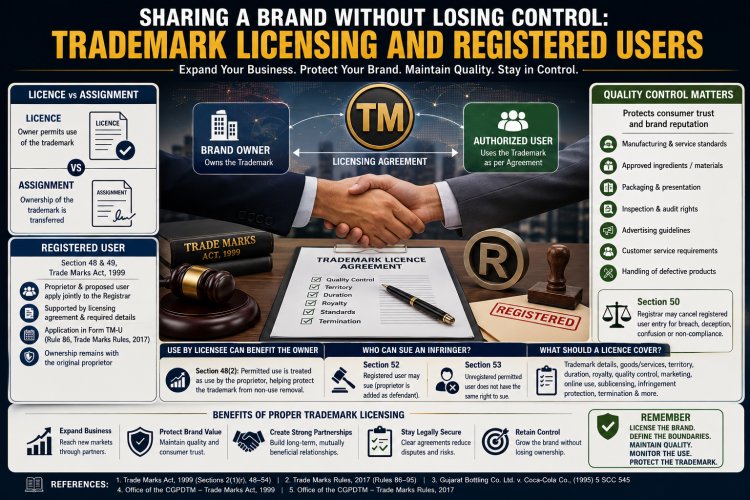
Trademark licensing is an arrangement under which the trademark proprietor permits another person or business to use the trademark subject to agreed terms and conditions.
The trademark owner continues to own the trademark, while the licensee receives permission to use it for specified commercial purposes.
For example, suppose “FROSTIVA” owns a trademark for ice cream products. If FROSTIVA allows a franchisee to operate an outlet using the FROSTIVA brand, the arrangement may constitute trademark licensing.
The licence can specify matters such as:
-
Which trademark can be used
-
Which products or services can carry the mark
-
Where the trademark can be used
-
How the trademark can be displayed
-
Duration of the licence
-
Royalty or licensing fees
-
Quality standards
-
Advertising requirements
-
Inspection and audit rights
-
Termination conditions
-
Restrictions on sublicensing
A properly structured trademark licence allows the proprietor to commercialise the brand while retaining ownership and control over the trademark.
Trademark Licence vs Assignment: What Is the Difference?
Trademark licensing and trademark assignment are not the same.
Trademark Licence
Under a trademark licence, the proprietor continues to own the trademark but gives another person permission to use it according to agreed conditions.
Trademark Assignment
Under a trademark assignment, ownership of the trademark is transferred from one person or entity to another.
For example:
If FROSTIVA permits a franchisee to use the FROSTIVA trademark for operating an ice cream outlet, this is a licensing arrangement.
If FROSTIVA permanently transfers ownership of the trademark and associated rights to another company, this is a trademark assignment.
In Simple Terms
Licensing = Permission to use the trademark
Assignment = Transfer of trademark ownership
Understanding this distinction is critical when structuring a commercial brand arrangement.
Who Is a Registered User of a Trademark?
The Trade Marks Act, 1999 recognises situations in which a person other than the registered proprietor may use a trademark with the proprietor's consent.
Under Section 48 of the Trade Marks Act, 1999, a person other than the registered proprietor may be entered in the Trade Marks Register as a registered user for some or all of the goods or services covered by the trademark registration.
Importantly, registration as a registered user does not transfer ownership of the trademark.
The original proprietor continues to remain the owner of the trademark.
The registered user simply receives recognised rights to use the trademark within the scope of the permitted arrangement.
How to Register a Registered User in India?
Section 49 deals with the procedure for registering a person as a registered user.
The proprietor and proposed registered user apply jointly to the Registrar.
The application is supported by information concerning matters such as:
-
Relationship between the proprietor and proposed user
-
Degree of control exercised by the proprietor
-
Relevant goods or services
-
Restrictions on the manner of use
-
Restrictions concerning the place of use
-
Duration of permitted use
-
Terms of the licensing arrangement
Under the Trade Marks Rules, 2017, the relevant application is made in Form TM-U, subject to the applicable procedural requirements.
Therefore, businesses should ensure that their trademark licensing documentation clearly establishes the relationship between the proprietor and the authorised user.
Registered User Does Not Become the Trademark Owner
One of the most important concepts in trademark licensing is that a registered user is not the owner of the trademark.
For example:
Company A owns the trademark FROSTIVA.
Company A authorises Company B to use FROSTIVA for specified products under a registered-user arrangement.
Company B does not become the owner of FROSTIVA merely because it has permission to use the mark.
Ownership remains with Company A.
This distinction should be clearly reflected in the licence agreement and related commercial documents.
Why Is Quality Control Important in Trademark Licensing?
Quality control is one of the most important aspects of trademark licensing.
A trademark is not simply a name or logo. It can communicate to consumers that particular goods or services come from a consistent commercial source.
If multiple licensees use the same trademark while providing products or services of significantly different quality, consumers may become confused about what the brand actually represents.
This can negatively affect:
-
Brand reputation
-
Consumer trust
-
Goodwill
-
Customer experience
-
Trademark value
Therefore, a trademark licence agreement should contain appropriate quality-control provisions.
What Should Quality-Control Clauses Include?
Depending on the business, quality-control provisions may cover:
1. Manufacturing Standards
The licence may specify the required manufacturing and production standards.
2. Approved Materials and Ingredients
For food, cosmetics, pharmaceuticals, clothing, or other products, the agreement may specify approved materials, ingredients, or components.
3. Packaging and Presentation
The licensee may be required to follow specific packaging, labelling, branding, and presentation standards.
4. Inspection and Audit Rights
The trademark owner may reserve the right to inspect premises, products, records, or processes to ensure compliance.
5. Advertising Guidelines
The licence should specify how the trademark can be used in advertisements, social media, websites, promotional campaigns, and other marketing material.
6. Customer-Service Standards
For franchise businesses and service providers, minimum customer-service standards may also be incorporated into the agreement.
7. Defective Product Procedures
The agreement may establish procedures for handling defective products, consumer complaints, recalls, or other quality-related issues.
What Happens If a Registered User Violates the Licence?
Section 50 of the Trade Marks Act provides for cancellation of the registered-user entry in circumstances specified by the Act.
Issues may arise where the registered user:
-
Acts outside the terms of the agreement
-
Uses the trademark in a manner capable of causing deception or confusion
-
Fails to comply with relevant quality-related requirements
-
Otherwise falls within the statutory grounds for cancellation
This demonstrates why trademark quality control is not merely a commercial issue—it can have legal consequences for the trademark arrangement.
Trademark Licensing and the Gujarat Bottling Case
The Supreme Court considered a trademark-related bottling and franchise arrangement in Gujarat Bottling Co. Ltd. v. Coca-Cola Co., (1995) 5 SCC 545.
The arrangement involved permission to use Coca-Cola trademarks and contained detailed contractual obligations relating to the manufacture, bottling, and sale of beverages.
The case illustrates how trademark licensing and franchise arrangements can involve extensive contractual controls governing how branded goods are manufactured and distributed.
For businesses entering into trademark licensing arrangements, this highlights the importance of clearly defining the obligations of the parties and controlling the manner in which the brand is commercially used.
Can a Licensee's Use Benefit the Trademark Owner?
Yes.
Section 48(2) provides that permitted use of a trademark is treated as use by the proprietor, subject to the statutory framework.
This can be important because trademark registrations may face vulnerability where there has been a lack of genuine commercial use for the relevant statutory period.
Accordingly, genuine use by an authorised user may help demonstrate that the trademark continues to be commercially active.
However, the relationship should be properly documented.
The trademark owner should be able to establish:
-
Who is authorised to use the trademark
-
What trademark is being used
-
Which goods or services are covered
-
Where the trademark is being used
-
The duration of the authorisation
-
The terms and conditions governing the use
Proper documentation can become particularly important if the trademark's use is subsequently challenged.
Can a Trademark Licensee Sue for Trademark Infringement?
This is another important consideration when drafting a trademark licence.
Under Section 52 of the Trade Marks Act, 1999, a registered user may, subject to the applicable requirements and the agreement between the parties, institute infringement proceedings in its own name.
The registered proprietor is ordinarily required to be added as a defendant to the proceedings.
However, Section 53 provides that a permitted user who has not been registered as a registered user does not receive the same statutory right to institute infringement proceedings independently.
Therefore, a trademark licence agreement should clearly address:
-
Who will monitor infringement?
-
Who will issue legal notices?
-
Who will investigate counterfeit products?
-
Who will initiate opposition proceedings?
-
Who will conduct infringement litigation?
-
Who will bear the legal costs?
Clear allocation of responsibility can prevent disputes between the trademark owner and licensee.
What Should a Trademark Licence Agreement Contain?
A professionally drafted trademark licence agreement should clearly define the rights and obligations of both parties.
Important clauses may include:
1. Identification of the Trademark
The agreement should identify the trademark, including relevant registration or application details.
2. Authorised Goods or Services
Clearly specify the goods or services for which the licensee may use the trademark.
3. Territory
Define the geographical territory in which the trademark can be used.
For example:
-
India
-
Particular states
-
Specific cities
-
International territories
4. Duration of the Licence
Specify when the licence begins and when it expires.
5. Royalty and Licensing Fees
The agreement should specify:
-
Royalty amount
-
Payment frequency
-
Minimum guaranteed payments, if applicable
-
Revenue-sharing arrangements
-
Taxes and other applicable charges
6. Quality Control
Set clear standards for manufacturing, services, packaging, advertising, customer experience, and brand presentation.
7. Marketing and Advertising
Specify how the trademark may be used in:
-
Websites
-
Social media
-
Advertisements
-
Brochures
-
Packaging
-
Signboards
-
Promotional campaigns
8. Sublicensing
The agreement should clarify whether the licensee can permit another person or entity to use the trademark.
If sublicensing is permitted, appropriate conditions and approval mechanisms should be included.
9. Online Use
Modern trademark licences should also address digital use, including:
-
Websites
-
Domain names
-
E-commerce platforms
-
Social media accounts
-
Online advertising
-
Digital marketplaces
10. Inspection and Audit
The proprietor may require rights to inspect products, premises, records, or other relevant materials to ensure compliance.
11. Infringement Protection
The agreement should specify responsibility for identifying and responding to:
-
Counterfeit products
-
Unauthorised trademark use
-
Online infringement
-
Passing off
-
Domain-name disputes
-
Unauthorised distributors
12. Termination
The agreement should clearly establish circumstances in which the licence may be terminated.
These may include:
-
Material breach
-
Non-payment
-
Quality-control violations
-
Unauthorised sublicensing
-
Misuse of the trademark
-
Insolvency
-
Expiry of the agreed term
What Happens When a Trademark Licence Ends?
Termination of a trademark licence should be carefully managed.
Once the licence ends, the former licensee may be required to stop using the trademark and remove it from all relevant commercial channels.
This may include:
-
Shop signboards
-
Product packaging
-
Websites
-
Domain names
-
Social media accounts
-
Online marketplace listings
-
Brochures
-
Advertisements
-
Promotional material
The agreement should specify the time period within which the former licensee must discontinue such use.
Continuing to represent oneself as an authorised user after termination can potentially result in trademark infringement, passing off, or other legal disputes, depending on the circumstances.
Trademark Licensing for Franchises
Trademark licensing is particularly important in franchise businesses.
A franchisee may use the franchisor's:
-
Brand name
-
Logo
-
Trade dress
-
Business identity
-
Marketing material
-
Operating systems
However, the franchisor generally needs mechanisms to maintain consistency across different franchise locations.
For this reason, a franchise arrangement should carefully address:
Trademark rights + quality control + brand guidelines + operational standards + termination rights.
The trademark licence should work together with the broader franchise agreement rather than operate as an isolated document.
Trademark Licensing for Manufacturers and Distributors
Trademark licensing can also be useful when a brand owner works with third-party manufacturers.
For example, a brand owner may own the trademark while another company manufactures products bearing that trademark.
The agreement should clearly establish:
-
Manufacturing standards
-
Product specifications
-
Packaging requirements
-
Approved trademark usage
-
Inspection rights
-
Confidentiality
-
Product liability responsibilities
-
Recall procedures
-
Territory
-
Duration
-
Termination
Similarly, distributors may be permitted to use trademarks for marketing and selling authorised products, subject to clearly defined restrictions.
Key Risks of Poorly Drafted Trademark Licensing Agreements
A weak trademark licence can create several problems.
Brand Dilution
Inconsistent use may reduce the distinctiveness and commercial value of the brand.
Consumer Confusion
Different levels of product or service quality may cause consumers to become uncertain about the source or standard of the goods or services.
Unauthorised Use
A licensee may continue using the trademark beyond the agreed scope.
Territorial Disputes
Multiple licensees may claim overlapping rights in the same territory.
Post-Termination Disputes
A former licensee may continue using the brand after termination.
Online Brand Misuse
Unauthorised use may continue through websites, domain names, social media, or e-commerce platforms.
These risks make proper drafting and ongoing monitoring essential.
Trademark Licensing vs Trademark Assignment
| Trademark Licensing | Trademark Assignment |
|---|---|
| Permission to use the trademark | Transfer of ownership |
| Proprietor retains ownership | Assignee becomes owner |
| Rights are generally subject to agreed conditions | Ownership rights are transferred |
| Can be limited by territory, goods/services and duration | Transfers the relevant ownership interest |
| Common in franchising and commercial collaborations | Common in business acquisitions and transfers |
In simple terms:
Licence = Use the brand without becoming the owner.
Assignment = Become the owner of the trademark.
Frequently Asked Questions About Trademark Licensing
What is trademark licensing in India?
Trademark licensing is an arrangement where the trademark proprietor permits another person or business to use the trademark under specified terms and conditions while retaining ownership of the mark.
What is a registered user of a trademark?
A registered user is a person or entity entered in the Trade Marks Register as a user of the trademark for specified goods or services under the statutory framework.
Does a registered user own the trademark?
No. Registration as a registered user does not transfer ownership. The original registered proprietor continues to own the trademark.
What is the difference between a licensee and an assignee?
A licensee receives permission to use the trademark, while an assignee receives ownership of the trademark through an assignment.
Why is quality control important in trademark licensing?
Quality control helps maintain consistency in the goods or services offered under the trademark and protects consumer trust, brand reputation, and goodwill.
Can a trademark licensee use the trademark online?
Yes, where the licence permits such use. A modern trademark licence should specifically address websites, social media, e-commerce platforms, domain names, and online advertising.
What happens after a trademark licence is terminated?
The former licensee generally needs to stop using the trademark according to the termination terms and remove the mark from authorised commercial channels such as packaging, websites, signboards, and promotional material.
Conclusion
Trademark licensing can be a powerful strategy for expanding a business without requiring the trademark proprietor to personally operate every outlet, manufacture every product, or provide every service.
However, successful trademark licensing depends on maintaining control over how the brand is used.
A well-drafted trademark licence agreement should clearly define the trademark, authorised goods or services, territory, duration, royalties, quality standards, marketing rights, sublicensing, infringement responsibilities, online use, inspection rights, and termination procedures.
Quality control is particularly important because a trademark represents more than a name or logo. It can represent the reputation, goodwill, consistency, and consumer expectations associated with a business.
The objective of trademark licensing is therefore not simply to allow another party to use a brand. It is to enable commercial expansion without losing control over the identity, reputation, and legal strength of the trademark.
For businesses, the right approach is simple:
https://youtu.be/dfG8HfvNR7Y?si=zHVqlLN5qYarl77L
License the brand. Define the boundaries. Maintain quality. Monitor the use. Protect the trademark.
References
-
Trade Marks Act, 1999 — Sections 2(1)(r), 48–54.
-
Trade Marks Rules, 2017 — Rules 86–95.
-
Gujarat Bottling Co. Ltd. v. Coca-Cola Co., (1995) 5 SCC 545.
-
Office of the Controller General of Patents, Designs and Trade Marks — Trade Marks Act, 1999.
-
Office of the Controller General of Patents, Designs and Trade Marks — Trade Marks Rules, 2017.