+91 7297051181
Trademark Infringement in India: B.C. Hasaram & Sons v. Smt. Nirmala Agarwal | Delhi High Court 2025
An in-depth analysis of B.C. Hasaram & Sons v. Smt. Nirmala Agarwal (Delhi High Court, 2025), examining trademark infringement, passing off, territorial jurisdiction, and damages in the dispute over the Ayurvedic mark “Nayan Jyoti.”
INTRODUCTION
In the bustling world of commerce, trademarks serve as a vital emblem of brand identity and reputation. The case of “B.C. Hasaram & Sons v. Smt. Nirmala Agarwal RFA(COMM) 214/2025, CM APPL. 22330/2025 & CM APPL. 22331/2025” serves as a pivotal illustration of the legal intricacies surrounding trademark infringement in India. It not only highlights the critical role of trademark registration and well-known status but also underscores the importance of proper evidence in judicial proceedings. The High Court of Delhi saw a fierce battle between a sole proprietorship engaged in the manufacture of ayurvedic medicines and the owner of a trademark that has made its mark in the industry for decades. This article will provide an in-depth exploration of the legal arguments, procedural history, and implications of the judgment rendered by the court.
PROCEDURAL BACKGROUND
Case Background and Procedural History
The origin of this case traces back to 2023, when Smt. Nirmala Agarwal—Proprietor of M/s Karmayogi Sharbhang Muni—filed a suit against B.C. Hasaram & Sons, alleging trademark infringement and passing off related to her well-established trademark “Nayan Jyoti.” The plaintiff claimed to have coined and used the mark since 1990, holding its registration and arguing that it has gained a well-known status under the Indian Trademark Act of 1999.
The procedural history unfolded rapidly:
· 10 May 2023: The District Court granted an ex parte ad interim injunction, allowing a Local Commissioner to conduct a search and seizure operation at B.C. Hasaram & Sons’ premises.
· 5 October 2023: The defendant failed to file a written statement, resulting in its defense being struck off.
· 13 January 2025: The District Court decreed in favor of the plaintiff, imposing a permanent injunction and awarding damages of ₹48,35,610.
Faced with this judgment, B.C. Hasaram & Sons filed a Regular First Appeal in the High Court of Delhi, primarily challenging the quantum of damages awarded and the territorial jurisdiction of the District Court.
MATERIAL FACTS
Trademark and Market Presence
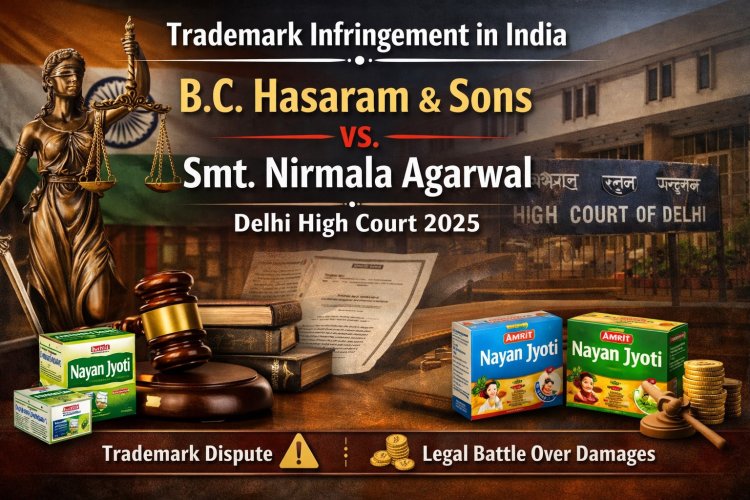
Smt. Nirmala Agarwal claimed that her trademark “Nayan Jyoti” for ayurvedic medicines had been in use since 1990. She presented substantial evidence to support her claim, including registration documents that established her rights over the mark. The plaintiff's assertion of their mark being well-known indicated the extra layer of protection enjoyed under trademark law. On the contrary, B.C. Hasaram & Sons, a sole proprietorship specializing in ayurvedic products, introduced a competing product under the name “Amrit Nayan Jyoti.” This was alleged to be deliberately similar to Agarwal's mark, leading to a confusingly similar trade dress.
Allegations of Infringement
Plaintiff's investigations showed stark overlaps between their product and that of the defendant, including a similar color scheme, writing style, and visual representation. Furthermore, the plaintiff alleged that B.C. Hasaram & Sons had previously faced consequences for trademark infringement in ‘2009’, where warnings from authorities led to the cancellation of their license for similar products. Subsequent test purchases made from the defendant’s website confirmed the ongoing infringement. The Local Commissioner’s seizure operation yielded substantial evidence against the defendant, presenting a range of finished products containing the disputed trademark.
Issues Before the Court
The High Court was presented with two pressing issues that would define the outcome of the appeal:
· Territorial Jurisdiction: Did the District Court possess the territorial jurisdiction to entertain the trademark infringement suit?
· Calculation of Damages: Did the District Court err in its methodology while calculating and awarding damages amounting to ₹48,35,610 in the absence of concrete evidence?
To know more about this, please check the link below.
ARGUMENTS PRESENTED
Appellant's (Defendant's) Arguments
The defense mounted a robust challenge on several grounds:
1. Insufficient Evidence: The appellant argued that the plaintiff failed to substantiate their claim for damages of ₹1 crore, which was inadequately supported by evidence. The affidavit presented did not address damages, and the calculation of damages was introduced late in the proceedings.
2. Errors in Judgment Computation: The defense highlighted multiple errors in the District Court's calculation, such as:
· Assuming that seized stock aligned with a month’s worth of sales.
· Incorrect calculations regarding the duration of the defendant’s business operations.
· Misrepresentation of the product’s selling price, both in terms of cost and consumer price.
3.Speculative Damages: The appellant emphasized that damages awarded should be based on concrete evidence rather than speculation. Relying on precedents like “Kabushiki Kaisha Toshiba v. Tosiba Appliances Co.”, the appellant argued that damages must be substantiated by proper evidence.
4. Jurisdictional Challenge: The claim was made that the plaintiff did not demonstrate any sales activity within North-East Delhi, hence questioning the District Court’s jurisdiction.
5. Licensing: The appellant argued that they operated under a valid license (No. A-2573/93) and that their restraint was applicable only to the specific mark “Nayan Jyoti.”
Respondent's (Plaintiff's) Arguments
In contrast, Smt. Nirmala Agarwal’s arguments provided a detailed defense of her position, focusing on several key aspects:
1. Established Trademark Rights: The plaintiff argued vehemently that the long-standing use and formal registration of the brand “Nayan Jyoti” conferred upon them rights that were not only well-established but were being directly infringed upon by the actions of the defendant. Smt. Agarwal emphasized the importance of trademark protection in maintaining the integrity and reputation of their brand, highlighting that their prior rights should be respected and upheld in the face of encroachment.
2. Confusing Similarity: Smt. Agarwal pointed out the striking similarities between the trade dress and product presentation of both brands. She argued that these similarities could easily mislead consumers, creating an undeniable risk of confusion in the marketplace. By emphasizing the potential for brand dilution, she contended that the defendant's actions not only threatened her business but also undermined consumer trust and choice, which are fundamental to fair competition.
3. Test Purchases and Seizure Evidence: To solidify her claims, the court was provided with compelling evidence from test purchases conducted by third parties, as well as findings from the Local Commissioner. The plaintiff maintained that these pieces of evidence were critical in substantiating their assertions of trademark infringement. The meticulous documentation of these purchases and the accompanying analysis underscored the extent to which the defendant’s actions had encroached upon the plaintiff’s trademark rights, reinforcing their legal arguments. Overall, Smt. Agarwal's arguments encapsulated a robust case for the protection of her established trademark and the prevention of consumer confusion, demonstrating a clear need for the court to consider these factors seriously.
Conclusion
The legal saga in “B.C. Hasaram & Sons v. Smt. Nirmala Agarwal RFA(COMM) 214/2025, CM APPL. 22330/2025 & CM APPL. 22331/2025” underlines the intricate balance between protection of trademark rights and the necessity of presenting concrete evidence in litigation. As businesses navigate the competitive landscape, a thorough understanding of trademark law becomes paramount in ensuring due diligence and preventing disputes that can lead to costly litigation. The High Court's eventual ruling, pending further examination, will resonate beyond the parties involved. It will serve as a guiding light on how trademarks are viewed within the legal framework, emphasizing the need for proper jurisdictional understanding and the necessity of robust evidence when alleging damages in trademark disputes. This case stands testament to the importance of protecting intellectual property rights and ensuring fair competition in the market. As the world of commerce continues to evolve, businesses must remain vigilant in safeguarding their brands, all while being prepared for the rigorous demands of legal scrutiny and the intricacies of trademark law.