+91 7297051181
Aqualite Industries v Relaxo Footwears: Design Piracy & Interim Injunction Under the Designs Act, 2000
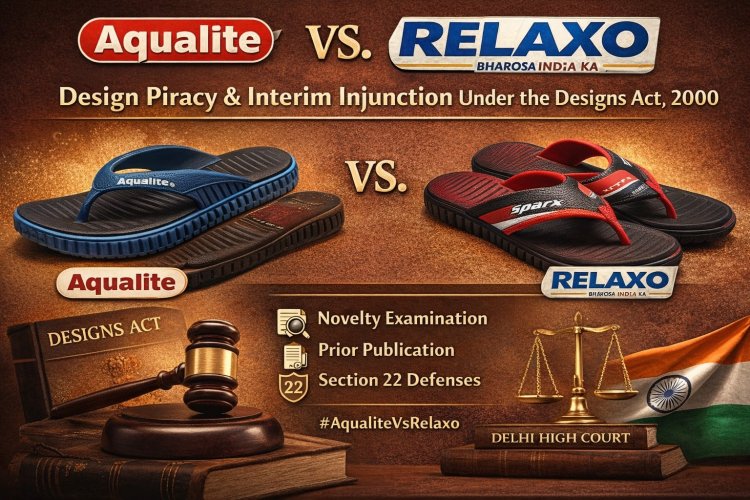
Explore the Delhi High Court ruling in Aqualite Industries Pvt Ltd v Relaxo Footwears Ltd (FAO(OS)(IPD) 1/2022) and its impact on design piracy law in India. This case analysis examines novelty, prior publication, Section 22 defenses, and interim injunction principles under the Designs Act, 2000 in the competitive footwear industry.
Introduction
In the realm of business, the protection of intellectual property (IP) is of paramount importance. It fosters innovation and ensures that companies can reap the rewards of their creative efforts. One of the more complex areas of IP is design protection, particularly in industries like fashion and footwear, where design elements can significantly sway consumer preferences. A recent case that has brought this issue to light is, Aqualite Industries Pvt Ltd v Relaxo Footwears Ltd FAO(OS)(IPD) 1/2022, adjudicated by the High Court of Delhi. This case serves as an essential study for understanding the dynamics of design litigation in India and the significance of safeguarding unique designs.
Procedural Background
The dispute originated when Relaxo Footwears, a prominent manufacturer of hawai slippers, filed a commercial suit against Aqualite Industries, claiming that the latter had infringed on its registered designs. Relaxo's designs for models BHG 136 and BHG 137 were registered under the Designs Act, 2000, which protects the unique aesthetic features of designs in India. Along with the suit, Relaxo sought an interim injunction to restrain Aqualite from manufacturing or selling slippers that allegedly duplicated their designs. On October 8, 2021, the Single Judge of the Delhi High Court granted the requested interim injunction, effectively halting Aqualite's production of the disputed slippers. Aqualite, contesting this order, appealed before the Division Bench, which led to the case designating as FAO(OS)(IPD) 1/2022. The ensuing deliberation not only examined the specifics of the case at hand but also spotlighted the broader implications of design registration and infringement disputes in the Indian legal framework.
The Statutory Framework
Key sections of the Designs Act that pertain to this case include:
· Section 2(d): This section defines what constitutes a design and emphasizes that it should be assessed visually.
· Section 4: Prohibits the registration of designs that lack novelty or originality, or designs that have been publicly disclosed prior to their registration.
· Section 22: Defines piracy and provides remedies available to the aggrieved party, including injunction and damages.
The significance of these sections gained prominence as Aqualite sought to challenge the validity of Relaxo's registered designs by claiming they were not new or original due to prior publication.
Material Facts of the Case
At the heart of the case are two registered designs by Relaxo—design number 325071 for model BHG 136 and design number 325074 for model BHG 137. These designs featured a series of vertical, rectangular ridges along the sidewalls of the slippers, which Relaxo claimed constituted their novelty and distinctive element.In February 2021, Relaxo discovered that Aqualite was marketing similar slippers featuring these side ridges. Comparative photographs submitted in court showed substantial similarities between Aqualite's slippers and Relaxo's designs, with a particular focus on the contested "side ridges." It was established that the primary point of contention was this feature, rather than secondary aspects like color or branding.
Claims and Defenses
Claims by Relaxo
Relaxo's claims were built around allegations of design piracy, asserting that Aqualite's slippers copied the side-ridge elements integral to their registered designs. They argued that Aqualite's actions diluted their market goodwill and unjustly benefited from Relaxo's brand reputation. Relaxo sought both interim and permanent injunctions against Aqualite, coupled with ancillary reliefs, including damages and a full accounting of profits derived from the alleged infringement.
Defenses by Aqualite
Aqualite's primary defense did not dispute the resemblance of their slippers to Relaxo's designs but leaned on the provisions of section 22(3) of the Designs Act. They contended that any fact which could justify the cancellation of a design registration under section 19 could also be used as a defense in a piracy claim. Thus, Aqualite argued that Relaxo's designs were invalid due to prior publication and a lack of novelty when compared against certain prior arts they presented. They cited several prior footwear designs that exhibited similar side-ridge characteristics, though the validity and timeline of these claims became a point of contention. Further, Aqualite emphasized that Relaxo could not claim monopoly over colors, as these were not part of the design's registered novelty.
Key Issues Considered by the Court
As the Division Bench deliberated the case, it focused on several critical issues:
· Whether Aqualite's slippers prima facie constituted piracy of Relaxo's registered designs, based on the demonstration of substantial similarity.
· Whether Aqualite's defense under section 22(3)—regarding prior publication and lack of originality—was robust enough to challenge the validity of Relaxo's designs.
· Whether the Single Judge exercised appropriate discretion in granting the interim injunction against Aqualite.
Legal Principles Involved
Definition and Scope of “Design”
The Designs Act, 2000 defines "design" as the features of shape, configuration, pattern, ornamentation, or composition of lines or colors that are applied to an article in a manner that gives it a unique appearance. This definition underpins the legal framework for assessing design infringement claims.
Understanding Design Piracy
Design piracy occurs when a company intentionally or unintentionally duplicates a design that is already registered and protected, thus infringing on the rights of the original designer. In India, design rights are governed by the Designs Act of 2000, which delineates what constitutes a design and the conditions under which designs can be registered or cancelled.
Comparative Table: Sample Slippers and Side-Ridge Features
The following table summarises the main slipper samples referenced in the judgment and the court’s assessment of their side-ridge features in relation to the suit designs.
PRODUCT BHG 136 CORRESPONDING TO DESIGN REGISTRATION 325071
|
Relaxo’s Product |
Aqualite’s Product |
|
|
|


|
Relaxo’s Product |
Aqualite’s Product |
|
|
|


RE-DESIGN REGISTRATION 325071
|
Relaxo’s Product |
Aqualite’s Product |
|
|
|


|
Relaxo’s Product |
Aqualite’s Product |
|
|
|


To know more about this, please check the link below.
Evaluation of Novelty
A fundamental principle in design law is the requirement of novelty. For a design to be protected, it must be new and original, meaning it should not have been disclosed to the public prior to registration. The onus often lies on the defendant to establish any prior publications that could invalidate a registered design.
Conclusion
The above discussed case presents a critical examination of design law and its application in India. As the court navigates the complexities of design infringement, the outcome will likely have lasting implications on how businesses approach the protection of their intellectual properties. Given increasing competition in industries like footwear, understanding the landscape of design rights is vital for corporations aiming to safeguard their innovations. Intellectual property not only represents a business's investment but also serves as a linchpin for fostering creativity and ensuring fair competition. The Aqualite-Relaxo case is a testament to the ongoing struggle to balance these interests as the legal system adapts to the rapidly evolving market dynamics. Ultimately, this case underscores the necessity for robust design protections to promote a fair and innovative marketplace.