+91 7297051181
Copy or Coincidence? Court Finds Red Battery Design Deceptively Similar
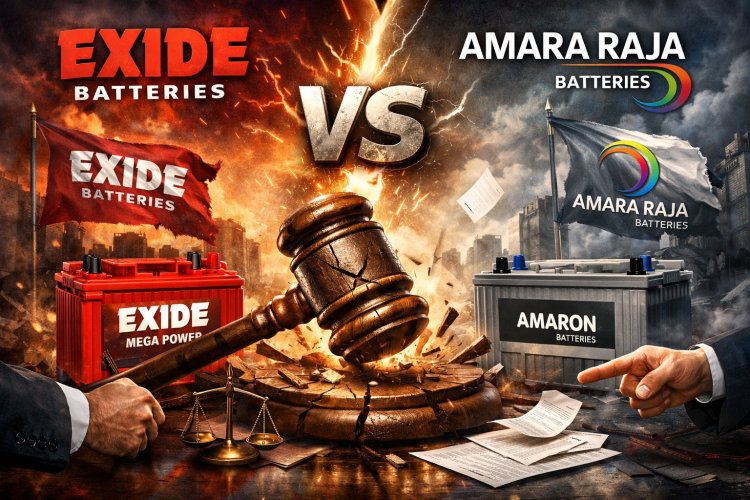
The protection of trade dress and colour-based branding has increasingly gained prominence within Indian trademark jurisprudence. In a recent decision, the Calcutta High Court upheld an interim injunction in favour of Exide Industries Limited, restraining Amara Raja Energy and Mobility Limited from using a red-centric trade dress for its automotive batteries. The Court found that the defendant’s product packaging was prima facie deceptively similar to that of the plaintiff, thereby raising a likelihood of consumer confusion. This case highlights the growing recognition of colour as a distinctive element of trade dress and reinforces the principles governing passing off in India. The ruling also underscores the importance of overall visual impression and market conduct in determining deceptive similarity at the interim stage
Introduction
Trademark law in India has steadily evolved to accommodate not only traditional word and device marks but also non-conventional elements such as colour combinations and trade dress. The recent ruling by the Calcutta High Court serves as a significant development in this trajectory. By upholding interim relief granted to Exide Industries Limited, the Court reaffirmed that visual presentation, including colour schemes, can acquire distinctiveness and deserve protection against imitation.
The dispute arose in the context of the automotive battery market, where branding and visual cues play a crucial role in influencing consumer choice. The case brings into focus the delicate balance between fair competition and the protection of established goodwill.
Factual Background of the Dispute
The litigation involved two prominent entities in India’s battery industry—Exide Industries Limited and Amara Raja Energy and Mobility Limited. Exide initiated legal proceedings alleging infringement of its registered trademarks as well as passing off. Central to its claim was the assertion that its batteries have long been marketed using a distinctive red trade dress, which has become synonymous with its brand in the minds of consumers.
Exide further relied on its registered marks, including stylised elements such as the “EL” mark and the distinctive “shattered O” device. It contended that Amara Raja’s launch of its “Elito” batteries in a similar red colour scheme, coupled with comparable design features, was calculated to mislead consumers into believing an association with Exide.
A Single Judge of the High Court had initially granted an interim injunction restraining the use of the impugned trade dress. Aggrieved by this order, Amara Raja preferred an appeal before a Division Bench comprising Debangsu Basak and Md. Shabbar Rashidi.
Arguments Advanced by the Parties
On behalf of Amara Raja, it was argued that no entity can claim exclusivity over a single colour, particularly in the absence of evidence demonstrating that such colour has acquired a secondary meaning. The appellant further submitted that consumers purchasing automotive batteries primarily rely on technical specifications, compatibility, and pricing rather than visual appearance. Therefore, the likelihood of confusion based solely on colour similarity was, according to the appellant, minimal.
Additionally, Amara Raja contended that it had previously used blue packaging and had adopted the red colour scheme only after considering market preferences. It also emphasised differences in size, labelling, and other product features, asserting that these distinctions were sufficient to negate any allegation of deceptive similarity.
In contrast, Exide maintained that its long-standing and consistent use of the red trade dress had led to the acquisition of distinctiveness. It argued that the colour scheme functioned as a source identifier and was strongly associated with its brand. Exide also alleged that Amara Raja’s adoption of a similar visual identity, including white lettering against a red background, was deliberate and intended to capitalise on its established goodwill.
Importantly, Exide highlighted Amara Raja’s earlier branding strategy, wherein the latter had associated itself with the colour green while implicitly recognising Exide’s association with red. This, according to Exide, demonstrated the defendant’s awareness of the plaintiff’s market identity.
To know more about this topic you can follow the link below:
Findings of the Court
The Division Bench, in its judgment dated April 2, 2026, dismissed the appeal and upheld the interim injunction. The Court undertook a detailed examination of the materials on record and arrived at several key findings.
Firstly, the Court observed that Exide had prima facie established prior use of the red colour as a distinctive feature of its products. It noted that both parties had historically treated colour as an important branding element, thereby reinforcing the argument that colour could function as a source identifier.
Secondly, the Court found that Amara Raja had failed to provide a convincing explanation for its shift to a red trade dress, particularly in light of its earlier acknowledgment of Exide’s association with that colour. The Court considered such conduct to be a relevant factor in assessing the likelihood of passing off.
Thirdly, upon comparing the competing products, the Court emphasised the importance of overall visual impression. It held that both products employed a similar shade of red and shared comparable packaging features, creating a real possibility of confusion for an average consumer.
The Bench also rejected the argument that consumer decisions in this sector are purely technical. It acknowledged that while certain buyers may rely on specifications or prior experience, the role of visual perception at the point of sale cannot be disregarded. Where products are displayed alongside one another, similarities in trade dress may significantly influence purchasing decisions.
In a notable observation, the Court remarked that the differences highlighted by the appellant were insufficient to distinguish the products. The similarities in word length, stylistic presentation, and design elements were considered “deceptively close,” thereby reinforcing the likelihood of confusion.
Principles Governing Interim Relief
The Court also reiterated the well-established principles governing the grant of interim injunctions. It held that Exide had successfully demonstrated a prima facie case, that the balance of convenience was in its favour, and that it would suffer irreparable harm in the absence of protection.
Furthermore, the Bench underscored the limited scope of appellate interference in discretionary orders. Unless such orders are shown to be arbitrary or perverse, appellate courts ought not to disturb them. In the present case, the Court found no reason to interfere with the findings of the Single Judge.
Legal Implications of the Ruling
This decision carries significant implications for trademark law in India. It reinforces the principle that while individual elements such as colour may not be inherently distinctive, their consistent and prolonged use can lead to the acquisition of secondary meaning.
The judgment also strengthens the doctrine of passing off by emphasising the importance of overall trade dress and consumer perception. It highlights that even subtle similarities, when viewed collectively, can result in actionable confusion.
Additionally, the ruling serves as a cautionary precedent for businesses seeking to rebrand their products. A shift in visual identity that closely mirrors that of a competitor may attract judicial scrutiny, particularly where there is evidence of prior association.
Conclusion
The ruling of the Calcutta High Court in favour of Exide Industries Limited represents a robust affirmation of trade dress protection under Indian law. By recognising the distinctiveness of colour-based branding and prioritising consumer perception, the Court has contributed to the development of a more nuanced and comprehensive trademark regime.
As the matter proceeds to final adjudication, it is likely to further clarify the boundaries of trade dress protection. Nonetheless, even at the interim stage, this judgment stands as a critical reminder that brand identity—whether expressed through words, symbols, or colours—remains a valuable and legally protectable asset.