+91 7297051181
₹1000 Crore Film vs 90s Nostalgia: The Legal Battle Rocking Bollywood
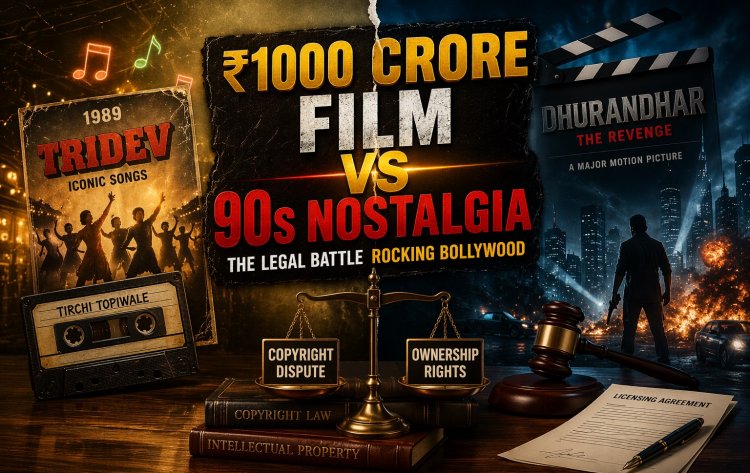
A ₹1000 crore blockbuster. A legendary 1989 soundtrack. And a lawsuit that could redefine Bollywood’s remix culture. The clash between Tridev’s legacy and Dhurandhar: The Revenge is more than a copyright dispute—it’s a battle over ownership of nostalgia itself. As Trimurti Films takes on B62 Studios, the case raises crucial questions: Can iconic melodies be reused? Where does inspiration end and infringement begin? And in an era of remixes, who truly owns the past? This blog unpacks the law, the drama, and the future of Bollywood’s musical memory.
INTRODUCTION
Bollywood has always had a long memory. Sometimes, that memory sings. And sometimes, it sues.
The recent legal battle between Trimurti Films and Aditya Dhar’s B62 Studios over Dhurandhar: The Revenge is not just another courtroom skirmish—it is a dramatic collision between legacy cinema and modern blockbuster ambition. For many, the mention of Tridev (1989) instantly evokes the electrifying rhythm of Tirchi Topiwale, a song that has long lived rent-free in India’s cultural consciousness. Fast forward to today, and Dhurandhar 2, a ₹1000 crore juggernaut, stands accused of dipping into that nostalgic reservoir without proper authorization.
At first glance, this may appear to be a routine copyright dispute. But look closer, and it reveals something deeper: a battle over ownership of memory in the age of remix culture.
Why This Case is Making Headlines
The stakes in this case are enormous. Dhurandhar 2 is not just a successful film—it is a commercial phenomenon. Any injunction or damages awarded could potentially run into record-breaking figures. This is not a small independent film that can quietly settle a dispute; this is a blockbuster whose theatrical and digital life could be significantly impacted.
Then there is the nostalgia factor. Songs like Tirchi Topiwale are not mere compositions—they are cultural artefacts. When such works are reused, even partially, the emotional resonance amplifies public scrutiny.
Adding another layer is the figure of Aditya Dhar, who recently emerged victorious in a separate plagiarism dispute in 2026. His presence in yet another high-profile legal controversy has only intensified public and legal interest. The result is a perfect storm: money, memory, and law colliding in spectacular fashion.
The Legal Core: What is Actually at Stake?
At the heart of the dispute are allegations that Dhurandhar 2 has used elements from songs such as “Rang De Lal” and “Hum Pyar Karne Wale” without proper authorization. Whether this use constitutes infringement depends on how copyright law interprets ownership and usage.
Under Section 13 of the Copyright Act, 1957, a film song is not a single entity but a bundle of three distinct copyrights: the literary work (lyrics), the musical work (composition), and the sound recording. Each of these can have different owners.
Section 14 defines the exclusive rights of the copyright holder, including the right to reproduce the work, adapt it, and communicate it to the public. If any of these rights are exercised without permission, infringement may arise.
The real battleground, however, lies in Section 17, which deals with first ownership. Historically, in cases like IPRS v. Eastern Indian Motion Pictures Association (1977), the Supreme Court held that film producers often become the first owners of the music incorporated in their films. However, modern contractual practices have evolved, and ownership may now rest differently depending on agreements.
This brings us to Section 19, which requires that any assignment of copyright must be in writing. Without a clear chain of title—essentially a documented trail of ownership—a filmmaker risks stepping into a legal minefield.
To know more about this, you can follow the link below
Understanding the Case Through a Legal Lens
One of the key questions in this case is whether the alleged use constitutes “substantial copying.” Courts often apply what is known as the lay observer test: would an average listener recognize the similarity between the two works? If the answer is yes, even partial copying—such as a hook line—can amount to infringement. The defense may argue the principle of De Minimis, suggesting that the portion used is too trivial to warrant legal action. However, in music, even a few seconds can carry immense recognitional value, especially when tied to iconic songs.
Licensing also plays a critical role. Organizations like the Indian Performing Right Society (IPRS) and Phonographic Performance Limited (PPL) manage certain rights, but synchronization rights—using music in films—typically require direct licensing from the rights holder. A failure in this licensing chain can be fatal.
Perhaps the most dramatic aspect of the case is the demand for an interim injunction. For Trimurti Films, stopping the film’s exhibition—whether in theatres or on streaming platforms—would create enormous leverage for settlement. However, courts are generally reluctant to halt the release of a film that has already entered the public domain, especially when financial stakes are high. The balance of convenience often tilts against disrupting a running blockbuster.
Conclusion: A Fight Beyond Music
This case serves as a wake-up call for filmmakers. The era of casually borrowing from the past is over. Every second of reused content must be backed by a clear chain of title and proper licensing. For lawyers, the case underscores the growing complexity of copyright enforcement in the digital age. With films now released globally and streamed across platforms, the calculation of damages has become exponentially more complicated.
For the industry, the case highlights a fundamental tension between remix culture and legal compliance. While audiences enjoy familiar tunes reimagined, the law demands that creators be compensated for their work.
To the average viewer, this case may look like a dispute over a song. But to the legal world, it represents a much larger question: who owns the past in an age that constantly reinvents it? As Bollywood continues to mine its rich musical history, the Trimurti vs. B62 Studios case may well become a defining precedent. It challenges the industry to balance creativity with compliance, nostalgia with legality. In the end, one question lingers—if nostalgia is turned into profit, should its original creators merely be remembered, or must they be rightfully rewarded?