+91 7297051181
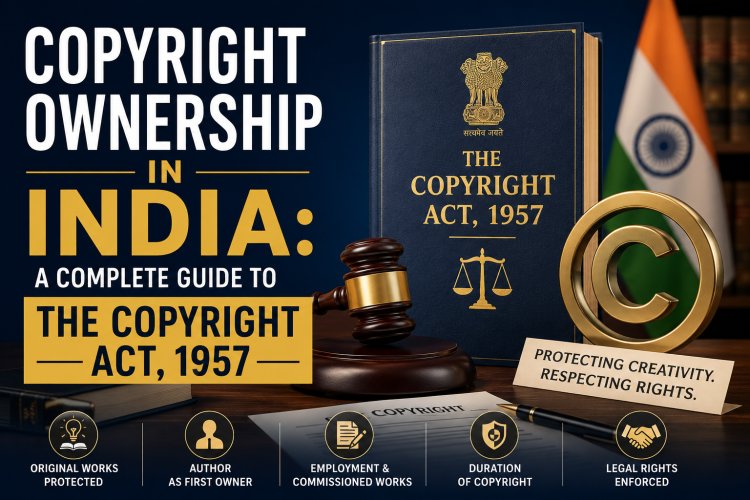
Copyright Ownership in India: A Complete Guide to the Copyright Act, 1957
Introduction
Copyright law in India provides legal protection to creators of original literary, dramatic, musical and artistic works, as well as cinematograph films and sound recordings. The principal legislation governing copyright protection is the Copyright Act, 1957, which has undergone several amendments, including significant changes introduced in 2012.
One of the most important aspects of Indian copyright law is that copyright generally arises from the creation of a qualifying work rather than from registration. However, determining who owns the copyright, whether copyright subsists in a particular work, and how long the protection lasts can become complicated, particularly where the work is created by an employee, commissioned by another person, or generated with the assistance of technology.
This article explains the key principles governing copyright subsistence and ownership in India, with particular focus on Sections 13, 17 and 22 of the Copyright Act, 1957.
What Is Copyright in India?
Copyright is a bundle of exclusive rights granted to the owner of a protected work.
Depending on the nature of the work, these rights may include the right to reproduce the work, issue copies, communicate it to the public, adapt it, translate it, perform it, or otherwise authorise specified acts in relation to the work.
Copyright protection therefore gives the owner legal control over the exploitation of the protected work, subject to the limitations and exceptions provided under the Copyright Act.
Importantly, copyright protects the expression of an idea, rather than the underlying idea itself.
What Are the Works Protected by Copyright in India?
Under Section 13 of the Copyright Act, 1957, copyright subsists in specified categories of works, including:
-
Original literary works
-
Original dramatic works
-
Original musical works
-
Original artistic works
-
Cinematograph films
-
Sound recordings
The term “literary work” is broad and can include works such as books, articles, written content, computer programmes, tables and compilations, including computer databases.
However, the work must satisfy the statutory requirements for copyright protection.
Does Copyright Registration Create Copyright in India?
Generally, copyright protection is not dependent upon registration.
Unlike patents, where statutory rights are obtained through the patent system, copyright generally arises when an original work meeting the statutory requirements comes into existence in a material form.
Registration can nevertheless have evidentiary and practical advantages, particularly when ownership or authorship later becomes disputed.
Therefore, creators and businesses should maintain appropriate records demonstrating:
-
When the work was created
-
Who created it
-
The original files and drafts
-
Agreements between the parties
-
Employment or consultancy arrangements
-
Assignment documents, where applicable
-
Publication records
These records can become particularly important in copyright ownership disputes.
What Is the Requirement of Originality?
One of the fundamental requirements for copyright protection is originality.
However, originality in copyright law does not mean that the work must be completely novel or inventive in the manner required for patent protection.
The Supreme Court's decision in Eastern Book Company v. D.B. Modak is particularly important in understanding originality under Indian copyright law.
The Court moved away from a purely “sweat of the brow” approach and recognised the importance of skill and judgment accompanied by a sufficient degree of creativity. The work must originate from the author and should not merely be a mechanical or trivial exercise.
Thus, copyright law does not require an invention or technical novelty. Instead, the focus is on whether the work is independently created and contains the level of originality required by copyright law.
What Is Copyright Subsistence?
Copyright subsistence refers to whether copyright legally exists in a particular work.
Section 13 identifies the categories of works in which copyright may subsist. For a work to qualify, it must satisfy the applicable statutory requirements.
For example, Section 13 recognises copyright in original literary, dramatic, musical and artistic works, cinematograph films and sound recordings.
The Act also contains provisions dealing with circumstances in which copyright may not subsist, including certain situations involving infringement of underlying works.
Therefore, before considering ownership, it is necessary to establish that the work itself qualifies for copyright protection.
Who Is the First Owner of Copyright in India?
A central principle of Indian copyright law is contained in Section 17 of the Copyright Act, 1957.
As a general rule:
The author of a work is the first owner of copyright.
However, Section 17 contains several important exceptions.
This distinction between authorship and ownership is particularly important for businesses, employers, freelancers, agencies and commissioning parties.
The person who creates a work may not always be the person who ultimately owns the copyright.
Copyright Ownership in Employment Relationships
One of the most important practical issues is determining who owns copyright in a work created by an employee.
Section 17 contains specific provisions dealing with works created in the course of employment, subject to the statutory conditions and any agreement between the parties.
Accordingly, employers and employees should not rely solely on assumptions about copyright ownership.
Employment agreements and intellectual property policies should clearly address:
-
Ownership of copyright
-
Rights in works created during employment
-
Ownership of software and databases
-
Rights in designs and marketing material
-
Confidential information
-
Assignment of intellectual property
-
Use of pre-existing intellectual property
A properly drafted agreement can substantially reduce the risk of future ownership disputes.
Copyright in Commissioned Works
Another important issue concerns commissioned works.
The person who pays for the creation of a work does not necessarily become the copyright owner merely because they commissioned or paid for it.
The Copyright Act contains specific exceptions dealing with certain commissioned works, and the exact legal position depends on the type of work and the circumstances in which it was created.
Therefore, parties commissioning:
-
Photographs
-
Artwork
-
Portraits
-
Illustrations
-
Films
-
Designs
-
Computer-generated works
-
Advertising material
-
Website content
should clearly record copyright ownership in a written agreement.
A contract should ideally specify whether the commissioning party receives:
-
Full copyright ownership;
-
An assignment of specified rights;
-
An exclusive licence; or
-
A limited non-exclusive licence.
Who Is the “Author” Under Indian Copyright Law?
The identity of the author can differ depending on the type of work.
Broadly:
| Type of Work | Relevant Author |
|---|---|
| Literary work | Person who creates the work |
| Dramatic work | Person who creates the work |
| Musical work | Composer |
| Artistic work | Author/creator of the work |
| Cinematograph film | Producer |
| Sound recording | Producer |
| Computer-generated literary, dramatic, musical or artistic work | Person who causes the work to be created |
This distinction becomes particularly important when determining first ownership of copyright.
For computer-generated works, Section 2(d)(vi) identifies the person who causes the work to be created as the author. This provision has also become increasingly relevant in discussions surrounding AI-assisted and computer-generated creative works.
Copyright and AI-Generated Works in India
The growth of Artificial Intelligence (AI) has created new questions concerning authorship and copyright ownership.
The Copyright Act recognises the concept of a computer-generated work and identifies the person who causes such a work to be created as the author for specified categories of works.
However, AI-generated content can raise complex questions concerning:
-
Human creative contribution
-
Authorship
-
Originality
-
Ownership
-
Use of copyrighted training material
-
Copyright infringement
-
Licensing
-
Commercial exploitation
As AI technology continues to develop, the application of existing copyright principles to highly automated creative processes is likely to remain an important legal issue.
Copyright Ownership in Government and Public Undertaking Works
Section 17 also contains special provisions concerning certain works made or first published by or under the direction or control of the Government, public undertakings and certain international organisations.
Depending on the circumstances, the Government, public undertaking or relevant international organisation may be treated as the first owner of copyright.
Therefore, determining copyright ownership requires consideration not only of the identity of the creator but also of the circumstances in which the work was produced.
How Long Does Copyright Last in India?
The term of copyright in India depends on the category of work.
For literary, dramatic, musical and artistic works, copyright generally lasts for the lifetime of the author plus 60 years, calculated from the beginning of the calendar year following the author's death. In the case of joint authorship, the relevant period is generally calculated with reference to the author who dies last.
Different terms apply to other categories of works, including:
-
Cinematograph films
-
Sound recordings
-
Government works
-
Works of international organisations
-
Anonymous and pseudonymous works
-
Posthumous works
Accordingly, it is important to identify the category of work before determining the exact duration of protection.
Copyright Ownership vs. Copyright Registration
It is important to distinguish between copyright ownership and copyright registration.
Copyright may arise automatically when the statutory requirements are satisfied. Registration does not necessarily create the underlying copyright.
However, registration can provide useful documentary evidence concerning the claimed ownership and particulars of the work.
For businesses and creators, maintaining a proper intellectual property record can therefore be valuable even where registration is not legally mandatory.
Why Copyright Agreements Are Important
Many copyright disputes arise not because the work itself is difficult to identify, but because the parties never clearly agreed who would own the rights.
For example, a company may hire a freelancer to create:
-
A logo
-
Website content
-
Product photographs
-
Software
-
Social media creatives
-
Marketing videos
-
Illustrations
Simply paying the freelancer does not always answer every question concerning copyright ownership.
A written intellectual property agreement should clearly establish the rights of each party.
Important clauses may cover:
-
Copyright ownership
-
Assignment of rights
-
Scope of licence
-
Territory
-
Duration
-
Permitted uses
-
Moral rights
-
Third-party material
-
Confidentiality
-
Warranties
-
Indemnity
-
Delivery of source files
Common Copyright Ownership Mistakes
Creators and businesses should avoid the following common mistakes:
1. Assuming the Person Who Paid Owns Everything
Payment for a creative work does not automatically resolve every copyright issue.
2. Failing to Sign a Written Agreement
Verbal arrangements can create significant uncertainty about ownership and permitted uses.
3. Confusing Authorship With Ownership
The person who creates a work may not always be the ultimate copyright owner.
4. Ignoring Employee and Freelancer Relationships
The legal position can differ depending on whether a person is an employee, independent contractor or commissioned creator.
5. Assuming Registration Is Mandatory
Copyright protection generally does not depend on registration, although registration may have practical evidentiary value.
6. Using Third-Party Material Without Permission
A work may itself contain copyrighted material belonging to someone else. Proper permissions and licences should therefore be obtained where required.
Practical Steps to Protect Copyright Ownership
Creators, businesses and organisations can reduce copyright disputes by taking a few basic precautions.
Keep Creation Records
Maintain dated drafts, source files, emails, development records and other evidence showing how and when the work was created.
Use Written Contracts
Clearly define ownership and licensing rights before work begins.
Include IP Clauses in Employment Agreements
Employers should expressly address intellectual property created by employees in the course of their employment.
Use Assignment Agreements Where Appropriate
Where copyright is intended to be transferred, ensure that the assignment complies with the statutory requirements.
Maintain Ownership Documentation
Keep copies of agreements, invoices, correspondence and copyright registration records, where applicable.
https://youtu.be/p_HuQOAEtCo?si=sxp6rEF-K0bocFsC
Conclusion
The Indian copyright system balances automatic protection of qualifying creative works with statutory rules determining ownership, duration and exploitation.
Sections 13, 17 and 22 of the Copyright Act, 1957 are particularly important when analysing copyright subsistence, first ownership and the duration of protection.
While the general rule is that the author is the first owner of copyright, statutory exceptions can significantly alter ownership in cases involving employment, commissioned works, Government works, public undertakings and other special circumstances.
For creators, businesses and commissioning parties, the most important practical lesson is to clearly document copyright ownership and licensing arrangements.
A properly drafted intellectual property agreement can prevent uncertainty about who owns the work, who can exploit it, and what rights have been transferred.
As digital content, software, AI-generated works and creative collaborations continue to expand, understanding copyright ownership in India is increasingly important for protecting valuable intellectual property and avoiding future disputes.