+91 7297051181
Delhi High Court Stays ‘KEEP DEEP–KD MASALE’ Trademark Registration | KD Rectification Case Explained
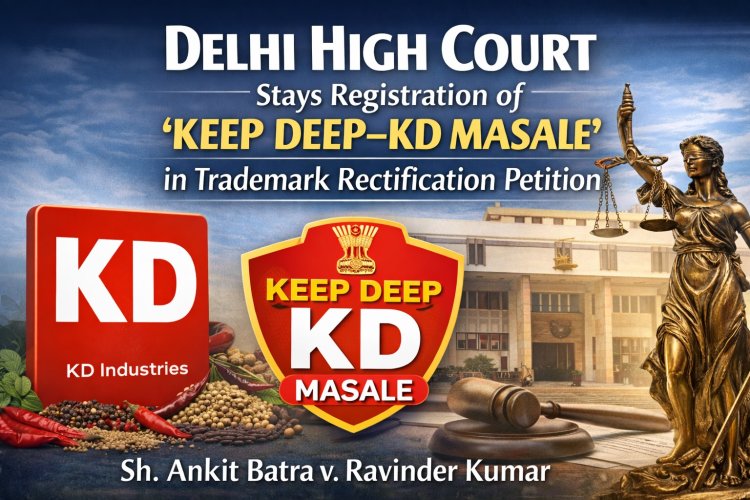
An analytical overview of the Delhi High Court’s interim order in Sh. Ankit Batra v. Ravinder Kumar, examining trademark rectification, prior rights, deceptive similarity, and the stay on registration of ‘KEEP DEEP–KD MASALE’ under the Trade Marks Act, 1999.
Introduction
The dynamic nature of business today often leads to the development of unique brands and identities; a facet celebrated through trademarks. A trademark serves as a crucial identifier of source for goods and services, establishing trust and recognition among consumers. However, with the proliferation of brands in every field, disputes surrounding trademarks have become increasingly common, raising questions of ownership, usage rights, and consumer deception. The case of “Sh. Ankit Batra v. Ravinder Kumar & Anr.C.O. (COMM.IPD-TM) 253/2025” highlights these complexities. In this blog, we will dissect the facts, judicial reasoning, and implications of this landmark case heard in the Delhi High Court, illustrating the crucial intersection between legal frameworks and business realities. By illustrating the key principles of trademark law, we seek to enhance understanding of how such disputes unfold in the legal arena and their far-reaching impacts on businesses.
Overview of the Case
The matter at hand revolves around an ownership dispute regarding the trademarks "KD" and "KEEP DEEP-KD MASALE," with Sh. Ankit Batra, the petitioner and proprietor of M/s KD Industries, challenging Ravinder Kumar, the respondent, with his registered mark. The essentials of the case present a narrative of resourcefulness, strategy, and a quest for justice in the ambit of trademark rights.
Parties Involved
v Petitioner: Sh. Ankit Batra, Proprietor of M/s KD Industries, an established entity associated with the trademark “KD,” primarily connected to spices and related goods.
v Respondent No. 1: Ravinder Kumar, the registered proprietor of the mark “KEEP DEEP-KD MASALE.”
v Respondent No. 2: The Registrar of Trade Marks, representing the government.
Background and Claims
Sh. Ankit Batra claims ownership over the trademark "KD" based on an assignment noted in trademark registration No. 1446270, transferred to him in February 2022. Moreover, he outlines extensive use of the mark dating back to 2003 across various platforms including products, invoices, and websites, demonstrating a longstanding market presence. The trademark "KD" has, according to the Petitioner, attained distinctiveness, representing a trusted brand in the North Indian market with international reach.Conversely, Ravinder Kumar has been accused of adopting a mark deceptively similar to “KD.” The Petitioner contends that Kumar's mark “KEEP DEEP-KD MASALE” exploits the established reputation of "KD," potentially confusing consumers.
Legal Framework Surrounding the Dispute
Trademark law provides a structured means to resolve disputes by protecting distinctive marks and preventing consumer deception. The crucial legal provisions applicable to this case derive from the “Trade Marks Act, 1999”, particularly Sections 47 and 57, addressing disputes of cancellation and rectification of registered marks.
Key Considerations in Trademark Disputes
v Prior Rights and Usage: Establishing prior rights on a mark hinges on ownership and continuous use, emphasizing the need for evidence of brand presence.
v Distinctiveness: A hallmark of trademark eligibility involves distinctiveness; that is, the ability of a mark to identify the source of goods and achieve secondary meaning among consumers.
v Deceptive Similarity: This principle investigates whether the similarities between two marks can mislead consumers regarding the source of goods, leading to confusion.
Court Proceedings and Requests for Relief
Relief Sought
The Petitioner sought several forms of relief:
v Cancellation of the Mark: Challenge to the registration of “KEEP DEEP-KD MASALE,” viewing it as infringing on his existing rights.
v Interim Relief: A request for a stay on the use of the contested mark during the ongoing litigation.
v Ancillary Requests: Efforts to summon the complete registration records associated with the impugned mark.
To know more about this please check the link below.
Court’s Key Findings on Interim Relief
The court emphasized the need to assess:
v Prima Facie Case: Review of evidence showing that the Petitioner held valid rights to the trademark “KD,” supported by registration and substantial use history.
v Balance of Convenience: A consideration of whether maintaining the status quo (the use of the contested mark) would cause irreparable harm to brand identity and market position of the Petitioner.
Judicial Reasoning
The court’s deliberations acknowledged the Petitioner’s long-standing use in conjunction with registered rights. Furthermore, invoices and marketing strategies that showcased the “KD” brand creation laid a compelling foundation for the claims made. The utilization of trademarks was analyzed in view of consumer perceptions, emphasizing the notion that consumers recognize and associate “KD” with the Petitioner’s goods alone.
Implications of the Case
The case has broad implications, reflecting on the essential nature of trademark protection in market dynamics. For businesses, registering a trademark signifies a safeguard against potential encroachments and lays a definitive claim to ownership. On the other hand, careless adoption of similar marks can lead to costly legal entanglements.
For Businesses
v Importance of Trademark Registration: Businesses must ensure proper registration of their trademarks to establish a legal claim and protect their brand identity.
v Vigilance Against Infringement: Preventative measures should involve monitoring current registrations and potential infringers to shield against market confusion.
For Legal Practitioners
v Navigating Trademark Law: Legal experts must be adept in navigating the nuances of trademark law, ensuring clients’ rights are not only asserted but effectively defended.
CONCLUSION
Trademark disputes are an ever-present concern for businesses seeking to establish and maintain brand equity and identity amidst a competitive landscape. The case of “Sh. Ankit Batra v. Ravinder Kumar C.O. (COMM.IPD-TM) 253/2025” exemplifies the challenges faced by brands in asserting their rights and the complexities ingrained in trademark law. Through understanding the key components of trademark rights, businesses can navigate potential disputes more effectively, ensuring their brands are not only recognized but protected.