+91 7297051181
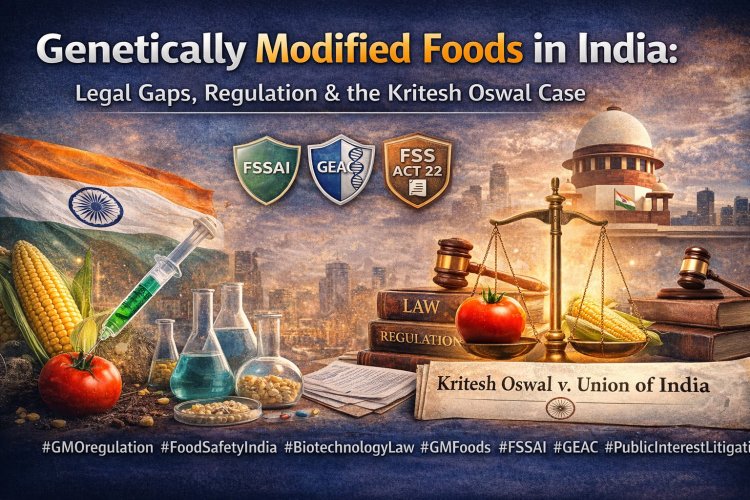
Genetically Modified Foods in India: Legal Gaps, Regulation & the Kritesh Oswal Case
An in-depth legal analysis of genetically modified food regulation in India through the Kritesh Oswal v. Union of India case, examining regulatory gaps under the FSS Act, the roles of GEAC and FSSAI, public health concerns, and the urgent need for a science-based GMO regulatory framework.
Introduction
In recent years, the debate surrounding genetically modified organisms (GMOs) has intensified globally. India, with its vast agricultural landscape and diverse population, is at the heart of this discourse, particularly regarding the regulation of genetically modified foods. A significant development in this context is the case of Kritesh Oswal S/O Sohan Lal v. Union of India, D.B. Civil Writ (PIL) Petition No. 9095/2019, decided on October 13, 2025, by the Jaipur Bench of the Rajasthan High Court. This public interest litigation (PIL) has raised critical questions about the regulatory framework governing GM foods in India, and it serves as a pivotal reference point for understanding the intricate relationship between agriculture, health, and law.
Case Overview
The petitioners, led by Kritesh Oswal and two co-petitioners, filed a PIL challenging the legality of genetically modified foods in India, citing the absence of comprehensive regulations under Section 22 of the Food Safety and Standards Act, 2006 (FSS Act). Their core grievance centred around the continued permission and importation of genetically modified edible oils and foods without adequate regulatory oversight. The case was heard by a bench consisting of Acting Chief Justice Sanjeev Prakash Sharma and Justice Sanjeet Purohit, highlighting the serious nature of the allegations made by the petitioners.
Core Issues Raised
The petitioners articulated several key points in their argument:
· Regulatory Vacuum: The absence of specific regulations for GM foods under Section 22 of the FSS Act was deemed a critical oversight. Despite a statutory mandate that calls for immediate regulations, the absence has created a significant gap in food safety.
· Continuing Approvals: The petition pointed out that the Genetic Engineering Appraisal Committee (GEAC), established under the Environment (Protection) Act, 1986, effectively had the authority to approve GM foodstuffs. However, following a notification on August 23, 2007, GM foods were exempted from GEAC’s jurisdiction. Successive notifications allowed GEAC to approve imports of GM foods, notably edible oils, further complicating the regulatory landscape.
· Scientific Concerns: The petitioners brought attention to international studies suggesting potential adverse health impacts associated with GM foods. They referenced findings from the Center for Science and Environment (CSE) that tested various food products available in Indian markets for GM content.
· Reliefs Sought: The petitioners demanded an immediate prohibition on the manufacture, sale, distribution, and import of all GM foods, the seizure of existing stocks, and the withdrawal of permissions granted for GM food imports.
Respondents’ Standpoint
The response from the Union of India, including the Ministry of Environment, Forest and Climate Change (MoEF&CC), GEAC, and the Food Safety and Standards Authority of India (FSSAI), was multi-faceted:
· Acknowledgment of Regulatory Gaps: The respondents recognized that the exemption notification for GM foods had been in abeyance, thus enabling the GEAC to regulate GM foods in the absence of FSSAI regulations. This admission underscored the complications in the existing regulatory framework.
· Legality of Earlier Approvals: The respondents maintained that prior approvals granted by GEAC were legal and that the petitioners had not individually challenged those specific approvals.
· Clarification of Responsibilities: The FSSAI clarified that while environmental safety for GMOs lay with GEAC, food safety fell under its jurisdiction. The FSSAI also admitted that no regulations under Section 22(2) had been notified, meaning GM foods could not yet be regulated.
· Contested Findings: The findings from CSE regarding GM presence in food products were contested by food business operators, who provided conflicting laboratory reports asserting the absence of GM content.
The Court’s Rationale
The court's judgment addressed the complexities surrounding GM foods, emphasizing the need for a well-defined regulatory framework. While it acknowledged the existing legislative gaps, it also underscored the importance of scientific evidence and international standards in informing regulatory decisions. The court's ruling reinforced the need for a comprehensive approach to GM foods, addressing public concerns about health and safety while balancing the interests of innovation and agricultural development.
Implications for Food Safety in India
The implications of this case extend beyond the parties involved. The court’s ruling can serve as a platform for future legislation concerning GM foods in India. It highlights the necessity for the government to establish robust regulations that ensure the safety and efficacy of GMOs while also fostering innovation in the agricultural sector.
· Strengthened Regulatory Framework: The decision may prompt the government to expedite the formulation of regulations under the FSS Act that specifically address GM foods, aligning with international best practices.
· Public Awareness and Participation: This case sheds light on the importance of public interest in regulatory decisions. Increased awareness and public discourse on GM foods will ensure that the voices of consumers and stakeholders are considered in policy-making.
· Collaboration Among Regulating Bodies: The court’s clarifications regarding the roles of various regulatory bodies may lead to improved coordination among the authorities responsible for environmental safety and food safety, ultimately leading to a more streamlined regulatory process.
The Way Forward
Moving forward, it is crucial for the Indian government and regulatory bodies to:
· Develop Comprehensive Regulations: Immediate action is needed to create regulations governing GM foods that address health, safety, and environmental concerns.
· Enhance Transparency: Ensuring that the approval process for GM foods is transparent, open to public scrutiny, and backed by scientific evidence will build public trust.
· Engage in Public Dialogue: Encouraging discussions among stakeholders, including scientists, policymakers, and the public, will help demystify GM foods and facilitate informed decision-making.
· Monitor and Evaluate: Continuous monitoring of GM foods post-approval is essential to assess their impact on health and the environment.
Conclusion
The Kritesh Oswal case serves as a landmark moment in India's legal and regulatory landscape concerning genetically modified foods. As the court has underscored the need for a robust regulatory framework, it also offers a critical opportunity for India to lead in the responsible governance of biotechnology. By addressing public concerns and fostering scientific innovation, India can navigate the complex waters of biotechnology while ensuring the health and safety of its citizens. It is now up to the authorities to transform this challenge into an opportunity for progress in agricultural management and food safety standards.