+91 7297051181
THE ₹100 CRORE BRAND THAT CLAIMED A COMMON WORD
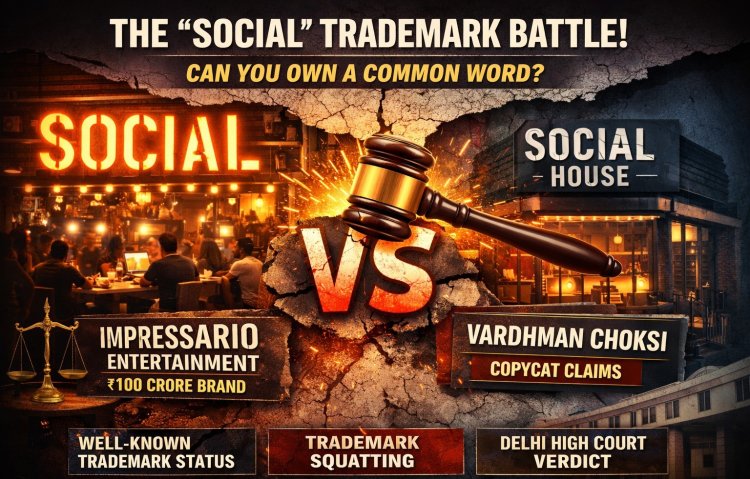
What happens when a word you use every day becomes legally untouchable? The battle between Impressario Entertainment and Vardhman Choksi over the mark “SOCIAL” answers this with striking force. What started as a trendy café chain in 2014 soon transformed into a cultural phenomenon, blending workspaces with nightlife across India. But success invited imitation, leading to a high-stakes legal showdown before the Delhi High Court. In a decisive ruling, the Court not only protected the “SOCIAL” brand but elevated it to the status of a well-known trademark, granting it protection far beyond its industry. The judgment goes beyond a simple dispute—it reshapes how Indian law treats generic words, cracks down on trademark squatting, and reinforces the power of brand-building. This case proves a compelling truth: even the most ordinary word can become an extraordinary legal asset when backed by recognition, investment, and consistency.
INTRODUCTION
In India’s ever-evolving urban culture, few brands have managed to capture the pulse of a generation quite like “SOCIAL.” It is not merely a café or a bar—it is a lifestyle space where work meets leisure, where ideas flow as freely as conversations over coffee and cocktails. But behind this vibrant ecosystem lies a serious legal question that recently reached the Delhi High Court: can a company claim exclusive rights over a word as common as “Social”?
In Impressario Entertainment & Hospitality Pvt. Ltd. v. Vardhman Choksi & Ors., the Delhi High Court answered in the affirmative, delivering a judgment that significantly strengthens trademark protection in India. This case is not just about a name; it is about ownership of identity, reputation, and consumer association in a competitive marketplace.
CASE BACKGROUND AND THE “SOCIAL” EVOLUTION
The story of “SOCIAL” began in 2014, when Impressario Entertainment introduced a unique concept that blended co-working spaces with cafés and nightlife hubs. The idea resonated deeply with India’s urban youth, leading to rapid expansion across major cities. Today, the brand boasts over 50 outlets nationwide, becoming synonymous with a hybrid lifestyle experience.
However, as the brand grew, so did imitation. The dispute arose when entities such as Vardhman Choksi began using marks like “SOCIAL HOUSE,” alongside other businesses like “The Shake Social,” particularly in the hospitality sector. Impressario alleged trademark infringement and passing off, arguing that such use would confuse consumers and dilute its brand identity. The conflict thus centered on whether the use of the word “Social” by others in a similar line of business was legally permissible.
THE “WELL-KNOWN TRADEMARK” STATUS
A key turning point in the case was the recognition of “SOCIAL” as a well-known trademark under Section 2(1)(zg) of the Trade Marks Act, 1999. A well-known trademark is one that has achieved such a level of recognition that it enjoys protection beyond the specific goods or services for which it is registered. This status transforms a trademark from being merely distinctive to becoming a powerful legal asset.
The Court considered several factors in granting this status. Firstly, the duration and continuity of use since 2014 demonstrated consistent brand presence. Secondly, the geographical spread of over 50 outlets across India showed extensive market penetration. Thirdly, the brand had invested over ₹100 crore in marketing and promotion, significantly enhancing public recognition. Most importantly, the Court acknowledged the strong association between the word “SOCIAL” and Impressario’s services in the minds of consumers.
The implication of this designation is profound. A well-known trademark enjoys cross-class protection, meaning it can prevent use even in unrelated industries if such use is likely to cause confusion or dilute the brand. In effect, “SOCIAL” has been elevated into a legal fortress, shielding it from unauthorized use across the commercial spectrum.
To know more about this, click the link below
TRADEMARK SQUATTING & NON-USE DOCTRINE
Another crucial aspect of the case was the Court’s treatment of trademark squatting. Trademark squatting refers to the practice of registering a mark without genuine intent to use it, often to exploit it later. In this case, Vardhman Choksi relied on an earlier registration from 2011. However, the Court found that there was no bona fide use of the mark in relation to restaurant services under Class 43.
Under Section 47 of the Trade Marks Act 1999, a trademark can be removed from the register if it has not been used for a continuous period of five years and three months. Applying this principle, the Court held that Choksi’s registration was vulnerable to cancellation due to non-use. The judgment reinforces a critical principle: trademarks are not assets to be hoarded like real estate. They must be actively used in commerce to retain their validity.
The Court’s approach sends a strong message against the practice of warehousing trademarks. It underscores that the legal system favors genuine commercial use over speculative registration, thereby ensuring that the trademark register remains uncluttered and meaningful.
SECONDARY MEANING: FROM DICTIONARY TO BRAND IDENTITY
Equally significant is the concept of secondary meaning, which played a central role in this case. A term that is originally generic or descriptive can acquire distinctiveness over time through extensive use and consumer recognition. The classic example is “Apple,” which, while originally referring to a fruit, is now globally associated with technology.
Similarly, the word “Social,” though generic in everyday language, has acquired a secondary meaning in the context of hospitality services in India. For a significant segment of consumers, “SOCIAL” does not merely describe a social setting—it specifically denotes Impressario’s chain of cafés and bars. The Court recognized this transformation, noting that consumer perception is the ultimate test of distinctiveness.
This reasoning aligns with earlier cases involving brands like “Maggi” and “Bisleri,” where common or descriptive terms evolved into powerful identifiers through consistent use and market presence. The law thus acknowledges that distinctiveness is not static; it can be built over time through effort, investment, and consumer engagement.
INDUSTRY IMPACT & PRACTICAL TAKEAWAYS
The implications of this judgment extend beyond the parties involved. For entrepreneurs, it highlights the importance of choosing and registering trademarks carefully. Filing under the correct class—such as Class 43 for restaurant services—is essential for effective protection. More importantly, consistent and bona fide use of the mark is critical to maintaining rights.
For legal practitioners, the case reflects a proactive judicial approach toward cleaning the trademark register by removing “deadwood” marks that serve no real commercial purpose. It also reinforces the importance of evidence in establishing reputation, including sales figures, advertising expenditure, and consumer recognition.
From an industry perspective, the judgment sends a reassuring signal that substantial investments in brand-building will be protected by law. It encourages innovation and creativity by ensuring that businesses can reap the rewards of their efforts without fear of unfair imitation.
CONCLUSION
In conclusion, the decision in Impressario Entertainment v. Vardhman Choksi represents a landmark moment in Indian trademark jurisprudence. It is a triple-threat victory: it rewards genuine brand creators, penalizes trademark squatters, and clarifies the legal position on the protection of generic words.
In today’s competitive marketplace, words are more than mere linguistic tools—they are vessels of identity, reputation, and trust. As this case demonstrates, even the most ordinary word can become an extraordinary legal asset when backed by vision, consistency, and the force of law.