+91 7297051181
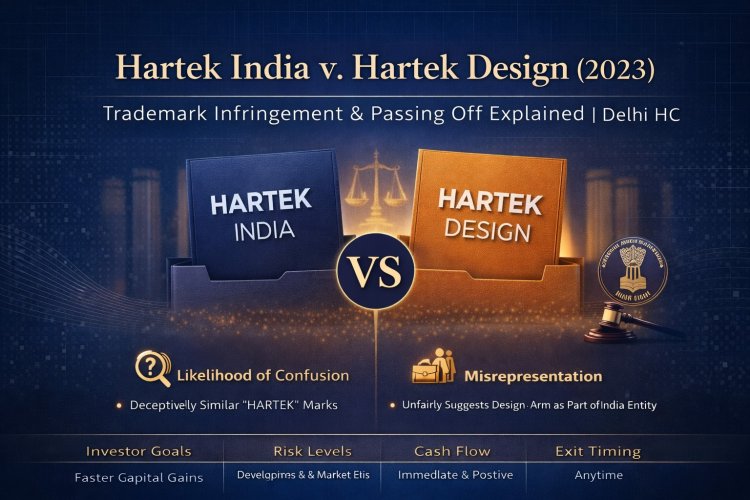
Hartek India v. Hartek Design (2023): Trademark Infringement & Passing Off Explained | Delhi HC
An in-depth analysis of the Delhi High Court’s decision in Hartek India Pvt. Ltd. v. Hartek Design and Software Solutions Pvt. Ltd. (2023), examining trademark infringement, passing off, deceptive similarity, and the grant of ex parte ad-interim injunctions under Indian trademark law. The case highlights how established brand goodwill and registered trademarks are protected against confusingly similar corporate names in the digital age.
INTRODUCTION
In today's competitive business landscape, trademarks serve as powerful symbols far beyond mere brand identifiers; they encapsulate a company's reputation, foster consumer trust, and enhance market goodwill. As businesses grow and diversify across various sectors, the risk of others encroaching on established brand identities escalates significantly. This reality underscores the critical importance of trademark protection as a foundational element of corporate strategy. A noteworthy illustration of the challenges businesses face in this regard is the case of “Hartek India Pvt. Ltd. v. Hartek Design and Software Solutions Pvt. Ltd. CS(COMM) 739/2023 & I.A. 20455/2023, I.A. 20456/2023, I.A. 20457/2023”. In this pivotal case, Hartek India, a prominent entity within the electrical engineering sector, found itself up against a software company that had adopted a name strikingly similar to its own. The Delhi High Court took a deep dive into several key issues during the proceedings, examining the strength of Hartek India’s rights, the extent of goodwill associated with its trademark, and whether the usage by the defendant qualified as trademark infringement or passing off. The Court's carefully crafted reasoning drew upon landmark judgments, notably “Laxmikant V. Patel” and “Midas Hygiene Industries”, highlighting the judiciary’s proactive role in safeguarding trademarks. This decision not only reinforces the significance of protecting intellectual property but also emphasizes the need for businesses to be vigilant in monitoring and asserting their rights against potential violations. In this blog, we aim to unpack the intricacies of the judgment and discuss its broader implications for businesses that are navigating the often-complex waters of intellectual property rights, ensuring they are well-equipped to defend their brand identities in an increasingly competitive marketplace.
Case Overview
Parties Involved
The dispute arose between “Hartek India Pvt Ltd” (the Plaintiff) and “Hartek Design and Software Solutions Pvt Ltd” (the Defendant) over the use of the trademark “HARTEK.” Hartek India, which has been operational since 1994, is the registered proprietor of the “HARTEK” mark across various classes under the Trade Marks Act, 1999. The Defendant, engaged in software and design services, began using the name "HARTEK" and applied for trademark registration, prompting the Plaintiff to seek legal remedies.
PLANTIFF MARK
|
REG. NO. |
TRADEMARK |
CLASS |
STATUS |
|
2534765 |
|
43 |
Registered |
|
2534766 |
|
11 |
Registered |
|
2534767 |
|
42 |
Registered |
|
2534768 |
|
35 |
Registered |
|
2534769 |
|
6 |
Registered |
|
2534770 |
|
41 |
Registered |
|
2534771 |
|
37 |
Registered |


DEFENDANT MARK
|
APP. NO. |
TRADEMARK |
CLASS |
STATUS |
|
6051303 |
|
42 |
Withdrawn |

Procedural Posture
The Delhi High Court addressed several interlocutory applications, including a request for an ex parte ad interim injunction to prevent the Defendant from using the impugned marks. The court noted that notice was provided to the Defendant, who did not respond adequately, allowing the plaintiff to proceed with the case.
Key Takeaways
v Use of a registered mark as the dominant component of another entity’s corporate name or service mark, even with an added descriptive suffix, can constitute infringement and passing off.
v Courts are inclined to grant ex parte ad interim injunctions in trademark cases where a strong prima facie case, likelihood of confusion, and risk of injury to goodwill are demonstrated, particularly when the defendant does not appear despite advance notice.
v Adoption of a “proposed to be used” mark substantially similar to an established registered mark is viewed with suspicion and may facilitate early injunctive relief.
v In passing off, intentional deception need not be proved; likelihood of confusion and probable damage are sufficient to justify injunctive orders.
Legal Principles and Precedents
The court relied heavily on established legal principles under the Trade Marks Act, 1999, and pertinent case law. Notably, it referenced the Supreme Court decisions in “Laxmikant V. Patel v. Chetanbhai Shah” and “Midas Hygiene Industries P. Ltd. v. Sudhir Bhatia”, emphasizing that:
v The goodwill associated with a trademark is inherently valuable and protects against confusion among consumers.
v The likelihood of damage or confusion is sufficient for passing off actions, with intention to deceive being largely irrelevant.
v An injunction is commonly granted once a prima facie case of infringement is established, particularly in cases where there is imitation of a distinctive mark.
Court's Analysis
The court analyzed the long-standing use and the extensive registration of the “HARTEK” mark by Hartek India. It also noted the financial investment in promoting the trademark, establishing significant goodwill. The defendant’s incorporation of “HARTEK” into its corporate name and the application for registration of similar marks were critical points of concern. The delays and changes by the defendant indicated a potential attempt to capitalize on the plaintiff's established brand, thereby justifying the plaintiff's claims.
Conclusion
The “Hartek India Pvt Ltd v. Hartek Design and Software Solutions Pvt Ltd CS(COMM) 739/2023 & I.A. 20455/2023, I.A. 20456/2023, I.A. 20457/2023”, case underscores the complexities surrounding trademark rights in India. It not only marks a significant step in protecting established trademarks but also serves as a reminder for businesses about the critical importance of protecting their brand identity. Organizations, especially startups and new entrants, must prioritize the registration and enforcement of their trademarks to avoid the pitfalls of infringement and ensure that their brands remain distinctive in the marketplace. As the digital landscape continues to evolve, so too must the strategies employed to safeguard intellectual property.