+91 7297051181
Identity Crisis: Can You Lose Your Company Name to a Trademark Battle?
Incorporating a company with a name similar to an existing brand is no longer just an administrative error—it's a legal battleground. This blog explores the evolution from Section 22 of the 1956 Act to Section 16 of the Companies Act, 2013. We analyze critical judicial developments, including the Panchhi Petha and T.T. Ltd. judgments, clarifying the "reasonable time" doctrine and the jurisdiction of Regional Directors. Essential reading for founders and legal counsels navigating brand protection in India.
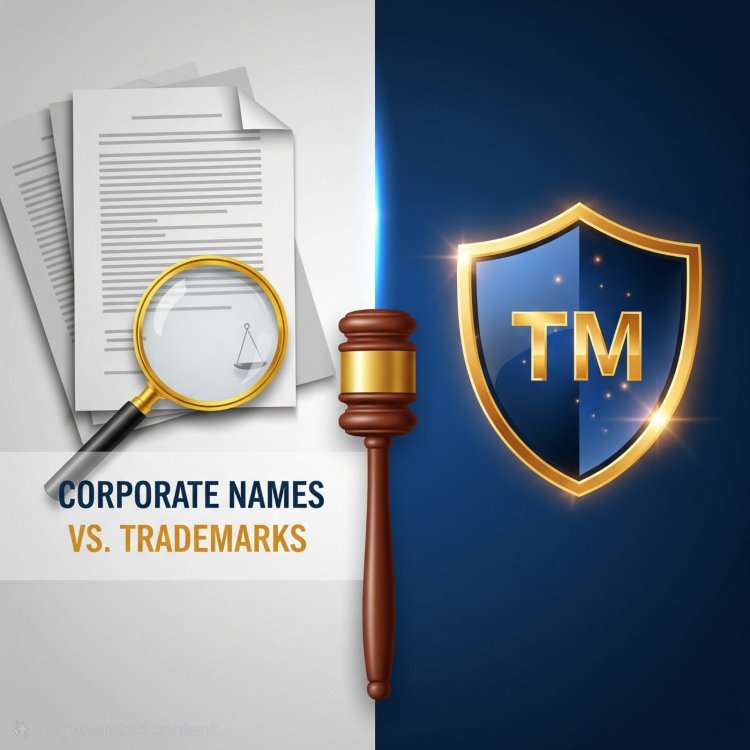
Identity Crisis: The Evolving Battle Between Corporate Names and Trademarks in India
In the corporate world, a name is more than just a registration entry, it is the vessel for goodwill, brand equity, and commercial identity. But what happens when a new company incorporates with a name that mirrors an existing brand?
For decades, this was treated as a mere administrative error under the Companies Act, 1956. Today, under the Companies Act, 2013, it has evolved into a full-blown intellectual property battleground.
This transformation represents a conceptual shift in Indian jurisprudence: moving from protecting "administrative accuracy" to shielding "commercial identity." This blog navigates the complexities of Section 16, the doctrine of "reasonable time," and the crucial new guardrails set by the courts in landmark judgments like Panchhi Petha and T.T. Ltd.
The Legislative Shift: From Section 22 to Section 16
Under the old regime (Section 22 of the 1956 Act), the Central Government could order a name change if a company’s name was "undesirable" or similar to another. However, the Government was often handcuffed by a strict 12-month limitation period. If they missed that window, the infringing name often stayed, leaving trademark owners with limited recourse.
Enter Section 16 of the Companies Act, 2013. This provision broadened the scope of protection and created a clear distinction between government action and private rights:
● Section 16(1)(a) – The Government’s Power: Allows the Government to order a name change if a name is identical or too nearly resembles an existing company name. Notably, the statute sets no specific time limit for this action.
● Section 16(1)(b) – The Trademark Owner’s Weapon: Explicitly empowers registered trademark proprietors to apply for rectification. However, this comes with a strict three-year deadline from the date of the infringing company’s incorporation or name change.
The "Reasonable Time" Dilemma
A major point of contention has been the silence of Section 16(1)(a) regarding timelines. Can the Government order a name change 10 or 20 years later just because the text doesn't explicitly say "stop"?
The courts have answered with a resounding "No."
In the pivotal case of T.T. Ltd. v. Union of India, the Madras High Court clarified that private parties cannot bypass the 3-year deadline of Section 16(1)(b) by trying to invoke the Government's general powers under Section 16(1)(a). Clause (a) is the exclusive preserve of the Central Government.
Furthermore, relying on Supreme Court precedents like Mohamad Kavi Mohamad Amin v. Fatmabai Ibrahim and Union of India v. Citi Bank N.A., courts have established that even when a statute is silent, authorities must act within a "reasonable time." The Government cannot dig up old cases decades later; doing so would destroy legal certainty and fairness.
To know more about this you can follow the link below
Jurisdictional Boundaries: The Panchhi Petha Limitation
Who decides if a name is "too similar"? That power lies with the Regional Director (RD) of the Ministry of Corporate Affairs. The jurisdiction is determined by the location of the company's registered office.
● Example: A company registered in Uttarakhand falls under the Northern Regional Director (New Delhi), while a company in Jaipur falls under the North Western Regional Director (Ahmedabad).
However, recent litigation has drawn a red line around the RD's authority. In the recent judgment of Panchhi Petha Store v. Union of India (2024), the Delhi High Court restrained the RD from overstepping. The case involved a dispute over the famous "Panchhi Petha" brand from Agra. The RD had attempted to adjudicate who actually owned the trademark.
The High Court struck this down, establishing a vital principle:
The Regional Director is an administrative authority, not a Civil Court. Their job is strictly to check for resemblance between names to prevent confusion. They do not have the jurisdiction to decide complex questions of title, validity, or ownership of a trademark. Those battles belong in Intellectual Property Tribunals or Civil Courts.
Judicial Tests for Resemblance
When the RD does evaluate resemblance, the scrutiny is rigorous. Three key judgments have shaped the current test:
1. Strict Scrutiny (CGMP Pharmaplan v. UOI, 2010): The Delhi High Court held that Company Law uses a stricter test than Trademark Law. Even if a Civil Court finds no "passing off," the RD can still order a name change if the names are "undesirable" or identical. The two laws operate on separate tracks.
2. The "Imperfect Memory" Test (GMR Spintex v. Regional Director, 2023): The Telangana High Court protected the "GMR" prefix, ruling that a famous corporate prefix cannot be used by others, even if the businesses are different. The test is not expert comparison, but whether an "ordinary person with imperfect memory" would assume a connection.
3. Prior User Rights (Shaktiman Equipments v. UOI, 2024): The Madras High Court reinforced that prior users (those who used the name first) have superior rights. If names are identical, confusion is presumed, and the newer entity must change its identity—regardless of whether they operate in the same field.
Practical Takeaways for Businesses
For founders, legal counsels, and investors, the implications of these developments are clear:
● Due Diligence is Non-Negotiable: Before incorporating, do not just check the MCA registry. Conduct a comprehensive Trademark search. A "clear" MCA search does not protect you from a Section 16(1)(b) rectification order later.
● Watch the Clock: If you are a trademark owner, you have exactly three years to object to a new company using your brand name. If you sleep on this right, Section 16(1)(b) closes its doors.
● Know Your Forum: If the dispute is about who owns the brand, go to Civil Court. If the dispute is simply that the names look too similar, approach the Regional Director based on the location of the company's registered office.
Conclusion
Section 16 of the Companies Act, 2013, is a powerful tool for brand protection, but it is not without limits. While it empowers trademark owners, it also demands vigilance. As the Panchhi Petha and T.T. Ltd. judgments show, the law balances the protection of intellectual property with the need for administrative certainty.
Disclaimer: This article is for informational purposes only and does not constitute legal advice.