+91 7297051181
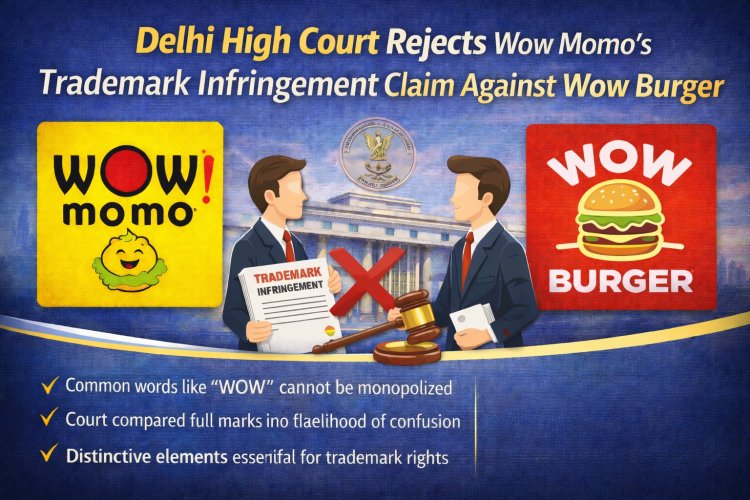
Delhi High Court Rejects Wow Momo’s Trademark Infringement Claim Against Wow Burger
The Delhi High Court dismissed Wow Momo’s plea against Wow Burger, ruling that common words like “WOW” cannot be monopolized without strong secondary meaning. The Court held that composite marks must be compared as a whole and found no likelihood of confusion or passing off.
Introduction
The Delhi High Court recently delivered a key ruling in Wow Momo Foods Private Limited V. Wow Burger & Anr [CS(COMM) 1161/2024 & I.A. 48983-48984/2024], dismissing Wow Momo’s plea for an interim injunction against the use of the mark WOW BURGER. The case centered on alleged trademark infringement and passing off. The Court held that common or descriptive words, like “WOW,” cannot be monopolized unless they acquire strong secondary meaning, and marks must be considered as a whole, preventing overreach on everyday language.
Background
Wow Momo, a well-known food services company operating since 2008, has expanded to over 600 outlets in 30+ cities. It owns registered trademarks such as WOW! MOMO, WOW! CHINA, and WOW! CHICKEN, asserting that “WOW!” is the dominant element of its brand family. The dispute arose when the defendants planned to launch food operations under WOW BURGER. Wow Momo claimed that its extensive use of “WOW!” over 15 years, combined with a sales turnover of ₹453 crore in 2023-24 and significant promotional investment, established distinctiveness and secondary meaning, entitling it to protection.
To know more about this, please check the link below.
Court Analysis
The Court took a different view, noting:
- Wow Momo had no standalone registration for “WOW” or “WOW! BURGER.” Its registrations were only for composite marks.
- The plaintiff itself had admitted that WOW is a common English word, distinctive only when combined with other elements. Disclaimers in registrations reinforced that it did not claim exclusive rights over the term “WOW.”
- “WOW” is a laudatory expression widely used in the food and hospitality sector, and descriptive or generic terms cannot be monopolized without strong secondary meaning.
- Secondary meaning must be proven through long, continuous, and exclusive use, which was not demonstrated. Use since 2008 was insufficient.
- The alleged mark WOW! BURGER had only appeared on the menu until 2018, later replaced by “Moburg,” weakening the claim.
In comparing the marks, the Court applied the anti-dissection rule, examining the marks as a whole. It found that apart from the common word “WOW,” WOW! MOMO and WOW BURGER differed visually, phonetically, and conceptually. Differences included color themes (yellow vs. red-and-white) and product focus (vegetarian vs. mixed offerings). The Court concluded there was no likelihood of confusion or deception.
Conclusion
The Court dismissed Wow Momo’s application for interim injunction, emphasizing that:
- Common or laudatory words cannot be monopolized without strong secondary meaning.
- Distinctive elements must accompany generic words to secure enforceable trademark rights.
- Marks must be compared in their entirety from the perspective of an average consumer, not dissected.
This decision serves as a guiding precedent for businesses, reminding brand owners that descriptive or laudatory words must be carefully paired with unique elements to protect intellectual property.