+91 7297051181
Section 11 Objections: When a Trademark Is Too Similar to an Earlier Mark
trademark
Section 11 Objections: When a Trademark Is Too Similar to an Earlier Mark
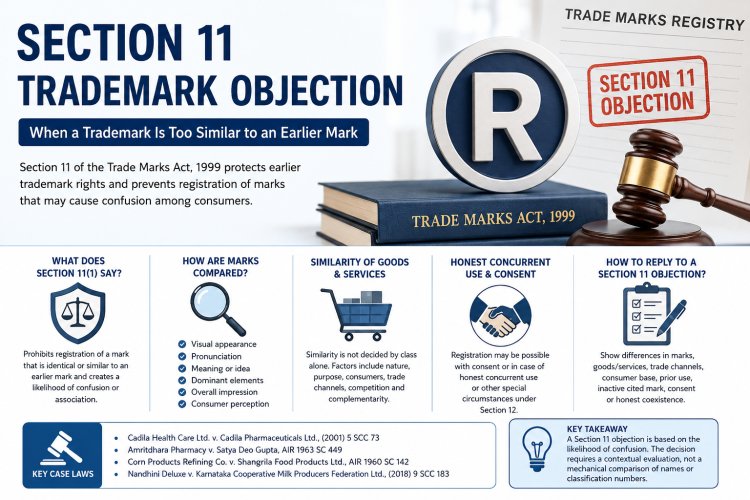
Even a creative and distinctive trademark may face objection if it conflicts with an earlier mark. Section 11 of the Trade Marks Act, 1999 contains the relative grounds for refusal, which protect earlier trademark rights and reduce the risk of consumer confusion.
A Section 11 objection usually identifies one or more earlier applications or registrations that the Examiner considers identical or deceptively similar to the proposed trademark.
What Does Section 11(1) Require?
Section 11(1) prohibits registration where:
- the proposed mark is identical to an earlier trademark and covers similar goods or services; or
- the proposed mark is similar to an earlier trademark and covers identical or similar goods or services;
and the circumstances create a likelihood of public confusion, including a likelihood of association with the earlier trademark.
Similarity alone is not always conclusive. The Registry must consider the relationship between the marks, goods or services and probable consumer perception.
For example, “NUTRIVA” and “NUTREEVA” may create confusion when both are used for nutritional supplements. The result could differ if one mark covers nutritional products and the other covers specialised industrial machinery.
How Are the Marks Compared?
Trademark comparison is not a side-by-side spelling exercise. Consumers usually encounter marks at different times and may remember only their dominant or essential features.
The comparison may involve:
- visual appearance;
- pronunciation;
- structure and length;
- meaning or idea;
- dominant elements;
- overall commercial impression; and
- the level of attention expected from consumers.
In Cadila Health Care Ltd. v. Cadila Pharmaceuticals Ltd., the Supreme Court identified factors including the nature of the marks, degree of visual and phonetic resemblance, nature of the goods, class of purchasers, purchasing method and surrounding circumstances. The Court emphasised greater caution in medicinal-product disputes because confusion may endanger health.
Similarity of Goods and Services
The Registry does not decide similarity merely by checking whether both marks fall within the same trademark class.
Goods in the same class may be commercially unrelated, while goods or services in different classes may be closely connected. Relevant factors may include:
- nature and purpose of the goods;
- method of use;
- consumer group;
- trade channels;
- whether the goods compete;
- whether they are complementary; and
- whether consumers would expect them to originate from the same business.
In Nandhini Deluxe v. Karnataka Cooperative Milk Producers Federation Ltd., the Supreme Court held that a proprietor does not automatically obtain a monopoly over every product within an entire class. Despite phonetic similarity between NANDHINI and NANDINI, the Court examined the particular goods, market circumstances and scope of the earlier rights before permitting a restricted registration.
Earlier Marks That Are No Longer Active
An examination report may cite an earlier application that has subsequently been abandoned, refused, withdrawn or removed.
The applicant should therefore verify the current status of every cited mark. A dead application may no longer present the same obstacle, although earlier use or passing-off rights could remain relevant in other proceedings.
The applicant should also examine whether the cited registration covers the same goods, whether it contains a limitation and whether its proprietor has disclaimed exclusive rights over any common component.
Consent and Honest Concurrent Use
Section 11(4) states that an earlier-right holder’s consent may permit registration in special circumstances under Section 12. Section 12 also authorises the Registrar to permit registration of identical or similar marks in cases of honest concurrent use or other special circumstances, subject to appropriate conditions.
Consent is relevant but does not automatically bind the Registrar. Trademark registration also protects consumers, and the Registrar may still consider whether coexistence is likely to cause deception.
An honest-concurrent-use claim should be supported by evidence showing:
- honest adoption;
- duration and extent of use;
- geographical area of trade;
- sales volume;
- absence or limited instances of confusion; and
- practical measures capable of distinguishing the businesses.
How Can the Applicant Respond?
A Section 11 reply may argue that:
- the marks are different when viewed as a whole;
- the shared element is descriptive or common to the trade;
- the dominant features differ;
- the goods or services have different purposes or consumers;
- the trade channels are separate;
- the cited application is inactive;
- the applicant is an earlier user;
- the marks have honestly coexisted; or
- the earlier proprietor has consented.
The applicant should not simply list cases. Each legal principle must be connected to the actual marks and goods involved.
Conclusion
A Section 11 objection is based upon the possibility that registration may interfere with an earlier trademark or confuse consumers. The decision requires a contextual evaluation rather than a mechanical comparison of names or classification numbers.
A successful response should examine the marks as a whole, the precise goods and services, the status of the cited rights and the realities of the relevant market.
https://youtu.be/oRlc-3lhzw8?si=GQsjS-oW9zYj96rb
- Trade Marks Act, 1999, Sections 11 and 12.
- Cadila Health Care Ltd. v. Cadila Pharmaceuticals Ltd., (2001) 5 SCC 73.
- Amritdhara Pharmacy v. Satya Deo Gupta, AIR 1963 SC 449.
- Corn Products Refining Co. v. Shangrila Food Products Ltd., AIR 1960 SC 142.
- Nandhini Deluxe v. Karnataka Cooperative Milk Producers Federation Ltd., (2018) 9 SCC 183.
- Trade Marks Rules, 2017, Rule 33.