+91 7297051181
V-Label GmbH v EUIPO (T-464/24): Certification Marks & Likelihood of Confusion under EU Trademark Law
An in-depth analysis of V-Label GmbH v EUIPO (T-464/24) examining certification marks, distinctiveness, and likelihood of confusion under Regulation (EU) 2017/1001. The article explores the General Court’s reasoning, evidentiary standards for reputation, and key implications for trademark enforcement in the EU’s competitive vegan products market.
Introduction
In today's fast-paced economy, protecting intellectual property rights is crucial for businesses striving to establish and maintain their brand identity. Trademarks, particularly certification marks, play a vital role in ensuring that consumers can identify genuine products that meet specific standards. The case of V-Label GmbH v EUIPO (T-464/24) is a poignant illustration of the complexities involved in trademark law, particularly with respect to the evaluation of likelihood of confusion between marks and the interpretation of distinctiveness. Set against the backdrop of an increasingly competitive vegan product market, this case not only raises pertinent legal questions but also underscores the challenges businesses face when navigating the intricacies of trademark registration and protection.
Background of the Case
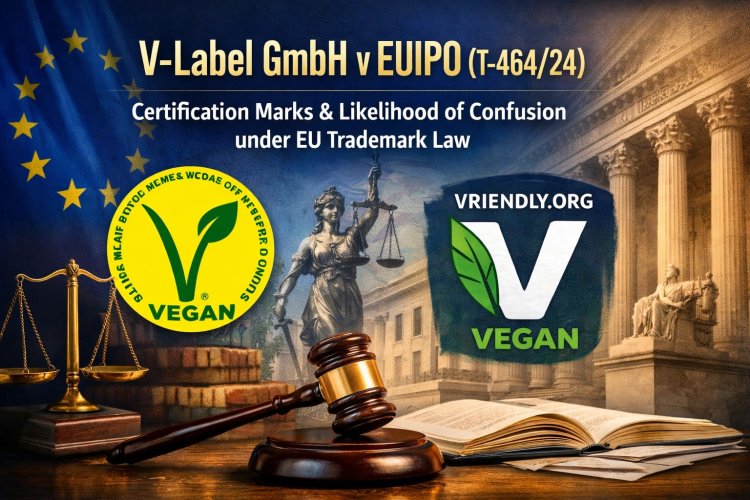
V-Label GmbH is a company that oversees the "V-Label" certification mark, known for signifying vegan and vegetarian products. This internationally recognized mark is crucial for consumers seeking ethical and environmentally friendly options. On the other hand, the contested mark, “VRIENDLY.ORG V VEGAN”, registered as an EU figurative mark on February 28, 2020, aimed to enter the same market segment.V-Label GmbH filed an application for invalidating the contested mark under Article 60(1)(a) of Regulation (EU) 2017/1001, arguing that the new mark's use would likely confuse the public regarding its association with the respected “V” certification mark. The core of the dispute was whether the marks were likely to be confused and, if so, whether "V" had a sufficiently distinctive character.
Legal Framework
The legal provisions governing this case are primarily derived from the Regulation (EU) 2017/1001 on the European Union trademark (EUTMR). Two key articles underpinning the arguments include:
1.Article 8(1)(b): This provision governs the likelihood of confusion, stating that a trademark application can be refused if it is similar to a prior mark and used for identical or similar goods/services, leading to a likelihood of confusion among the public.
2. Article 8(5): It provides protection for reputed marks, indicating that even marks that are not identical or similar can be protected if their distinctive character or repute is compromised by the use of another mark.
Additionally, Article 94 emphasizes that EUIPO's decisions must provide adequate reasoning, particularly concerning the relevant public's level of attention and the assessment of distinctiveness and reputation.
Procedural History
The procedural history of this case is crucial for understanding how the legal proceedings unfolded:
· May 16, 2022: V-Label GmbH filed an application for trademark invalidity before EUIPO, invoking its earlier certification mark.
· October 17, 2023: The EUIPO Cancellation Division rejected the application, leading V-Label to appeal to the Second Board of Appeal.
· June 21, 2024: The Board of Appeal dismissed the appeal, indicating no likelihood of confusion and insufficient evidence of the reputation of the V-Label.
Ultimately, V-Label GmbH sought annulment of the Board's decision in the General Court, declaring the contested mark invalid and demanding costs from EUIPO.
The Court’s Considerations
Relevant Public and Goods
The Court established that the relevant territory was the European Union, and the relevant public spanned a broad spectrum of end consumers. Notably, it acknowledged different levels of public attention for various product categories:
· Classes 29 and 30: Generally, the public's attention is considered below average for everyday food products.
· Class 5 products: Due to their health-related nature, these goods require a higher level of public attention.
The Court upheld the Board of Appeal's findings regarding the varying levels of attention and rejected V-Label's argument of consistently low public attention for Class 5 goods.
In the interest of procedural economy, the Court accepted that the goods and services under the contested mark were identical to those under the earlier certification mark. This assumption was in favor of the applicant, simplifying the assessment of potential confusion.
Comparison of Signs
Distinctive Elements of the Marks
· Earlier Certification Mark: The "V" mark consisted of a dark green figurative element that some consumers viewed as a stylized "V," while others recognized it as a leaf, embodying natural and environmentally friendly attributes. However, the Court noted that as a perceived "V," it was directly descriptive, rendering it weakly distinctive.
· Contested Mark: The "VRIENDLY.ORG V VEGAN" mark prominently features a large capital "V," along with the word "vegan" and descriptive elements. The Court found the combined elements are largely descriptive or non-distinctive regarding vegan products.
Ultimately, the Court concluded that both marks lacked strong decisive elements, leading to an evaluation focused on their overall impression rather than isolated components.
Key Issues Addressed by the Court
Likelihood of Confusion
The essence of the conflict lay in whether the contested mark induced a likelihood of confusion among consumers compared to the earlier certification mark. Given both marks' descriptive nature, the Court recognized that although the overlap in goods might suggest similarity, the distinctiveness and the overall impression played critical roles in determining confusion.
Enhanced Distinctiveness and Reputation
The applicant claimed that repeated use of the "V-Label" had enhanced its distinctiveness and reputation. The Court evaluated the evidence presented regarding the mark’s market presence, consumer recognition, and the potential risk of unfair advantage or detriment to the mark's repute. Ultimately, however, the Court upheld the Board's decision that the evidence of reputation was insufficiently substantiated.
Adequacy of Reasoning
One of the applicant's complaints was that the Board failed to provide adequate reasoning, particularly regarding public attention levels. The Court found that the Board had sufficiently justified its determinations in its decision, leading to the rejection of this argument.
Implications of the Case
The ramifications of the V-Label GmbH v EUIPO (T-464/24) case extend beyond the immediate parties involved. It illustrates the challenges in trademark law surrounding certification marks, the importance of distinctiveness, and the evolving nature of consumer expectations. Some key implications include:
1.Strengthening the Requirements for Distinctiveness: The case underlines the need for companies to demonstrate sufficient distinctiveness, particularly in markets with overlapping goods and services.
2.Evaluating Public Perception: This ruling emphasizes the importance of assessing consumer perception in trademark cases, particularly concerning descriptive elements that may diminish a mark's distinctiveness.
3. Legal Precedents for Future Cases: The decisions made in this case will likely serve as a reference point for future disputes surrounding likelihood of confusion and certification marks within the EU.
Conclusion
The case of V-Label GmbH v EUIPO (T-464/24) epitomizes the dynamic interplay between trademark law, consumer perception, and business branding in the European Union. As businesses navigate the complexities of intellectual property protection, understanding the implications of this case becomes paramount. The Court’s ruling demonstrates the significant hurdles that trademark applicants face in establishing the distinctiveness of their marks, moving through layers of legal scrutiny and consumer perception. This case not only reflects the ongoing evolution of brand protection but also highlights the need for clarity regarding the requirements for trademark validity and enforcement in an increasingly competitive marketplace. Companies striving to protect their intellectual property must remain vigilant, adeptly navigating legal frameworks to safeguard their interests in a world where brand identity is pivotal to sustained success.