+91 7297051181
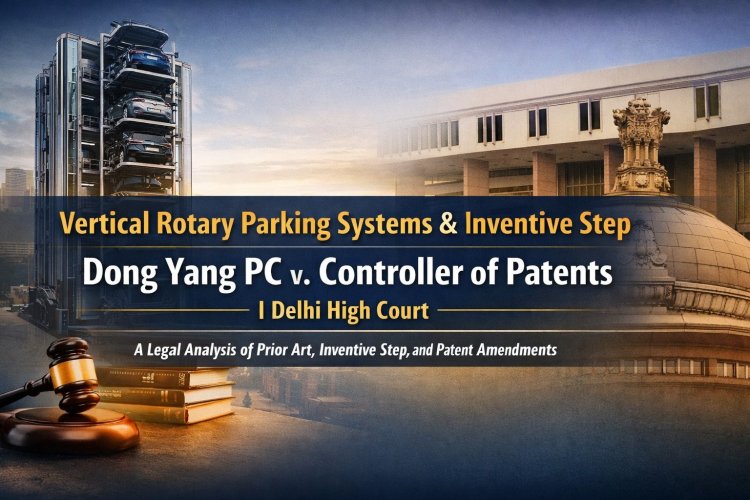
Vertical Rotary Parking Systems & Inventive Step: Dong Yang PC v. Controller of Patents | Delhi High Court
This blog examines the Delhi High Court’s decision in Dong Yang PC, Inc. v. Controller of Patents and Designs, analysing how inventive step, prior art, and amendment principles were applied to a vertical rotary parking system under Indian patent law.
INTRODUCTION
In the rapidly evolving world of technology and innovation, patents serve as a critical mechanism for protecting intellectual property. A patent not only confers exclusive rights to an invention but also fosters a competitive market by encouraging creativity. However, the dialogue around what constitutes an ‘invention’ can often become contentious, especially in cases where prior art overlaps with new claims. The case of “Dong Yang PC, Inc. v. Controller of Patents and Designs C.A. (COMM.IPD-PAT) 60/2024” is emblematic of these challenges, as it scrutinizes the very concept of inventive step within the framework of India's patent law. This blog delves into a detailed examination of the case, exploring its key aspects—from procedural intricacies to the broader implications for patent law. The case revolves around the appellant's claim for a "Vertical Rotary Parking System," which was met with opposition grounded in the prior art introduced by the Controller. With the decision rendered by the High Court of Delhi serving as an important precedent, understanding its ramifications is crucial for innovators, legal professionals, and entrepreneurs alike.
BACKGROUND OF THE CASE
The appellant, Dong Yang PC, Inc., filed an Indian Patent Application No. 2554/DEL/2013 on 29 August 2013 for a vertically oriented rotary parking system—a design aimed at optimizing space in urban environments. The invention claimed a novel arrangement where support plates were mounted on a circulating main chain, allowing vehicles to be parked vertically using a motorized mechanism. Upon examination, the Controller identified several prior arts (D1-D4) introduced by M/s Parkerbot India Pvt Ltd, which questioned the novelty of the invention. Complicating matters further, the appellant’s prior invention (D5) was cited, leading to an assertion by the Controller that the new claim lacked an inventive step relative to D5. The premise that the reconfiguration of the coupling mechanism was merely a workshop modification—a term used to denote minor improvements lacking in inventive merit—sparked a legal battle.
PROCEDURAL HISTORY AND THE HIGH COURT’S RULING
The procedural history of the case is critical in understanding how patent applications are scrutinized in India. The Controller's decision was based on sections of the Patents Act, 1970, particularly focusing on inventive steps and the allowance of amendments. The High Court of Delhi, presided over by Justice Mini Pushkarna, ultimately needed to address several pivotal issues:
v Lack of Inventive Step: The Controller held that the changes made were simply exchanges of male and female components, which did not represent a significant technological advancement over prior art D5.
v Amendment Denial: The request from the appellant to amend the application to incorporate D5 into the background and explain the technical advancements was rejected, with the rationale that the appellant should have disclosed D5 initially.
v Common General Knowledge: The Controller’s reliance on common general knowledge in deciding the obviousness of the invention was called into question, raising concerns over the validity and evidential basis for such a determination.
At the heart of these issues lay the question of whether a seemingly minor alteration could, in fact, convey a significant technical benefit and merit patent protection.
ARGUMENTS PRESENTED
Appellant's Perspective
Dong Yang PC, Inc. mounted a robust defense, emphasizing the following points:
v Acknowledgment of Novelty: The Controller accepted the novelty of the vertical rotary parking system but mischaracterized the inventive step as merely a workshop modification. The appellant argued that even simple improvements can be inventive as long as they provide non-obvious technical advantages.
v Technical Advantages: Data was presented that compared the old system with the newly configured components, demonstrating reduced stress, friction, noise, and an overall higher safety factor.
v Amendment Justification: The appellant contended that amending the specification post-citation of D5 was both reasonable and necessary, especially as it aimed to clarify the advancements relevant to their invention.
v Use of Technical Evidence: The argument was further bolstered with post-filing technical evidence, which the appellant asserted should be considered admissible under international patent law standards.
Respondent's Position
The Controller defended the ruling by asserting:
v Obviousness: The features claimed were deemed obvious to a person skilled in the art, given that the distinguishing aspects boiled down to swapping male and female coupling parts.
v Review of Common General Knowledge: The Controller cited common general knowledge assumptions in the field that seemed to support the decision without referencing specific evidence or literature that would validate these claims.
v Amendment Grounds: The rejection of the amendment was based on procedural grounds and the assertion that a prior art should have been disclosed initially, challenging the appellant's credibility and process adherence.
RELEVANT STATUTORY PROVISIONS
|
SECTION |
PATENT ACT, 1970 |
|
Section 2(1)(ja) |
Definition of “inventive step” (technical advance or economic significance or both, making the invention non-obvious to a person skilled in the art). |
|
Section 11A |
Publication of applications. |
|
Sections 12 and 13 |
Examination and search for anticipation by prior publication. |
|
Section 15 |
Power of controller to refuse amendment of applications etc. |
|
Section 57-59 |
Amendment of applications and specifications; scope and limitations. |
|
Section 64 |
Revocation of patents (relevance of undisclosed prior art at later stages). |
|
Section 117A |
Appeal to high court from decision of the controller. |
<iframe width="560" height="315" src="https://www.youtube.com/embed/8eLrrn0_J1I?si=nM4p1qLAqcyKmw13" title="YouTube video player" frameborder="0" allow="accelerometer; autoplay; clipboard-write; encrypted-media; gyroscope; picture-in-picture; web-share" referrerpolicy="strict-origin-when-cross-origin" allowfullscreen></iframe>
ANALYSIS OF LEGAL IMPLICATIONS
The case highlights several legal implications in the context of patent law in India:
The Definition of Inventive Step
The concept of 'inventive step,' as articulated in Section 2(1)(ja) of the Patents Act, raises important questions about the thresholds for what qualifies as an invention. The balance between novelty and non-obviousness is delicate; merely altering components without showcasing a substantial advantage can lead to dismissal. Through this case, the definition of inventive step is rendered more subjective, urging further clarity in legal interpretation
Prior Art and Its Influence
The introduction of prior art is pivotal in shaping patent applications. In this instance, the appellant’s own prior art (D5) complicated the originality of the claim. This situation emphasizes the importance of full disclosure and strategic planning during the patent application process, as existing or self-cited inventions can be used against new submissions.
Amendment Denial and Procedural Fairness
The High Court's treatment of amendments and the adherence to procedural norms underscores the need for clarity in the patent examination process. By denying the amendment without sufficient reason to lean on the interpretation of prior art, the ruling raises concerns about fairness and the opportunity for applicants to refine their claims in light of evolving evidence.
The Role of Common General Knowledge
Reliance on common general knowledge without substantial evidence poses a risk to patent applicants. This case showcases the potential pitfalls of using generalized perceptions, makingit crucial for patent examiners and courts to provide clear, evidentiary backing when grounding decisions on expertise perceived as common within the field.
CONCLUSION
The case of “Dong Yang PC, Inc. v. Controller of Patents and Designs C.A. (COMM.IPD-PAT) 60/2024” serves as a vital reminder of the complexities and potential pitfalls inherent in the patent filing process. It emphasizes the necessity for inventors to not only establish novelty but also demonstrate a clear inventive step that holds significance without being dismissed as mere modifications. In navigating the fine line between innovation and the restrictions imposed by prior art, future applicants can glean important lessons regarding the need for clarity in submissions and the articulation of technical advancements. This case not only enriches the discourse around patent law but also serves as a preventative guide for future inventors seeking to protect their intellectual achievements in an increasingly competitive landscape. Legal professionals, inventors, and enterprises within engineering and design fields should take heed of the implications presented in this ruling to better prepare for future patent applications and anticipate the challenges that may arise. As innovation persists in shaping society, it is imperative for patent law to adapt and clarify its parameters, ensuring that deserving inventions receive the recognition and protection they warrant.