+91 7297051181
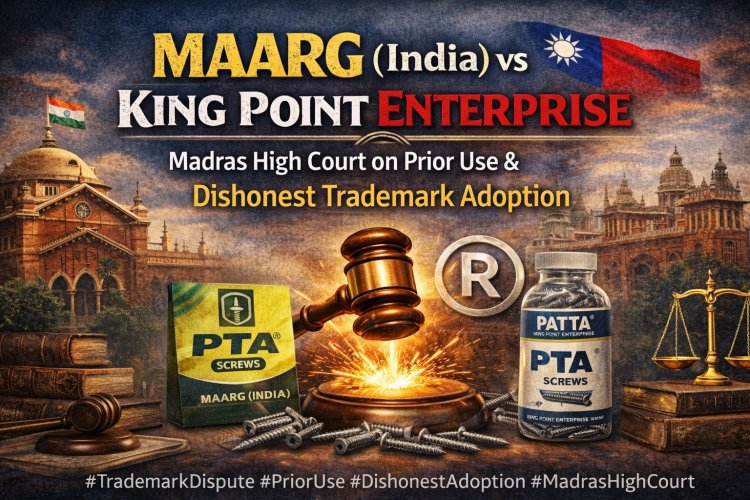
MAARG (India) vs King Point Enterprise: Madras High Court on Prior Use & Dishonest Trademark Adoption
A detailed analysis of the Madras High Court’s landmark ruling in MAARG (India) v. King Point Enterprise, examining trademark prior use, dishonest adoption, rectification proceedings, and transnational goodwill in the hardware fasteners industry under the Trade Marks Act, 1999.
INTRODUCTION
In the dynamic arena of modern commerce, trademarks serve as essential tools for businesses to establish their identities and ensure consumer recognition. Trademark disputes, particularly those involving allegations of infringement and passing off, can significantly affect a company's reputation and market positioning. A notable case in this milieu is “Maarg (India) v. King Point Enterprise Co. Ltd.C.S.No.163 of 2018 & (T)OP(TM) No.32 of 2023,” recently adjudicated by the Madras High Court. This case exemplifies the complex interplay between trademark rights, brand identity, and the legal principles surrounding them. The litigation arises from competing claims related to the "PTA" trademark, specifically within the hardware fasteners industry, where both parties engage in the manufacture and sale of screws and related products. King Point, a Taiwanese company with extensive global operations, contends that it has prior rights to the "PTA" mark. In contrast, Maarg, an Indian partnership firm, claims to have registered and used this mark in India since 2001. This blog post provides a comprehensive overview of the case, delving into the facts, legal arguments, procedural history, and the broader implications of the judgment for the parties involved and the trademark landscape in India.
CASE BACKGROUND
Business Profiles and Trademark Claims
Both Maarg and King Point are active players in the hardware fasteners market, specializing in screws and related items.
v “Maarg (India)”, a registered partnership firm based in Chennai, claims that it coined the "PTA" mark for hardware in 1997 and has used the associated logo since 2001. It obtained registration for its trademark under Class 6 in India on April 17, 2008, asserting its first use from January 1, 2001. Maarg has heavily invested in advertising and building goodwill around its trademark within the Indian market, presenting itself as a trusted brand for hardware products.
v “King Point Enterprise Co. Ltd.”, based in Taiwan, asserts a longstanding history of trademark use and registration, claiming to have coined "PATTA" in 1987 and "PTA" in 1990. King Point has established a robust international presence, with evidence of trademark registration in multiple jurisdictions worldwide. It contends that it has used the "PATTA" and "PTA" marks in India since 2002 through its affiliated companies. Furthermore, King Point alleges that Maarg engaged in importing and trading its products, subsequently attempting to misappropriate the "PTA" mark for its gain.
Previous Litigation in Delhi
The legal battle between Maarg and King Point is not fresh; it has a history of prior litigation. King Point filed a suit (CS (OS) No. 1409 of 2011) against Maarg and its related companies in the Delhi High Court from 2011 to 2017 regarding similar claims of infringement and passing off. King Point initially secured an interim injunction against Maarg, but as the suit faced procedural hurdles—including a dismissal for non-prosecution—the matter remained unresolved. Despite this setback, King Point has consistently maintained its claims regarding prior adoption and use of the "PTA" mark, leading to its current rectification petition and the simultaneous infringement suit by Maarg.
Procedural History
The current proceedings before the Madras High Court encompass two interconnected matters: “C.S. No. 163 of 2018”, Maarg's suit alleging infringement of its registered trademark, and (T)OP(TM) No. 32 of 2023”, King Point's rectification petition seeking to expunge Maarg's trademark registration.
v “Maarg's Suit:” Filed on March 5, 2018, Maarg's claims revolve around the alleged infringement of its PTA logo and passing off by King Point's use of the "PTA" mark. Maarg seeks permanent injunctions against King Point's use of the PTA mark or logo on screw heads and packaging, alongside damages totaling INR 50,00,000 and the delivery of relevant accounts.
v “King Point's Rectification Petition”: In this petition, King Point seeks the removal of Maarg's Trade Mark No. 1677459 from the register under relevant sections of the Trade Marks Act, arguing that Maarg's registration and claimed use are invalid.
Both matters were ordered to be tried together, with common issues framed on October 6, 2023, covering areas such as prior adoption and use, the nature of business relationships, the validity of Maarg's trademark registration, likelihood of confusion among consumers, and entitlement to relief.
Analysis of Legal Arguments
The court proceedings brought forth crucial legal arguments from both parties, highlighting significant issues relevant to trademark law.
v Prior Use and Registration
A central issue in the case pertains to the claims of prior use and registration of the "PTA" mark. Maarg argues that its registration for the PTA logo predates King Point's entry into the Indian market, alleging that it has built substantial goodwill over the years. Conversely, King Point counters by asserting its earlier adoption of both "PATTA" and "PTA" marks, substantiated by evidence of prior use in multiple jurisdictions.
The court's examination of documentary evidence, including trademark registrations, invoices, and correspondence between the two parties, plays a pivotal role in establishing the timeline of use and the legitimacy of claims. The court's adherence to principles of "first use" and "good faith" in trademark registration will significantly influence its ruling.
v Likelihood of Confusion
Another critical aspect of the case involves the likelihood of confusion among consumers. Under trademark law, the fundamental purpose of a trademark is to distinguish goods or services from those of others. The court must assess whether the simultaneous use of the "PTA" mark by both parties could lead to consumer confusion regarding the origin of the products. King Point's argument hinges on the assertion that Maarg's use of the "PTA" mark could mislead consumers in India, leveraging its established brand reputation. Conversely, Maarg must demonstrate that its marketing efforts and brand identity have created a distinct consumer recognition sufficient to dispel any potential confusion.
v Commercial Relationships
The relationship between Maarg and King Point presents another layer of complexity. Evidence presented in court indicates that Maarg, through its associated companies (such as Valmax and Amkar International), engaged in importing and reselling King Point's products. Emails and invoices submitted as evidence reveal a close commercial connection, suggesting a deeper operating relationship than merely competing brands.
The court's evaluation of this relationship will bear weight in determining the sincerity behind Maarg's claims and whether it acted in good faith when adopting the "PTA" mark. Understanding the nuances of their business dealings may impact the court's conclusions regarding infringement and passing off claims.
To know more about this, please check the link.
Implications of the Judgment
The ramifications of the court's ruling in Maarg v. King Point will extend far beyond the immediate parties involved. Several significant implications arise from this case:
v Brand Protection in Competitive Markets
This case highlights the essential need for rigorous brand protection strategies for businesses competing in niche markets. The growing globalization of trade and interconnectedness of markets necessitate that companies prioritize securing their trademarks, establishing clear usage timelines, and maintaining comprehensive documentation to defend their rights.
v Balancing Trademark Rights and Fair Competition
The judgment will also contribute to the ongoing discourse concerning the balance between protecting trademark rights and fostering fair competition in the marketplace. Courts must carefully navigate the lines between rightful ownership claims and the potential stifling of competition, particularly in sectors like hardware fasteners, where multiple players vie for market share.
v Guidance for Future Trademark Disputes
The case serves as a vital reference point for future trademark disputes, providing guidance on the factors to consider when assessing claims of infringement, likelihood of confusion, prior use, and the validity of trademark registrations. Legal professionals and businesses alike can glean valuable insights into navigating the complexities of trademark law through this ruling.
Conclusion
The case of “Maarg (India) v. King Point Enterprise Co. Ltd.C.S.No.163 of 2018 & (T)OP(TM) No.32 of 2023” is emblematic of the intricacies involved in trademark law and the intense competition within specialized markets. As it unfolds in the Madras High Court, the outcome will likely have profound implications not only for the parties involved but also for the broader intellectual property framework in India. This legal battle elucidates the importance of diligent trademark management, clear documentation of prior use, and the careful crafting of brand identities to safeguard businesses against infringement claims. In an era where brands are pivotal to consumer connection and loyalty, this case serves as a reminder of the necessity for businesses to remain vigilant in protecting their trademarks while respecting the rights of others. As the legal landscape evolves, businesses in the hardware fasteners industry and beyond must heed the lessons learned from Maarg v. King Point to navigate the challenges of trademark law successfully, ensuring they can thrive in an increasingly competitive environment. The ongoing developments in this case are sure to shape the future of trademark rights and protection in India, steering the course for how brands engage in commercial endeavors and resolve disputes in the years to come.