+91 7297051181
Sumitomo Rubber’s Rose Smell Trademark: India’s First Olfactory Mark Explained
A detailed analysis of India’s first smell trademark application by Sumitomo Rubber Industries, examining distinctiveness, graphical representation, scientific evidence, and the CGPDTM’s 2025 decision under the Trade Marks Act, 1999.
INTRODUCTION
For decades, trademark jurisprudence in India has revolved around conventional marks—logos, labels, devices, words, names, packaging, numerals, and colors. However, with global developments acknowledging non-traditional marks such as sound marks, motion marks, holograms, and smell marks, India too has taken a progressive leap. The order issued on 21 November 2025 by the Controller General of Patents, Designs and Trade Marks (CGPDTM) marks a historic turning point, as it formally accepts India's first smell trademark for advertisement. The mark, filed by Sumitomo Rubber Industries Ltd., Japan, claims “Floral fragrance/smell reminiscent of roses as applied to tyres. “This case tested the very limits of Indian trademark law—particularly the statutory requirements of distinctiveness and graphical representation under Section 2(1)(zb).
The decision not only showcases India’s readiness to embrace unconventional marks but also underscores the role of scientific innovation in enabling legal progress.
THE CASE OVERVIEW
Case Identification and Procedural History
On March 23, 2023, Sumitomo Rubber Industries filed an application with the CGPDTM for a non-conventional olfactory trademark characterized by a “floral fragrance/smell reminiscent of roses as applied to tyres.” This application, assigned the number 5860303, drew attention due to its novelty as the first smell-mark application in India. The Trade Marks Registry initially raised objections under sections 9(1)(a) and 2(1)(zb) of the Trade Marks Act, 1999. The objections were rooted in the assertions that the mark lacked inherent distinctiveness and failed to meet the requirement for a valid graphical representation. In response to the examination report issued on August 4, 2023, Sumitomo submitted a comprehensive reply on September 27, 2023. The complexity of the case warranted multiple hearings, during which the applicant presented further submissions. Recognizing the case's unique nature, the CGPDTM appointed Shri Pravin Anand as amicus curiae to provide additional perspectives.
The Role of Science in Trademark Applications
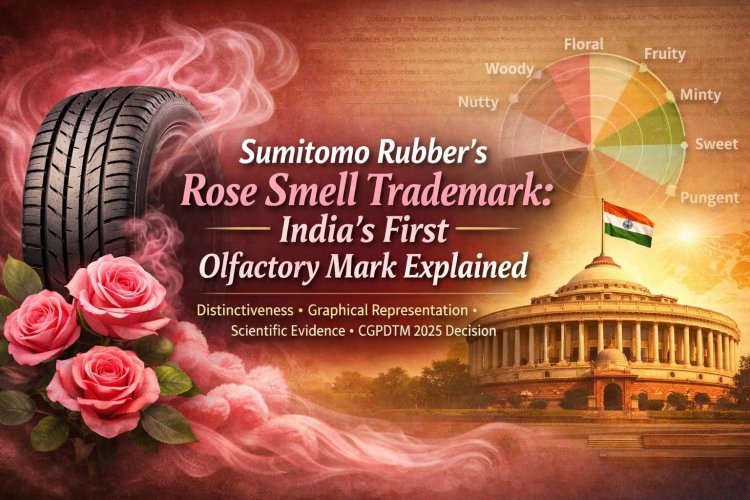
The attempts to establish a graphical representation of the rose-like smell were significant. A team from the Indian Institute of Information Technology (IIIT) in Allahabad contributed to the case by developing a scientific model representing the smell in a seven-dimensional olfactory space. This model utilized seven fundamental smells—floral, fruity, woody, nutty, pungent, sweet, and minty—to create a radar-like chart visually depicting the intensity of each smell component. This amalgamation of scientific rigor and legal inquiry poses intriguing questions about how smell can be represented graphically and whether it can be registered as a trademark.
LEGAL FRAMEWORK AND CHALLENGES
Definition under the Trade Marks Act, 1999
The Trade Marks Act, 1999, provides a clear legal framework for trademark registration in India. It defines a trademark in Section 2(1)(zb) as a mark that is capable of being represented graphically and capable of distinguishing the goods or services of one person from those of others. Furthermore, Section 9(1)(a) establishes grounds for refusal if a mark is deemed devoid of distinctive character. Olfactory marks pose unique challenges in meeting these statutory requirements. The abstract nature of a smell complicates the graphical representation needed for registration and raises questions about distinctiveness—whether consumers can identify and associate the scent specifically with a single brand.
Distinctiveness and Graphical Representation Issues
The crux of the CGPDTM's examination revolved around two pivotal issues: graphical representation and distinctiveness.
1. Graphical Representation: For any mark to be registrable, it must be representable graphically. The applicant in this case introduced a scientific approach to satisfy this requirement. The use of a radar-like chart to illustrate the olfactory characteristics represented a novel attempt to bridge the gap between sensory experiences and legal frameworks.
2. Distinctiveness: It was argued that the rose fragrance infused in tyres since 1995 had acquired distinctiveness and a reputation globally. Sumitomo contended that this scent was uniquely associated with their products, making it arbitrary within the context of tyres. The discussion of distinctiveness is critical, as it significantly influences the likelihood of successful trademark registration.
ARGUMENTS FROM THE APPLICANT
Nature and Significance of the Smell Mark
Sumitomo's legal counsel, Ms. Swati Sharma, articulated the uniqueness of the proposed smell mark. The differentiation of branded products through an olfactory signature has become increasingly relevant in branding strategies, where sensory experiences dictate consumer preferences. The rose-like fragrance, synonymous with Sumitomo's tyres, is not merely a sensory addition; it is an integral aspect of the brand’s identity.
Global Context and Precedents
Another argument put forth by Sumitomo was the pre-existing registration of a similar olfactory mark in the United Kingdom. The UK registration of the same floral fragrance demonstrates a precedent for recognizing scent as a valid trademark. This bolstered the argument that the mark could distinguish Sumitomo's products in the competitive market.The admissibility of scent-based marks in jurisdictions like the United Kingdom instigates a broader conversation about global harmonization in trademark law, especially as nations grapple with the complexities of non-conventional marks like olfactory trademarks.
Amicus Curiae's Contribution
The appointment of Shri Pravin Anand as amicus curiae introduced an additional layer of insight into the case. The amicus contributed not just legal arguments but also scientific evidence that supported the applicant's claims. The involvement of academic experts in the graphical representation of scents facilitates a more robust understanding of how olfactory trademarks may be navigated within legal frameworks. The collaboration between legal and scientific communities is vital in paving the way for future considerations of non-conventional trademarks, potentially establishing standards for their validation and protection.
CONCLUSION
The CGPDTM's decision regarding Sumitomo Rubber Industries' application for a smell trademark marks a significant milestone in India's trademark law landscape. As sensory branding becomes more prevalent, the need for legal frameworks to accommodate non-conventional trademarks is more pressing than ever. The challenges pertaining to distinctiveness and graphical representation are not just hurdles; they represent opportunities for evolving interpretations of what constitutes a trademark in a modern context. As this case unfolds, it will invariably influence future applications and legal interpretations surrounding olfactory trademarks. Whether this application will set a precedent in Indian law remains to be seen, but it certainly signals a growing recognition of the importance of sensory experiences in brand identity. In summary, Sumitomo Rubber Industries’ smell trademark application is not just a legal battle; it is at the forefront of a transformative moment in trademark law that could redefine how we think about branding in the sensory-age marketplace. The discussions surrounding such innovative cases can reshape market strategies, consumer experiences, and ultimately, legal interpretations globally.
This evolving landscape promises exciting prospects for the future of trademark applications, where smells, tastes, and other sensory attributes may soon occupy a legitimate space alongside traditional trademarks, reflecting the rich tapestry of consumer experiences in a postmodern marketplace.
REPRESENTATION OF THE MARK IS BELOW.