+91 7297051181
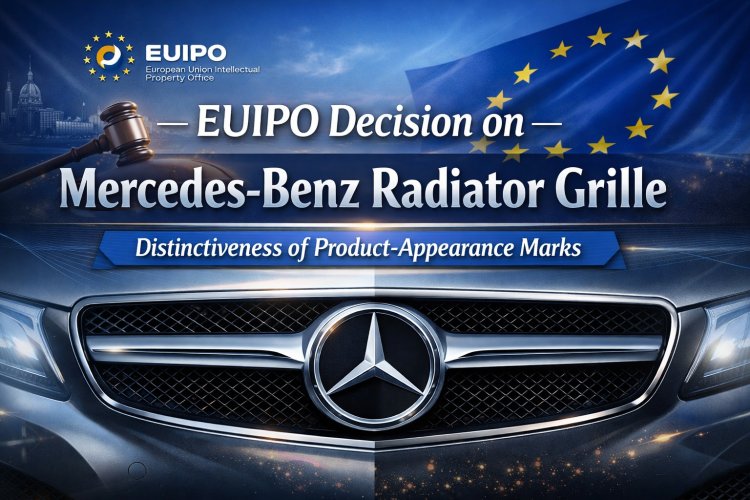
EUIPO Decision on Mercedes-Benz Radiator Grille: Distinctiveness of Product-Appearance Marks
The EUIPO First Board of Appeal recognises inherent distinctiveness in Mercedes-Benz’s radiator grille, reinforcing trademark protection for product-appearance marks under Article 7(1)(b) EUTMR and setting a key precedent for automotive design law.
Introduction
In recent years, the European Union Intellectual Property Office (EUIPO) has seen a surge in cases regarding product-appearance marks, particularly in the automotive sector. One such significant case is the EUIPO First Board of Appeal decision R 2316/2024-1 involving Mercedes-Benz Group AG, which was delivered on April 7, 2025. This decision is notable not only for its implications on the protection of distinctiveness in design but also for its broader impact on how businesses can safeguard their unique product features in an increasingly competitive market. Mercedes-Benz, an iconic name in the automotive industry, applied for a trademark for a figurative sign depicting a vehicle radiator grille, characterized by a central circular element set within a horizontal strip and mesh pattern. They submitted this application (EU TM 18922038) on September 5, 2023, seeking protection for radiator grilles classified under Class 12, which covers various vehicle components. However, on October 3, 2024, the EUIPO examiner issued a partial refusal based on Article 7(1)(b) of the European Union Trade Mark Regulation (EUTMR), which concerns the lack of distinctive character. The examiner argued that the design merely reproduced a customary radiator grille without any distinctive elements, thus failing to fulfil the requirements set forth in EUTMR. Mercedes-Benz decided to appeal this decision, asserting that the distinctive combination of the mesh field and the centrally positioned circular element does in fact confer distinctiveness, setting it apart from others in the market.
Details of Mercedes Benz’s mark are below.
|
Mark |
Application No. |
Description of goods |
|
|
018922038 |
Class 12: Vehicles, Radiator grills of metal for vehicles, Radiator grills of non-metallic materials for vehicles -28; Class 28: Toys, Games. |

The Appeal Decision
The First Board of Appeal of EUIPO ruled in favour of Mercedes-Benz, annulling the prior decision and allowing the application to proceed to publication for the previously refused Class 12 goods. The Board's analysis hinged on the assessment of inherent distinctiveness, focusing on the design's unique combination of elements. The Board recognized that while the sign depicted the product itself, its specific combination indeed created a distinctive overall impression that deviated from the standard designs typically encountered in the automotive sector.
Key Legal Framework
A crucial takeaway from this decision is the interpretation of Article 7(1)(b) of the EUTMR, which concerns the distinctiveness of marks. For a mark to be eligible for registration, it must possess at least a minimum degree of distinctive character. The Board indicated that even the most basic level of distinctiveness is sufficient for a mark to qualify as a trade mark, particularly when tailored to the perception of the relevant public across the EU. The Board emphasized that the examination of distinctiveness for product-appearance marks demands that they "depart significantly from the norm or customs of the sector." This finding is pivotal for industries where product design plays a central role in branding, like automotive design.
Insights from the Board’s Analysis
The First Board of Appeal conducted an in-depth analysis of the relevant public perception, primarily targeting specialists such as vehicle workshop professionals. While these professionals exhibit heightened attention to detail, the Board underscored that such attentiveness does not reduce the distinctiveness threshold that a mark must meet. One of the critical points in the Board's reasoning was the nature of the sign as a product-appearance mark. It reiterated that the assessment should focus on how the sign was filed rather than on minute details that may not effectively communicate a brand's identity. This ensures that companies can safeguard distinctive elements relevant to product design, without being hindered by overly literal interpretations. The central circular element combined with the tapering strip produced a unique figurative effect that facilitates origin indication. Such observations helped discredit the examiner's premise that the sign merely served as a placeholder for a logo, emphasizing that the unique arrangement of components culminates in a distinctive design.
To know more about this, you can follow the below link:
The Broader Impact on the Automotive Sector
The Mercedes-Benz decision sets a promising precedent for the automotive industry. Previous cases, including Calandre (T-128/01) and Forme de phares d’automobile (T-260/23), supported the notion that vehicle design elements, including grilles and headlamps, can effectively serve as indicators of origin. The affirmation of this principle encourages other automotive companies to pursue trademark protection for distinctive front-end designs, expanding the framework of design law within the sector. As competition intensifies, businesses can benefit from this decision by understanding the importance of distinctive design elements in establishing brand identity. A registered trade mark that protects unique product features can act as a powerful shield against infringing competitors, fostering innovation and creativity within design teams.
Figurative sign (06/03/2003, T-128/01, Calandre, EU:T:2003:62,).
|
Mark |
Class |
|
|
Class 12 |

The three-dimensional signs mark (26/06/2024, T-260/23, Forme de phares d’automobile, EU:T:2024:421).
|
Mark |
Class |
|
|
Class 11, 12 |

Practical Implications for Brands
For businesses moving forward, the implications of this decision are manifold. Firstly, non-traditional marks, particularly those with expertly composed product-appearance features, may now achieve a level of inherent distinctiveness that could have previously been deemed unattainable. This encourages companies to invest in distinctive designs guaranteed to enhance brand recognition in the market. Furthermore, companies in the automotive sector should strategize their design and branding alignment. This ensures that when a mark is published, there is consistent use of the protected configuration in the marketplace, which can fortify claims of distinctiveness and brand recognition. It is also advisable for companies to closely monitor the publication and opposition periods once a trademark is published. This vigilance ensures that they can promptly address any potential conflicts with competitors’ designs that may cause confusion in the market.
Conclusion
The EUIPO’s First Board of Appeal decision regarding Mercedes-Benz’s radiator grille serves as a crucial benchmark in understanding product-appearance marks within the automotive industry. The decision not only clarifies the requirements for distinctiveness under EU trademark law but also emboldens manufacturers to protect their innovative designs. As the boundaries of trademark law continue to evolve, this case provides a roadmap for brands aiming to secure their unique identities in a highly competitive environment. In an era where design increasingly influences consumer perceptions, organizations should harness the insights gleaned from this decision to create and protect their intellectual property more effectively. By navigating the complexities of trademark registration while aligning with legal standards, companies can solidify their brand identity and maintain their competitive edge in an ever-evolving marketplace.