+91 7297051181
Understanding Trademark Law: Wilcox Excavation v. DiGregorio & We Dig Investments Case Analysis
Explore the Wilcox Excavation v. DiGregorio case under the Lanham Act, analysing trademark infringement, likelihood of confusion, corporate separateness, and key lessons for brand protection and trademark litigation.
Introduction
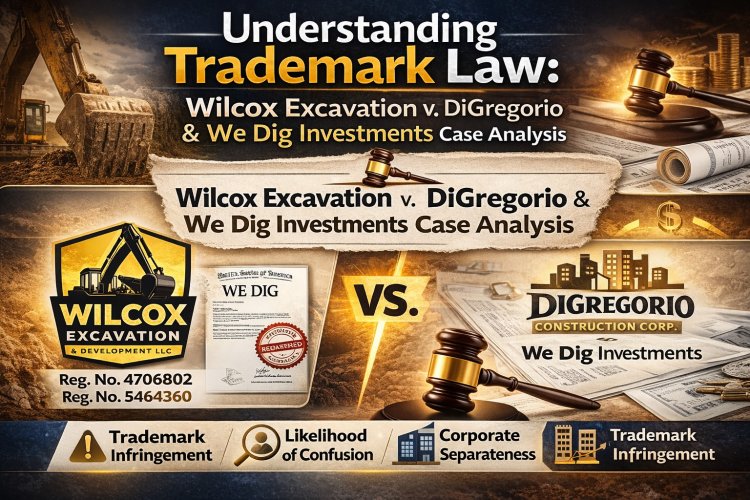
In the continuously evolving landscape of business, the significance of trademark protection cannot be overstated. Trademarks are essential for branding and identity, providing consumers with a way to differentiate between products and services. A recent legal dispute, Wilcox Excavation & Development LLC v. DiGregorio, Inc. and We Dig Investments, LLC, 1:23-cv-00543-MSM-PAS, serves as an insightful case study into the complexities of trademark law, particularly concerning how courts assess claims of infringement and unfair competition. Wilcox Excavation & Development, LLC, founded in 1990, operates as an excavation company in Rhode Island. The company owns the trademark for the word “WE DIG” as well as a stylized design mark associated with that name, registered with the United States Patent and Trademark Office. The company uses these marks in connection with its excavation and construction services, establishing significant recognition over time. The defendants, DiGregorio, Inc. and We Dig Investments, LLC (WDI), present a contrasting scenario. DiGregorio is a larger excavation firm, while WDI operates as an investment and real estate entity established by members of the DiGregorio family in 2017. The controversy arises when WDI, with minimal branding, began to utilize the name "We Dig Investments," which Wilcox argued was infringing on its established trademark rights.
Marks of Wilcox Excavation & Development, LLC are below.
|
Mark |
Registration No. |
Class |
|
|
4706802 |
Class 37: “excavation services, construction services, namely, septic system installation, retaining wall construction, underground utilities construction, construction of buildings, namely, residential homes, demolition of buildings.” |
|
|
5464360 |
Class 37: “excavation services, construction services, namely, septic system installation, retaining wall construction, underground utilities construction, construction of buildings, namely, residential homes, demolition of buildings.” |


Legal Framework of Trademark Infringement
The essence of trademark law under the Lanham Act is to prevent confusion among consumers as to the source of goods and services. To succeed in a trademark infringement claim, the plaintiff must prove two critical elements: first, it must demonstrate its protectable rights in the mark; second, it must establish a likelihood of consumer confusion resulting from the defendant's use of the mark. In the present case, the court applied an eight-factor test often utilized by the First Circuit to assess the likelihood of confusion. This analysis includes the similarity of the marks, the similarity of goods and services, the channels of trade, advertising methods, the classes of purchasers, any evidence of actual confusion, the intent of the defendants, and the strength of the mark.
Summary of Findings
After considering the facts and arguments presented by both parties, Judge Mary S. McElroy granted summary judgment for the defendants on all claims. This effectively signalled the court's view that there was no substantial evidence to support the assertion that WDI’s use of "We Dig" would create confusion among consumers.
· Similarity of Marks
The court analysed the similarity between Wilcox's established "WE DIG" mark and the name "We Dig Investments." While this factor initially seemed to favour Wilcox due to the phonetic resemblance, the court highlighted that merely having similar names does not automatically imply a likelihood of confusion.
· Similarity of Goods and Services
Importantly, WDI's operations were limited to investment and real estate activities, which are distinct from the excavation services provided by Wilcox. This dissimilarity was pivotal, as the court determined that occasional collaboration between WDI and DiGregorio did not equate to offering similar services.
· Channels of Trade and Advertising
The court also addressed the channels of trade, noting that WDI operated primarily within the real estate investment sector. WDI did not engage in the kind of marketing or advertising typically associated with excavation services, further undermining Wilcox’s claims. The lack of a clear overlap in target markets and distribution channels favoured the defendants.
· Evidence of Actual Confusion
One notable aspect of the case involved claims of actual confusion. Wilcox pointed to three isolated incidents that did not reflect a robust incidence of confusion among consumers. The court held that these instances were insufficient to demonstrate a likelihood of confusion, particularly given that they stemmed from clerical mistakes rather than a genuine misunderstanding among consumers.
· Defendants’ Intent
The intent behind WDI’s naming strategy was also examined. The court found that the name was selected in good faith and after conducting availability checks, thus suggesting that there was no intent to deceive or mislead consumers.
To know more about this, please check the link below.
Key Takeaways from the Decision
The decision underscores several critical principles regarding trademark law and the importance of corporate separateness:
· Corporate Separateness Matters: The court drew a clear distinction between WDI and DiGregorio, emphasizing that the conduct of one company cannot be imputed to another without strong evidence, such as a veil-piercing theory. This suggests that even when companies share ownership or family ties, their legal identities can be distinct in terms of liability.
· Investment Entities and Market Confusion: The court also points to the fact that investment firms or holding companies using similar names to their operating affiliates must prove that actual marketplace confusion exists due to their naming. This case demonstrated that without overlapping goods, channels of trade, and consumer bases, the likelihood of confusion diminishes significantly.
· Evidence of Confusion: The court emphasized that isolated administrative or vendor mistakes do not warrant a finding of actual confusion. For plaintiffs to prevail, they must provide concrete evidence of confusion that impacts market behaviour rather than anecdotal or rare incidents.
· Legal Costs and Exceptional Cases: The judge denied Wilcox's request for an exceptional case determination, indicating that the plaintiff must present substantial evidence of wrongdoing to warrant the recovery of attorney's fees. This highlights the uphill battle businesses face in trademark litigation, especially regarding financial implications.
Conclusion
This case serves as an enlightening example of the complexities surrounding trademark law, particularly in assessing brand confusion. Businesses must be diligent not only in protecting their trademarks but also in understanding how courts interpret the intricacies of trademark rights. As the legal landscape continues to adapt to new commercial realities, this case reinforces the necessity for clear evidence and strong arguments in trademark disputes. For entrepreneurs and legal practitioners alike, the order in this case provide valuable lessons on safeguarding brand identity in competitive marketplaces.