+91 7297051181
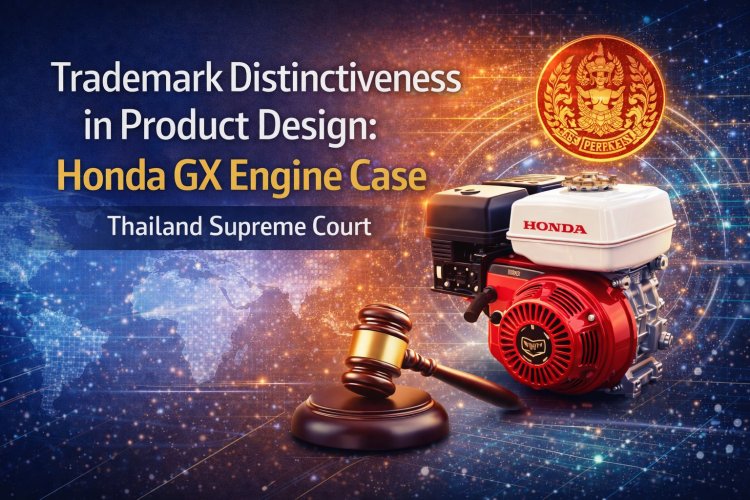
Trademark Distinctiveness in Product Design: Honda GX Engine Case (Thailand Supreme Court)
An analysis of Honda Motor Co. v. Department of Intellectual Property (Thailand), where the Supreme Court rejected trademark protection for the GX engine design due to lack of distinctiveness, highlighting key principles of product design trademarks, consumer perception, and competition law.
Introduction
In the realm of intellectual property, trademarks serve as vital tools for businesses, allowing them to establish brand identity and separate their products from those of competitors. The registration of a trademark is contingent on its distinctiveness, the ability of a mark to identify the source of a product in the eyes of consumers. A recent case that exemplifies these principles is Honda Motor Co., Ltd. v. Department of Intellectual Property, adjudicated by the Supreme Court of the Kingdom of Thailand on October 18, 2011.
Background of the Case
Honda Motor Co., Ltd., a prominent Japanese automotive manufacturer, sought to protect its three-dimensional representation of the GX general purpose engine by registering it as a trademark under the Trademark Act B.E. 2534 (1991) in Thailand. Specifically, Honda aimed to register the shape and figure of its engine for goods classified in Class 7, which includes engines not meant for land vehicles and water pumps. However, the Department of Intellectual Property (DIP), a government agency, rejected Honda’s application, citing a lack of distinctiveness. The Registrar asserted that the design merely described the characteristics of the engine and therefore failed to qualify as a trademark. Honda appealed this decision, but both the Trademark Board and later the Central Intellectual Property and International Trade Court upheld the Registrar's stance, leading Honda to escalate the matter to the Supreme Court.
The Legal Framework
The appeal was primarily guided by Section 7 of the Trademark Act, which outlines the requirement for distinctiveness and prohibits the registration of marks that directly indicate the characteristics or properties of the goods. This legal provision is foundational to trademark law, aimed at preventing monopolies over terms or designs that other businesses might also need to use.
The Arguments
Honda argued vehemently that its engine’s configuration and color scheme distinguished it from competitors, emphasizing several features. Among them were the positioning of the gas tank, air filter, starter, and exhaust pipe, combined with a distinctive color scheme consisting of a red engine body, white gas tank, and black components, all elements Honda claimed reflected its brand identity and had been consistently used since 1983. On the other hand, the Department of Intellectual Property contended that Honda failed to present a clear representation of the trademark in question, using instead a photograph that depicted the engine. They maintained that the examination should focus on what the photo represented rather than any inherent distinctiveness of the mark itself.
Supreme Court’s Findings
After a thorough examination, the Supreme Court ultimately ruled against Honda, affirming the previous decisions. The Court articulated that the shape and configuration of the GX engine lacked sufficient distinctiveness to warrant trademark protection. In its reasoning, the Court underscored several key points:
a. Common Characteristics: The configuration features presented by Honda were found to be common among general-purpose engines. The Court noted that the various aspects Honda highlighted did not significantly distinguish the GX engine from its peers.
b. Comparative Analysis: The Supreme Court undertook a comparison of Honda’s engine with similar products in the market. This analysis revealed that Honda’s design was not unique and bore similarities to other existing engines. The decision implied that many such designs would likely need to remain available for use by other manufacturers, reinforcing the need for competition in the market.
c. Descriptive Nature: The Court concluded that the GX engine's configuration was essentially descriptive of its function and structure. To best serve consumer interests and maintain a competitive environment, the law protects designs that maintain functionality rather than grant exclusivity over basic shapes and configurations.
d. Existing Brand Indicators: The presence of Honda’s brand name prominently on the engine already served as a significant indicator of origin. This fact suggested that the shape registration might be an attempt to unduly stifle competitors by denying them the freedom to sell functionally similar engines.
The Broader Implications
The decision in Honda Motor Co. v. Department of Intellectual Property has profound implications for businesses seeking trademark protection, particularly in product design and configuration. It articulates the delicate balance that must be maintained in trademark law between protecting the interests of brand owners and ensuring that market competition remains healthy.
This case draws attention to several critical factors that companies must consider when applying for trademark registration:
a. Distinctiveness Assessment: Businesses are encouraged to carefully evaluate whether their marks possess the requisite distinctive character before filing for registration. Relying solely on product design attributes that may be functional or commonly used could lead to rejection.
b. Historical Use: Demonstrating a long-standing use of the design in a way that has developed consumer recognition over time can bolster claims for distinctiveness, although it may not guarantee success if the shape is deemed too descriptive.
c. Precedent of Competitors: When defining a mark, businesses should be aware of existing designs in their industry that may weaken their claims of distinctiveness. Prior art can be scrutinized during trademark registration processes.
d. Marketing Strategies: Effective marketing can play a significant role in establishing a brand's identity beyond mere physical representation. Firms should not only focus on design but also on how they communicate the uniqueness of their brand to consumers.
Conclusion
The Honda Motor Co. case serves as a poignant illustration of the complexities involved in trademark registration for product designs. While it highlights Honda’s efforts to protect its intellectual property, the Supreme Court’s ruling reinforces important legal principles surrounding distinctiveness and the need to avoid monopolizing functional designs that may inhibit competition. For businesses aiming to leverage trademark law effectively, understanding the intricacies of distinctiveness, market competition, and the realities of consumer perception is crucial. Ultimately, trademarks must serve their primary purpose, enabling consumers to identify the source of goods, while fostering a competitive marketplace that promotes innovation and variety. As such, navigating the landscape of intellectual property requires not only a keen legal insight but a strategic vision that aligns with the practical realities of the market. In the world of trademarks, success hinges not just on the creativity of design but also on the legal frameworks that govern these vital assets.